

You can buy a one-time lifetime fishing license that replaces annual fees and helps fund conservation programs. Prices vary by age: 0–9 and 62+ cost $709.00, 10–39 cost $1,160.25, and 40–61 cost $1,045.00. It covers freshwater and saltwater angling but requires separate validations and report cards for certain activities, plus optional privilege packages. You purchase it only through CDFW license sales offices or by mail with proof of age. Expect a small application fee and about 15 business days for processing — more details below.
Quick Answer
A California Lifetime Fishing License gives residents a free annual sport fishing license every year for life. It covers basic freshwater and saltwater fishing with no yearly renewal fees after the one-time purchase.
- 2026 prices: $709 for ages 0–9 or 62+, $1,160.25 for 10–39, $1,045 for 40–61.
- Buy only at CDFW offices or by mail — not online.
- Add the $478.75 Fishing Privilege Package for common extras like second-rod and ocean validations.
- Separate report cards and validations still needed for some species and areas.
What Is a Lifetime Fishing License?
Think of a Lifetime Fishing License as a one-time purchase that gives you permanent angling privileges. You get a new annual sport fishing license every year at no extra cost, and the money goes straight to conservation programs.
The card you receive never expires. It saves you the hassle of renewing every year and helps keep fish habitats healthy for the long term.
Fees depend on your age when you buy, but everyone gets the same lifelong access. You can purchase it at CDFW license sales offices or by mail, and you must show proof of age.
Optional add-ons, such as validations and report cards, cost extra and target specific fishing activities.
Lifetime License Price Breakdown by Age Group
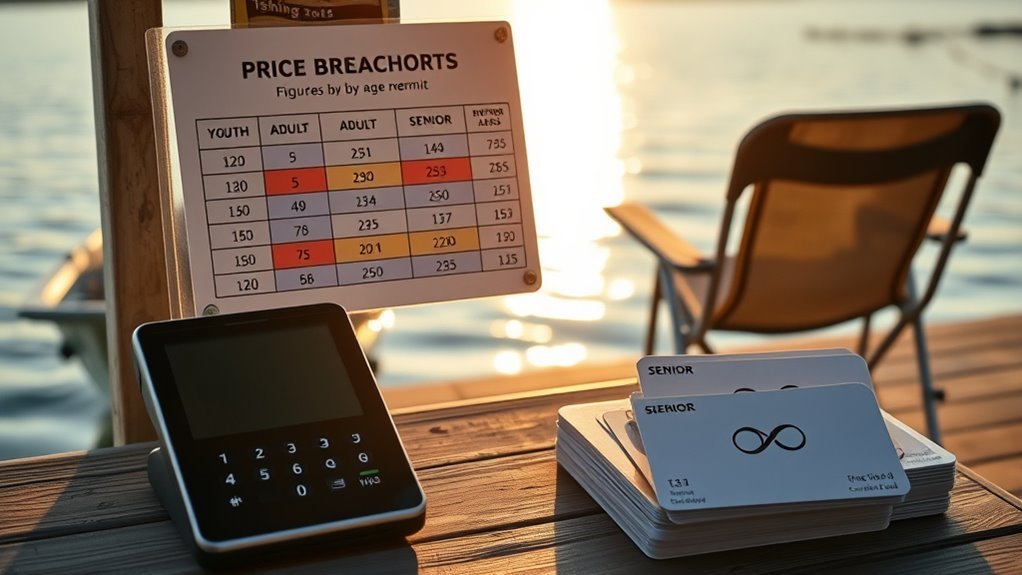
Here are the clear 2026 price tiers for a California Lifetime Fishing License:
- Ages 0–9: $709.00
- Ages 10–39: $1,160.25
- Ages 40–61: $1,045.00
- Ages 62+: $709.00
For the most up-to-date fees, check the CDFW Sport Fishing Licenses page. The optional Fishing Privilege Package costs $478.75 and bundles several common add-ons.
Ages 0–9 Cost
For kids ages 0–9, the California Lifetime Fishing License costs $709.00. This one-time payment locks in fishing privileges for life and supports fish and wildlife conservation programs.
You buy it at a CDFW office or by mail. The fee stays the same no matter how many years the child fishes.
| Item | Value | Note |
|---|---|---|
| Price | $709.00 | Ages 0–9 |
| Duration | Lifetime | One payment |
| Purchase | Office/mail/fax | CDFW channels |
Ages 10–39 Cost
Anglers ages 10–39 pay $1,160.25 once for a California Lifetime Fishing License. This resident-only permit (six months or more in California) gives you a free annual fishing license every year for life.
You apply with proof of age and residency at a CDFW office or by mail. The money helps pay for habitat restoration and fisheries management.
- Cost: $1,160.25 paid once
- Purpose: funds conservation and monitoring programs
- Process: submit application with documents
Ages 40–61 Cost
The 40–61 age group pays $1,045.00 for the lifetime license. You still get full freshwater and saltwater privileges and a free annual license each year.
Buying at this age often pays for itself quickly if you fish regularly. The single payment also helps fund long-term habitat projects.
Compare your expected fishing years against the annual rate of $64.54 to see the value for yourself.
What the Lifetime License Covers and Excludes
Your Lifetime Fishing License gives you permanent access to recreational fishing in California’s freshwater and saltwater. You no longer pay annual fees, but you still must obey all regulations and buy any required report cards or validations separately.
Covered Fishing Privileges
The license covers basic angling for life. It does not include activity-specific validations or report cards — those are extra.
- Covered: all freshwater and saltwater recreational fishing
- Not covered: species-specific report cards or extra validations
- Compliance: you must follow catch limits, seasons, and reporting rules
Excluded Permits & Validations
You still need separate purchases for things like the Ocean Enhancement Validation, Sturgeon Report Card, or second-rod stamp. These help CDFW track harvests and manage fish populations.
Treat the lifetime license as your foundation. Add the specific items you need before you fish those activities.
How to Purchase a Lifetime Fishing License
You buy a Lifetime Fishing License only at a CDFW license sales office or by mail/fax. Download the application from the Lifetime License Information page, fill it out, and include proof of age (birth certificate, driver’s license, or passport copy).
- Visit a CDFW license sales office in person
- Mail or fax the form with payment and proof of age
- Add the privilege package at the same time if you want it
Processing usually takes up to 15 business days. You will receive your permanent card by mail.
Payment Methods, Fees, and Processing Times
Pay with check, money order, or debit/credit card (Visa or Mastercard). Cash is not accepted. A $7.50 nonrefundable application fee applies.
Mail or drop off your completed form at any CDFW license sales office. Most people receive their license within 15 business days.
Adding Validations, Report Cards, and Privilege Packages
The $478.75 Fishing Privilege Package adds several popular extras and renews them automatically each year at no extra cost. You can also buy individual validations and report cards as needed.
- Fishing Privilege Package: $478.75 (includes second-rod, ocean enhancement, North Coast salmon, and steelhead report cards)
- Most validations and report cards renew annually
- Match your target species to the exact items you need
Free and Reduced-Fee Lifetime License Options
Lifetime license prices are fixed by age and have no general discounts. However, CDFW does offer reduced-fee annual sport fishing licenses for certain groups.
Base lifetime fees vary by age — discounts apply only to annual licenses for qualifying residents.
Disabled veterans (50% or greater service-connected disability) and recovering service members can get an annual license for about $10. Low-income seniors on SSI or CAPI also qualify for the reduced annual rate. Document your eligibility carefully when applying.
Replacing, Transferring, and Updating a Lifetime License
If you lose your card, buy a duplicate for $14.04 online or at any CDFW office. Damaged but readable cards are still valid.
Sturgeon report cards linked to your lifetime license must be replaced in person for $18.28. Lifetime licenses cannot be transferred to another person.
- Contact CDFW for name or address changes
- Replace lost cards for $14.04
- Keep your card readable — discoloration is OK if text is clear
Long-Term Value Comparison: Lifetime Vs Annual Licenses
At the current annual resident rate of $64.54, the lifetime license pays for itself in roughly 18 years for the 10–39 age group ($1,160.25 total). Most anglers see savings well before that, plus the convenience of never renewing again.
If you fish often, the lifetime option saves money and gives agencies stable funding for habitat work. Infrequent anglers may prefer paying year by year.
Frequently Asked Questions
Are Lifetime Licenses Valid for Non-Resident Anglers Visiting the State?
No. Lifetime licenses are for California residents only. Visiting anglers need short-term or annual non-resident licenses.
Can Lifetime Licenses Be Used for Commercial Fishing Activities?
No. These are strictly for recreational sport fishing.
Do Lifetime Licenses Cover Fishing in Private Lakes and Ponds?
No. You still need the property owner’s permission. The license only covers public waters under state rules.
Are There Tax Implications When Purchasing a Lifetime License?
License fees are usually not tax-deductible for personal use. Talk to a tax advisor for your situation.
Can Lifetime Licenses Be Revoked for Wildlife Violations?
Yes. Serious or repeated violations can lead to revocation, just like with any license.
Conclusion
You’ve seen the prices, the coverage, and the process. For regular anglers, the one-time cost usually pays off within 15–20 years and gives you peace of mind plus extra support for California’s fisheries. Think about how often you fish and pick the option that fits your plans.
