
A lifetime fishing license can cost anywhere from a free or deeply discounted permanent privilege for some qualifying residents to more than $1,000 for a standard adult product, and more than $2,000 for certain nonresident combination packages. There is no nationwide license: each state sets its own fee, residency rule, water coverage, included permits, and post-move validity. Before paying, compare the exact state product with the annual license you would otherwise buy.
Last updated: August 10, 2026. Fees and rules below were checked against official state wildlife-agency information.
Quick Answer
For many resident adults, a lifetime fishing license costs roughly $300–$1,000+, but age, disability, veteran, and state-specific programs can be much cheaper or free. It is most likely to make financial sense when you fish most years and the simple break-even period fits your expected use. Confirm freshwater versus saltwater coverage, extra permits, residency, annual credential requirements, post-move validity, and refund rules before buying.
Key Takeaways
- There is no national lifetime fishing license; every state sets its own fees and privileges.
- Current examples include $301.50 for Florida residents age 13+, $460 for most New York residents, $841.75 for many Idaho adults, and $1,000 for the Texas resident lifetime fishing package.
- A license may cover freshwater, saltwater, inland water, coastal water, or only one of those categories.
- Species permits, access permits, registrations, report cards, and transaction fees may remain separate.
- “Lifetime” does not always mean “nothing to do each year”; Idaho lifetime-certificate holders, for example, must obtain a no-cost annual or three-year license.
- Lifetime licenses are generally nontransferable, even when a state lets someone buy one as a gift for another person.
At a Glance
| Typical Price Range | Many adult resident fishing-only examples fall around $300–$1,000+, while special resident programs can cost far less or be free |
| Best Fit | A resident who fishes most years, qualifies for the product, and expects to use the covered waters long enough to pass break-even |
| Check Before Buying | Residency, age tier, freshwater/saltwater scope, separate permits, annual credential steps, refund rules, and validity after a move |
| Simple Break-Even | Lifetime price ÷ comparable annual price, rounded up to the next full year; then adjust for years you may skip and extra permits |
Understanding Lifetime Fishing Licenses
A lifetime fishing license grants the named holder specified fishing privileges for life, subject to the issuing state’s laws and regulations. It does not create a nationwide right to fish, waive catch limits, or replace every permit that may be required.
Also check how the state delivers the privilege. Some programs are truly “buy once and carry the credential,” while others require a no-cost annual or multi-year license to be issued from a lifetime certificate. Idaho Fish and Game, for example, requires lifetime-certificate holders to obtain the required no-cost license each year or every three years.
The word lifetime describes the period of validity, not the scope of coverage. A state may sell several lifetime products, including:
- Freshwater or inland fishing
- Saltwater or coastal recreational fishing
- Combined freshwater and saltwater fishing
- Sportsman packages that combine fishing and hunting
- Reduced-fee senior, youth, disability, or veteran licenses
For example, the New York State Department of Environmental Conservation sells a lifetime freshwater fishing license. Florida sells separate lifetime freshwater and saltwater products, while North Carolina offers inland, coastal, and unified inland/coastal choices.
Warning: Do not buy based only on the words “lifetime fishing.” Confirm the exact waters, species, privileges, and excluded permits listed by the issuing agency. Lifetime-license purchases are often nonrefundable.

This daily devotional helps parents pray purposefully for their children through a full year of Scripture readings, reflections, and guided prayer prompts. Written to encourage faithful family discipleship, it offers practical, biblically grounded support for parents who want to shape their prayers around God's Word. A foreword by Sinclair B. Ferguson adds trusted theological insight and encouragement.

These colorful answer buzzers turn lessons, review games, and family activities into lively game-show style challenges that boost participation and make learning more interactive. Each buzzer has a distinct sound to clearly identify who buzzed in first, while the durable, palm-sized design makes them easy for kids and adults to use in classrooms, homeschools, and group settings.

This interactive sentence building set helps children practice early reading, writing, and grammar through hands-on play. Color-coded word cards, photo cards, and punctuation pieces make it easy to build simple sentences while reinforcing capitalization, parts of speech, and sentence structure. It is a versatile learning tool for homeschool and classroom use, with included game ideas and teaching suggestions to support multiple skill levels.
Benefits of a Lifetime Fishing License
The main benefit is convenience. Once the license is issued, you generally avoid purchasing the same base annual license every year. This can be useful for people who fish regularly, parents buying a license for a child, and anglers who want to protect themselves against future fee increases.
Possible benefits include:
- Long-term savings: Frequent anglers may eventually spend less than they would on repeated annual licenses.
- No base-license renewal: The covered lifetime privilege remains active without another full purchase.
- Protection from future base-fee increases: A properly issued lifetime privilege remains valid even if the state later raises the price for new buyers.
- Gift potential: Some states let a purchaser buy a new license in a child’s or relative’s name.
- Conservation support: State license programs fund fish-and-wildlife work, and certified fishing-license sales also factor into federal Sport Fish Restoration apportionments.
Some packages include valuable extras. The Florida Fish and Wildlife Conservation Commission, for example, states that its lifetime saltwater fishing license includes snook and lobster permits. That feature is specific to Florida’s package and should not be expected in another state.
Note: Buying a license as a gift does not make the license transferable. The agency normally issues it directly to the named recipient, who becomes the permanent holder.
Lifetime Fishing License Costs by State, Age, and Residency
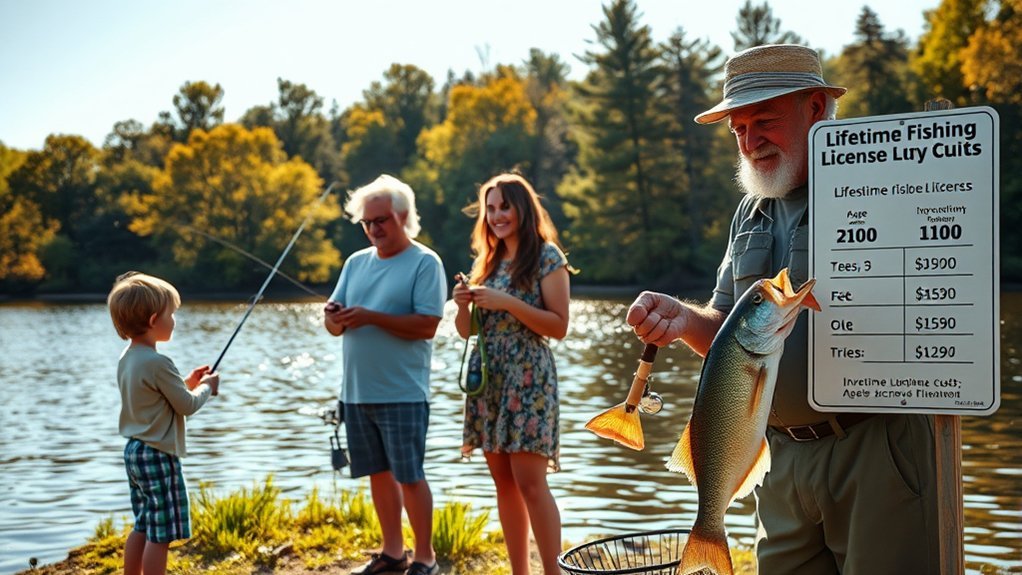
Lifetime fishing license prices vary widely. The following examples were checked against official agency information available in August 2026. They are not interchangeable, because each product covers different privileges.
| State and product | Current example fee | Important limitation |
|---|---|---|
| Florida resident lifetime freshwater or saltwater | $126.50 age 4 or younger; $226.50 ages 5–12; $301.50 age 13 or older | Freshwater and saltwater are separate products |
| New York resident lifetime freshwater fishing | $460 ages 0–69; $65 age 70 or older | Does not create a lifetime marine fishing registration |
| North Carolina resident comprehensive inland fishing | $326 for an adult; $20 for a qualifying senior, plus the transaction fee | Does not include coastal-water fishing |
| North Carolina resident unified inland/coastal fishing | $587, plus the transaction fee | Check the current application for exact privileges |
| California resident lifetime fishing | $709 ages 0–9; $1,160.25 ages 10–39; $1,045 ages 40–61; $709 age 62+ | Some validations and report cards are separate; the optional lifetime fishing privilege package costs extra |
| Idaho resident lifetime fishing certificate | $601.75 infant age 0–1; $841.75 ages 2–50; $481.75 age 51+ | Requires a no-cost annual or three-year license; effective July 1, 2026, buyers must meet Idaho’s five-year residency rule |
| Texas resident lifetime fishing package | $1,000 | Available to Texas residents by application |
| Oklahoma resident lifetime fishing | $375; senior resident lifetime fishing is $30 | Some access and special permits remain separate |
How to use this table: Do not compare price alone. A $300 fishing-only license can be a worse fit than a more expensive unified product if you regularly fish both inland and coastal waters. Compare the exact privilege you would otherwise renew each year, then check whether the state still requires annual no-cost credentials, separate species permits, or access fees.
Age-Based Pricing Tiers
Many states charge less when a license is purchased for a young child or qualifying senior. Florida uses three age bands for its lifetime freshwater and saltwater products. New York charges one freshwater rate for ages 0–69 and a much lower rate for residents age 70 or older.
North Carolina’s senior rules require extra care. Its July 2026 application states that residents born on or before August 1, 1953, become eligible for a senior lifetime license at age 65. Residents born after that date generally become eligible at age 70.
Resident Versus Nonresident Costs
Many lifetime fishing licenses are limited to residents. New York, Texas, and Oklahoma require qualifying residency for the standard products discussed above. North Carolina sells some nonresident lifetime packages, but they can cost substantially more than resident licenses.
Residency definitions are not always the same as simply owning property, holding a driver’s license, or receiving mail in the state. Check the agency’s definition and the required period of residency before applying.
What the Base Price May Not Include
A lifetime base license may not include:
- Trout, salmon, paddlefish, or other species permits
- For combination hunting/fishing packages, federal duck stamps or other federal hunting requirements
- Land-access or wildlife-management-area permits
- Marine registrations
- Harvest-reporting documents, validations, or species report cards
- Replacement cards or printed copies
- Online, phone, vendor, or transaction fees
Oklahoma, for example, explains that its lifetime fishing license does not replace certain Lake Texoma, land-access, or paddlefish requirements. New York states that there is no lifetime privilege for its recreational marine fishing registry.
How Lifetime Licenses Support Conservation

Fishing-license revenue supports agency work such as fish management, habitat improvement, research, public access, hatcheries, enforcement, and aquatic education. The exact accounting method differs by state.
North Carolina deposits lifetime-license money and associated fees into the N.C. Wildlife Endowment Fund. The state reports that more than $100 million in earned income from the fund has been used for conservation programs and projects since the fund began in 1981.
North Carolina reports that more than $100 million in lifetime-license endowment earnings has supported fish, wildlife, and habitat work.
License sales also matter at the federal level. The U.S. Fish and Wildlife Service explains that Sport Fish Restoration funds are apportioned using a formula based 60% on fishing-license sales and 40% on state size. That is another reason states track qualifying paid licenses carefully.
This does not mean the full lifetime purchase price is immediately spent on a local fishing project. States may place the principal in a protected fund and spend only investment earnings, as New York and North Carolina do with certain lifetime-license revenue.
How to Apply for a Lifetime Fishing License

The precise process differs by state, but most applications follow the same basic sequence.
- Choose the correct product. Decide whether you need freshwater, saltwater, inland, coastal, or combined privileges.
- Check eligibility. Review residency, age, senior, disability, veteran, and youth requirements.
- Read the privilege description. Identify excluded permits, stamps, registrations, and access fees.
- Gather documents. Prepare identification, residency records, and proof of age or eligibility.
- Apply through an approved channel. Depending on the state, this may be online, by mail, by phone, or through a licensing agent.
- Review the application before payment. Confirm the applicant’s name, birth date, address, and license type.
- Save proof of purchase. Keep the receipt, customer number, electronic credential, and any temporary license.
New York allows individual lifetime purchases for applicants age 12 and older through its online licensing system or an issuing agent. North Carolina’s July 2026 forms allow online or mailed applications, with special documentation and deadlines for infant and youth products.
Pro Tip: Take a screenshot or save a PDF of the official privilege description and fee schedule on the day you buy. It gives you a clear record of what the agency said the product included at purchase.
Common Eligibility and Documentation Requirements

Common application requirements include:
| Requirement | Possible documents |
|---|---|
| Identity | Driver’s license, state identification card, passport, or agency customer record |
| Residency | State ID, tax record, voter registration, vehicle registration, lease, or other approved evidence |
| Age | Birth certificate, passport, or government-issued ID |
| Special eligibility | Veterans Affairs certification, disability documentation, income documentation, or senior-status proof |
| Child application | Birth certificate and parent, guardian, or donor information |
New York requires a lifetime-license applicant to have been a state resident for at least one year immediately before applying. That requirement should not be treated as a national rule; other agencies use their own residency definitions.
Hunter education is not ordinarily required for a fishing-only license. It may become relevant when a lifetime package includes hunting privileges. For example, New York and North Carolina impose education or supervision conditions before a young holder can use certain hunting portions of a combination license.
Note: Replacement procedures are state-specific. New York currently charges $5 to replace a lost lifetime-license ID card through an issuing agent, but another state may use a free electronic reprint or a different fee.
Is a Lifetime Fishing License Worth It?
A lifetime license is most valuable when you expect to fish for many years and would otherwise buy the same annual privilege regularly. The simplest starting calculation is:
Break-even years = lifetime license price ÷ current annual license price
Round the result up to the next full year because you do not recover the upfront cost until the accumulated annual-license spending reaches or exceeds the lifetime price.
This basic formula does not account for future fee increases, investment returns, transaction charges, years you do not fish, or extra permits.

This kid-friendly cookbook helps young chefs build confidence in the kitchen with more than 100 recipes designed for fun, learning, and delicious results. Created by America's Test Kitchen Kids, it offers approachable instructions, helpful guidance, and a wide range of dishes that make cooking and eating an engaging family activity.

These MathLink Cubes make early math hands-on and engaging for children ages 5 and up, helping turn counting, addition, subtraction, patterns, and comparison into interactive learning. The colorful linking cubes connect on all sides and feature geometric cutouts for shape recognition and more advanced patterning, while also building fine motor skills, spatial reasoning, and problem-solving through play.

These Rawlings practice baseballs are built for young players ages 8 and under, offering an easy grip and consistent feel for recreational play. Each ball features a synthetic leather cover with a solid cork and rubber center, plus official size and weight for reliable training. The set includes a durable bucket for convenient storage and transport, making it a smart choice for coaches, parents, and teams.
Break-Even Examples
| Example | Calculation | Simple break-even |
|---|---|---|
| Florida resident, age 13+, freshwater | $301.50 ÷ $17 annual fee | About 18 years |
| New York resident, age 16–69, freshwater | $460 ÷ $25 annual fee | About 19 years |
| Oklahoma resident lifetime fishing | $375 ÷ $31 annual fee | About 13 years |
These are simplified examples based on current listed fees. Future annual increases could shorten the effective break-even period, while skipped fishing years could lengthen it.
Five Checks Before You Buy
- Match the privilege: Compare the lifetime product with the exact annual license you normally buy, not with a cheaper or broader product.
- Calculate break-even: Divide the lifetime price by the comparable annual price and round up.
- Count likely fishing years: If you skip seasons often, your real break-even takes longer.
- Check what survives a move: New York and North Carolina keep certain purchased lifetime privileges usable after residency changes, while Alaska’s senior permanent identification card becomes void when the holder is no longer an Alaska resident.
- List recurring extras: Species permits, report cards, access permits, registrations, and annual no-cost credential steps can remain after the lifetime purchase.
When a Lifetime License Makes Sense
- You fish almost every year.
- You qualify for a favorable child, senior, resident, veteran, or disability price.
- The product covers the waters and species you use most.
- You expect the privilege to remain useful after a possible move.
- You value convenience enough to pay upfront.
- You can pay without using high-interest debt or reducing essential savings.
When an Annual or Short-Term License Is Better
- You fish only occasionally.
- You are trying the sport for the first time.
- You may move and the license would not remain useful.
- You mainly fish in other states.
- The lifetime product excludes the water or species you target.
- The upfront cost would strain your budget.
- You qualify for a free or very inexpensive annual exemption.
Special Options for Seniors, Disabled Anglers, and Veterans
Reduced-fee and free programs differ substantially by state. Applicants should compare a lifetime product with any annual exemption for which they qualify.
- Alaska seniors: Qualifying residents age 60 or older can apply for a free permanent identification card that replaces the ordinary sport-fishing, hunting, and trapping licenses while they remain Alaska residents.
- Colorado veterans: Qualifying resident veterans with a service-connected disability may apply for a lifetime fishing license or lifetime small-game-and-fishing combination.
- Colorado residents with total and permanent disabilities: The state offers a Columbine lifetime fishing license to qualifying applicants.
- New York disabled veterans: Qualifying residents with a service-related disability of 40% or more may be eligible for reduced-fee annual sporting licenses.
- Oklahoma seniors: A qualifying resident senior lifetime fishing license is currently $30.
- North Carolina seniors: Qualifying resident senior comprehensive inland fishing is currently $20, subject to the state’s birth-date-based age rules and transaction fee.
A free annual exemption can sometimes be more valuable than purchasing a full-price lifetime license. Compare privileges carefully because a reduced product may cover only certain waters or activities.
Practical Benefits and Friction Points
The practical appeal of a lifetime license usually comes from predictable access rather than special treatment on the water. Holders must still follow the same seasons, size limits, bag limits, gear restrictions, reporting rules, and area closures as annual-license buyers.
In practice, the main advantages of a lifetime product are:
- Not remembering a base-license renewal date
- Avoiding future base-license price increases
- Keeping a childhood gift for decades
- Retaining privileges after moving when state rules allow it
- Supporting a protected conservation fund
Common frustrations include discovering that a stamp or permit remains separate, losing an old physical card, failing to update an address, or assuming that the license covers another state. Reviewing the current regulations at the start of each season remains necessary even when the base license never expires.
What North Carolina Lifetime License Buyers Should Know
North Carolina offers more than one lifetime fishing option, so buyers should match the product to the waters they intend to use. According to the state’s July 2026 adult application:
- Comprehensive inland fishing covers statewide inland fishing, designated Public Mountain Trout Waters, trout waters on game lands, and joint waters. It does not cover coastal waters.
- Coastal recreational fishing covers coastal and joint waters but not inland waters.
- Unified inland/coastal recreational fishing combines statewide inland and coastal recreational fishing.
- Sportsman packages may add hunting privileges but can still exclude items such as the Bear Management E-Stamp and federal duck stamp.
The N.C. Wildlife Resources Commission states that its lifetime licenses remain usable when the holder returns to North Carolina after moving away. It also allows infant and youth licenses to be purchased as gifts in the named child’s account. However, North Carolina licenses themselves are nontransferable.
Fees, application forms, and regulations may change. Check the current license page and fishing regulations immediately before purchase or before relying on a privilege in a new season.
For state-specific detail on this site, see the guides to California lifetime fishing license costs, Colorado lifetime fishing license options, and Alaska lifetime fishing privileges.
Frequently Asked Questions
Can I transfer my lifetime fishing license to someone else?
Usually not. Treat a lifetime license as nontransferable unless the issuing agency publishes a specific exception. New York permits transfer only in narrow death-related circumstances. Buying a new license as a gift for a named recipient is different from transferring an existing license.
What happens if I lose my lifetime fishing license?
Contact the issuing fish-and-wildlife agency or sign in to its licensing portal. You may be able to display an electronic credential, print another copy, or order a replacement card. Fees vary; New York currently charges $5 to replace a lifetime-license ID card through an issuing agent.
Are there age restrictions for applying?
Rules vary. Some states sell discounted infant or youth licenses, while others use one rate for most ages. A parent, guardian, or donor may need to provide a child’s birth certificate and submit the application before a strict age cutoff.
Is a lifetime fishing license valid in other states?
Generally no. A state lifetime license normally authorizes fishing only in that state. Limited reciprocal rules may apply to named border waters, but they do not create nationwide validity. Check both states’ rules before crossing a boundary.
Can I fish in freshwater and saltwater with one lifetime license?
Only when the named product includes both. Florida sells separate lifetime freshwater and saltwater licenses, New York’s lifetime fishing license covers freshwater, and North Carolina offers separate inland, coastal, and unified options.
Does my license remain valid if I move out of state?
It depends on the issuing state. New York says its purchased lifetime privileges remain valid after a residency change, and North Carolina says holders may use their lifetime licenses whenever they return. Verify this rule before buying because it is not universal.
Do lifetime fishing licenses require any yearly action?
Sometimes. A lifetime purchase may remove the annual fee without removing every annual step. Idaho, for example, requires lifetime-certificate holders to obtain a no-cost annual or three-year license. Other states may require current tags, report cards, registrations, or seasonal items.
Do I still need to check fishing regulations every year?
Yes. A lifetime license does not freeze seasons, bag limits, size limits, closed areas, gear rules, reporting duties, or permit requirements. Review the current regulations before each trip or season.
Conclusion
A lifetime fishing license can be a sound purchase for someone who fishes regularly, qualifies for a favorable rate, and understands exactly what the product covers. The best choice is not automatically the cheapest advertised license. Compare freshwater and saltwater privileges, extra permits, residency rules, break-even time, transfer restrictions, and continued validity after a move.
Before paying, read the issuing agency’s current privilege description and fee schedule. Confirm what happens after a move, whether any no-cost credential must still be obtained each year, and which permits remain separate. That verification can prevent years of confusion and help ensure that the license supports the fishing access and family traditions you actually intend to use.
Sources
- New York State Department of Environmental Conservation — Lifetime Sporting Licenses — New York fees, residency, transfers, privileges, and replacement rules
- Florida Fish and Wildlife Conservation Commission — Lifetime Licenses — Florida age-based freshwater and saltwater fees and included permits
- N.C. Wildlife Resources Commission — North Carolina Lifetime Licenses — endowment funding, gifts, residency, and continued validity
- N.C. Wildlife Resources Commission — Adult Lifetime License Application, revised July 2026 — current adult fees, senior eligibility, and privilege descriptions
- Texas Parks and Wildlife Department — Lifetime Licenses — Texas resident lifetime package fees
- U.S. Fish and Wildlife Service — Apportionments and License Data — conservation funding and fishing-license apportionment formula
- California Department of Fish and Wildlife — Lifetime Licenses — 2026 age-based lifetime fishing fees and optional privilege package
- Idaho Fish and Game — Lifetime Licenses/Certificates — lifetime fishing certificate fees, residency rule, and no-cost annual or three-year credential requirement
- Oklahoma Department of Wildlife Conservation — License Fees — current annual, lifetime, and senior lifetime fishing fees
- Alaska Department of Fish and Game — Senior Licensing — permanent senior identification-card eligibility and residency limits
- Colorado Parks and Wildlife — Fishing Licenses and Dates — veteran and disability-based lifetime fishing options

This hardcover cookbook offers fast, approachable recipes designed for busy days and low-energy nights. Caroline Chambers focuses on simple, flavorful meals that help you get dinner on the table without overthinking it. It's a practical pick for home cooks who want quick weeknight inspiration and minimal-fuss cooking.

SET is a fast-paced family card game that challenges players to spot patterns and make matches by color, shape, shading, or number. Easy to learn yet mentally engaging, it works well for solo play, group game nights, travel, and classroom fun. Its quick rounds and educational value make it a favorite for kids, teens, and adults alike.

Die With Zero offers a fresh perspective on personal finance by encouraging readers to use money intentionally to create memorable life experiences instead of simply accumulating wealth. Written by Bill Perkins, this book combines practical guidance with a motivating philosophy to help readers align spending, saving, and life goals for a more fulfilling future.
