
You total labor, materials, gas, equipment, and overhead. Then add profit. Start by measuring weld length, joint type, and thickness. Pick MIG mode, wire diameter, and travel speed. Compute arc-on time (length ÷ in/min) plus repositioning. Convert weld volume to wire mass and cost. Estimate shielding gas use (L/min × minutes). Amortize equipment and add overhead per job. Sum costs. Apply profit percentage. You have the job price. Keep going for step-by-step formulas.
Quick Answer
- Break costs into labor, materials, equipment, consumables, and overhead for precise estimates.
- Define weld scope: list joints, measure total length, note tolerances and access issues.
- Select MIG mode, filler wire, and shielding gas based on material and joint needs.
- Calculate time, materials, add equipment/overhead, then apply profit for final price.
Understanding Welding Cost Components
When you calculate MIG welding costs, break them into five clear components. These are labor, materials, equipment, consumables, and overhead. This way, you quantify each expense precisely.
For example, compute labor as welder hourly rate times total hours. List material items like base metal, filler, and shielding gas. Include unit costs and quantities. Amortize equipment purchase or rental plus maintenance and power per job. Tally consumables like tips and wire per weld length. Allocate overhead such as utilities, rent, admin, and PPE as a percentage or fixed cost per project.
Itemized labor by skill level and efficiency helps. Tally material unit costs and quantities. Amortize equipment over expected life or rental days. Record consumables per meter of weld. Use these line items for accurate welding budget and cost estimation. For more on standards, check the American Welding Society’s welding standards.
Step 1: Define the Scope of Work and Weld Geometry
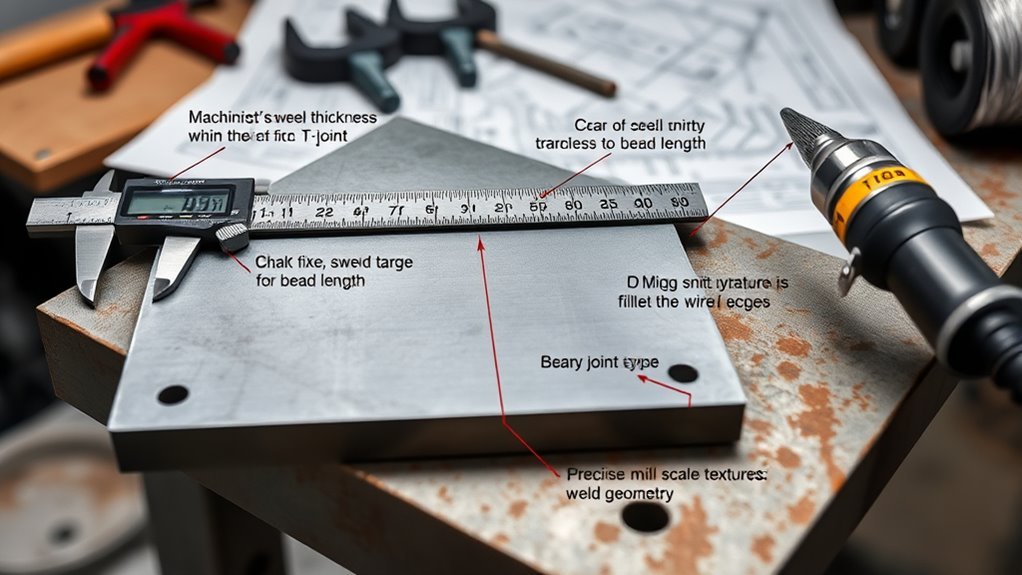
Start by listing the parts and joint types you will weld. These include butt, fillet, and lap. Count each joint to get total welds.
Measure and sum weld length per joint and total weld length. Note stitch versus continuous runs.
Record required tolerances and access restrictions. Think about positions and fixturing. They change time and cost per meter.
Parts and Joint Types
Parts and joints determine most of your MIG-welding decisions. Identify each component’s joint type like butt, lap, corner, or edge. Note part thickness and shape. This helps size welds, pick wire and shielding gas, and calculate filler volume.
List weld types. Apply joint considerations. Quantify geometry to derive material and labor estimates. Use measured thicknesses in mm or in. Note edge prep. Record part shapes that affect access and travel speed.
| Item | Key data |
|---|---|
| Joint type | Butt / Lap / Corner / Edge |
| Thickness | mm or in |
| Shape | Plate, tube, channel |
| Access | Single/Double-side |
| Edge prep | None / Bevel angle |
With this table, convert geometry into weld size, deposition rate, and cost inputs.
Weld Length and Count
Begin by measuring and summing the total linear feet or meters of every weld you will make. Record each joint’s length and the number of individual welds. This lets you convert geometry into labor and filler estimates.
Use consistent weld measurement techniques. Try tape, calipers, or CAD takeoffs. Note start and stop points and any intermittent welds. Classify each joint like butt, lap, or corner. List weld size from 0.125 to 1.250 in to calculate filler volume and welding time per foot.
Count welds individually. N welds times length per weld equals total length. Note joint preparation methods required like cleaning or beveling. They affect prep time and cost.
Document everything in a worksheet. Then move to accurate labor, gas, and consumable estimates.
Tolerances and Access
With your weld lengths and joint types documented, set explicit dimensional tolerances. Assess physical access for each weld location. Both will change your labor rate and method selection.
Quantify tolerance variations in ±mm per joint. Link tighter tolerances to slower deposition rates and higher rework risk. Log access challenges like reach, rotation, or fixturing that add minutes per weld.
- Specify nominal dimension and tolerance band for every weld; tighter bands mean a percent time multiplier.
- Categorize access: unobstructed, limited, confined, rotated; assign labor time factors.
- Reference past jobs with similar geometry and tolerance variations to calibrate time estimates.
- Convert time factors to cost by applying hourly welder rate plus overhead and anticipated rework.
Step 2: Select the MIG Process and Consumables

Now pick the MIG mode. Options are Short Circuit, Spray Transfer, or Pulsed. Base it on material thickness and joint type. Each affects deposition rate and labor time.
Then select filler wire. Choose solid versus flux-cored and diameter. Note wire-to-flux ratios from about 0.5 to 2.5. They change material usage and cost per meter.
Finally choose shielding gas. Try pure Argon or Ar/CO2 mixes. Gas composition alters weld quality and expense per cubic meter.
Products Worth Considering

ER5356 WELDING WIRE: 5% magnesium aluminum (AlMg5) filler metal welding wire designed for the MIG welding process. As a general-purpose aluminum alloy, it offers exceptional versatility for a wide array of applications.

ER4043 WELDING WIRE: A premium 5% silicon aluminum (AlSi5) filler metal designed for the MIG welding process. This composition delivers excellent fluidity and wetting characteristics, making it ideal for welding a wide range of aluminum alloys. It features a melting range of 1065°F to 1170°F, a density of 0.097 lbs/in³, and produces a consistent gray finish after anodizing.

Gel eliminates erratic operation with a film that will not clog orifices and threads on MIG nozzles and contact tips
Choose the MIG Mode
Pick the correct MIG mode based on material thickness and joint requirements. Use short-circuit for sheets under 3 mm. Try spray transfer for parts over 3 mm. Use pulsed MIG when you need controlled heat input or cannot use high currents.
Choose a MIG process to match thickness, penetration needs, and heat control. Welding techniques affect deposition rate, spatter, and rework.
Consider arc stability with Argon/CO2 mixes. See how wire-to-flux ratios from 0.5 to 2.5 change material usage and cost.
- Match mode to thickness: short-circuit under 3 mm, spray over 3 mm, pulsed for thin-to-thick changes.
- Evaluate penetration versus heat input and cycle time.
- Factor gas mix for arc stability and reduced spatter.
- Use wire-to-flux ratio to optimize consumable cost.
For details, see Lincoln Electric’s MIG process guide.
Select Filler Wire
Filler wire selection determines weld strength, compatibility, and cost. Choose diameter and chemistry to match base metal, joint thickness, and required properties.
Pick wire chemistry like ER70S-6 for mild steel or ER4047 for aluminum. It matches mechanical and corrosion requirements.
Diameter considerations: 0.023″, 0.030″, 0.035″, 0.045″ are common. Use thinner for under 1/8″ material. Try 0.035″ to 0.045″ for thicker sections.
Calculate wire consumption: feed speed in in/min times diameter gives lb/hr. Use manufacturer charts to convert.
Estimate wire-to-flux ratio from 0.5 to 2.5 where applicable to include flux-cored costs.
Factor unit price in $/lb, expected deposition efficiency, and scrap or weld rework rates into per-foot and per-joint cost.
Record choices for later gas and productivity steps.
Pick Shielding Gas
The shielding gas directly controls contamination, arc stability, penetration, and bead appearance. Choose a mix that matches material thickness and welding goals.
For MIG cost calculations, list shielding gas options and expected consumption in cfh. Include cylinder life and unit cost to get accurate gas cost per weld. Use gas mixtures deliberately: higher-argon blends for thin gauges, higher-CO2 blends for heavy sections.
- Argon-rich like 75 to 95% Ar: smooth arc, low spatter, best for thin material; consumption about 20 to 30 cfh.
- CO2 or high-CO2 mixes like 100% CO2 or 75/25 Ar/CO2: deeper penetration, higher spatter; consumption about 25 to 40 cfh.
- Specialty blends like Ar+O2+CO2: improved wetting; adjust flow 20 to 30 cfh.
- Cost calc: cylinder price divided by usable hours times hours used per job.
Step 3: Calculate Labor Time and Travel Speed
Measure the total weld length. Divide it by your chosen travel speed to get labor time. Travel speeds typically range from about 4 to 12 in/min. They slow down as weld size increases.
Use the MIG Welding Cost Model to pick travel speed based on weld size and distance. Larger welds lower inches per min.
Calculate arc-on time as total length divided by travel speed.
Add arc-off time per weld for move and reposition. It is about 0.5 to 2.0 minutes per joint. This gives total labor minutes.
Convert minutes to hours for wage multiplication.
Track welding efficiency as actual arc-on divided by shift time. Refine estimates. Apply labor optimization by reducing unnecessary arc-off intervals.
Accurate time yields precise labor cost per project.
Step 4: Estimate Material, Gas, and Wire Costs
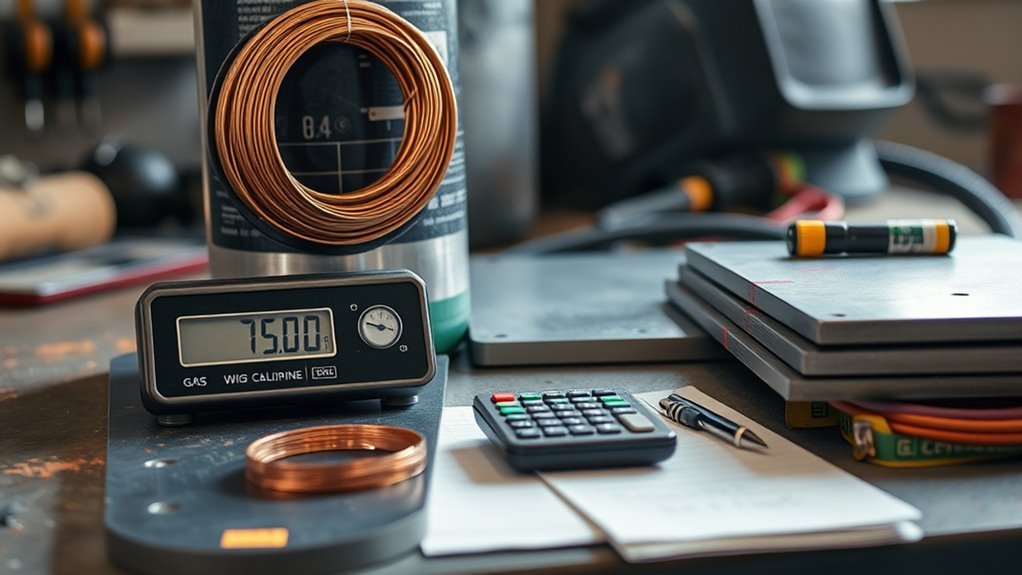
Step 4 narrows your estimate to three cost buckets. These are base metal, shielding gas, and consumable wire. Each comes from quantities tied to weld size and joint geometry.
Use material selection to pick base and filler metals. Compute quantities from joint geometry and groove or weld cross-section area. For gas, choose Argon or mix. Multiply flow rate times weld time times gas price.
For wire, convert wire length to kg. Apply the wire-to-flux ratio from 0.5 to 2.5 where relevant. Multiply by cost per kg for wire and flux.
- Calculate base metal and filler mass from weld volume and material density.
- Determine gas consumption: L/min times minutes times price/L.
- Convert wire length to kg; apply cost/kg.
- Add flux per wire-to-flux ratio for final cost estimation.
Products Worth Considering

Compatible with CGA-580 tanks: Easily attach this Gas Pressure Regulator/Flowmeter to your Argon, Helium, and CO2 tanks with its CGA-580 inlet connector


Package Including 10pcs x 0.035" Contact Tip, 2pcs x Gas Nozzle, 2pcs x Gas Diffuser.
Step 5: Add Equipment, Overhead, and Profit
When you finish calculating labor, materials, gas, and consumables, add equipment costs, overhead, and your profit margin. This gives the final per-job price. Itemize depreciation, rental fees, and equipment maintenance as hours times rate to get a totaled equipment line. Perform an overhead analysis: utilities, rent, admin, insurance, safety gear. Allocate per job using a sensible driver like hours or revenue. Then pick a profit margin percentage and apply it to the subtotal.
| Category | Example (USD) |
|---|---|
| Equipment depreciation | 50.00 |
| Equipment maintenance | 25.00 |
| Overhead allocation | 40.00 |
| Subtotal before profit | 115.00 |
| Profit (20%) | 23.00 |
Keep records to refine these numbers over time.
Products Worth Considering

【Powerful 3-in-1 Welding Machine】 BESTMIG FLUX-135 offers robust output with a true current of 135A, capable of welding materials up to 1/8 inch thick. Enjoy versatile functionality with MIG, Lift TIG, and Stick welding capabilities for various applications.

【PROTABLE HANDHELD MIG WELDER】The GEARLASSO MIG-120 handheld welder weighs 3.15KG with a compact body, making it easy to carry and operate in tight spaces. Designed for gasless MIG welding, it eliminates the need for external gas cylinders—perfect for outdoor projects, on-site repairs, and mobile use.
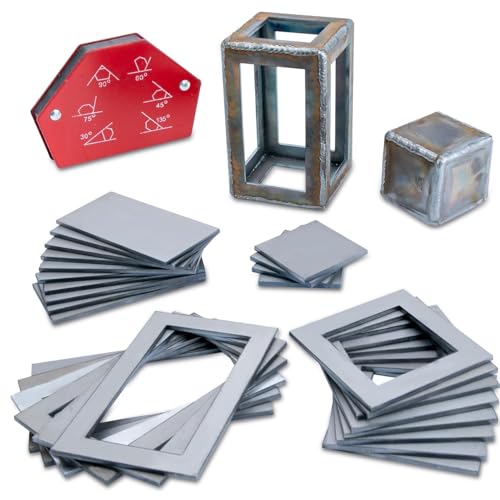
Richly Packed Welding Kit: This kit includes 10 pieces of 3x2-inch plates, 10 pieces of 2x2-inch plates, 10 pieces of 5x3-inch plates, and 10 pieces of 4x2-inch plates. You can weld them into basic 3x3x3-inch and 2x2x2-inch cubes, or create rectangular shapes like a 5x3x3-inch box or a 4x2x2-inch box. Perfect for beginners looking to enhance their welding skills.
Common Mistakes to Avoid in MIG Welding Cost Estimation
People often underestimate arc-off time for repositioning. This adds up quickly on complex jobs. Another error is ignoring rework rates. Factor in 5 to 10% for scrap or fixes based on past projects.
Forgetting to update gas or wire prices leads to low bids. Check supplier quotes regularly. Overlooking tolerances can inflate labor costs unexpectedly. Always link them to time multipliers early.
Tools and Resources for MIG Welding Cost Calculation
Use free online calculators from welding suppliers. They handle basic inputs like weld length and material type. Spreadsheet templates work well too. Build one with formulas for labor, gas, and wire.
Software like WeldOffice or custom apps can automate estimates. They include databases for wire and gas costs. Pair them with CAD for accurate geometry takeoffs.
Products Worth Considering
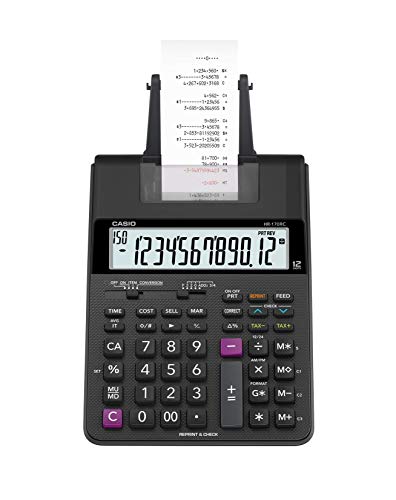
FAST TWO-COLOR PRINTING – Prints at 2.0 lines per second with dual-color output (black/red) for easy distinction between positive and negative values. CHECK, CORRECT &...
Frequently Asked Questions
Can MIG Welding Costs Be Reduced by Switching to Flux-Cored Wire?
Yes. Switching to flux-cored wire often reduces costs. You see flux cored advantages like faster deposition rates and higher productivity. It lowers shielding gas expense. Cost comparison shows reduced labor and consumable costs. Though cleanup and filler use vary.
How Do Seasonal Gas Price Fluctuations Affect Long-Term Quoting?
Like a tide, seasonal trends push gas pricing up or down. Model multi-year averages. Apply ±15 to 25% volatility buffers. Update quotes quarterly. Lock critical contracts. Track month-by-month spend to protect margin.
Is Post-Weld Inspection Included in Typical MIG Cost Estimates?
Usually no. You often see basic visual checks included. But formal post weld quality verification and specific inspection standards like NDT or dimensional checks are commonly billed separately. Request itemized quotes with per-inspection pricing and frequencies.
Can Automation (Robotic MIG) Change Per-Piece Pricing Thresholds?
Yes. You see automation benefits shift thresholds. Robotic precision lowers per-piece labor to cents. It raises fixed investment. Calculate break-even units, cycle times, defect rates, and throughput to quantify savings precisely.
How to Account for Scrap and Rework in Initial Cost Bids?
Build scrap management and rework strategies into bids. Estimate scrap rate in percent. Include rework hours, material per unit cost, labor per hour, and overhead. Multiply to get expected scrap or rework cost per unit. Add contingency, typically 5 to 15%, for variability.
Conclusion
You have tallied hours, wire ounces, and oxygen’s existential cost. Congratulations, you are officially a welding accountant. Stick that per-inch rate on the quote. Add a sensible markup. Do not pretend profit is optional. Round for human error. If labor, gas, and consumables do not add up to your target margin, adjust travel speed, consumable choice, or price. Repeat until bank account and customer both stop complaining. That is your MIG cost.
