

If you’re planning to get a welding certification, expect a mix of fixed test fees and variable costs for training, retests, and upgrades. You’ll typically pay about $460–$520 for foundational tests like AWS D1.1, plus optional fees (ATF registry, retests $120–$250 per position) and substantial training expenses if you need classes or apprenticeships. There are ways to lower costs — but first you need to know which cert and process fit your goals.
Types of Welding Certifications and What They Cover

When you pursue welding certification, you’ll encounter distinct standards tailored to specific applications—AWS D1.1 for structural steel and ASME IX for pressure-retaining piping—each defining required test positions, joint types, materials, and skill demonstrations; for example, AWS D1.1 commonly certifies welders on plate thicknesses (3/8″ tests cost $460) while ASME IX evaluates pipe welding skills in positions like 6G (also $460 for Stick/MIG or TIG).
Both programs require a vision test plus documented education and work experience to qualify for examination. You’ll choose certification types based on your work: AWS D1.1 targets plate and structural work, ASME IX focuses on pipe and pressure-retaining systems.
Qualification requirements include documented education, verifiable work history, and a vision screen before testing. Optional upgrades, like AWS registry enrollment, raise fees and add administrative steps. Retest fees apply if you fail a position, so plan training to meet the specific joint, position, and material standards each certification mandates.
Standard Pricing for Common Certification Tests

Although pricing varies by test type and upgrades, you can expect most common certifications to fall in the $460–$685 range depending on thickness, position, and ATF upgrades.
You’ll find AWS D1.1 tests priced at $460 for 3/8″ thickness in vertical and overhead; add the ATF upgrade and that same test rises to $615.
For 1″ thickness in vertical and overhead, the base AWS fee is $520, increasing to $685 with ATF.
ASME IX 6G position exams (6 SCH80, Stick/MIG or 2 SCH60, TIG) are typically $460.
Retest policies differ: ASME IX specific retest entries are listed at $120, but a standard retest fee is set at $250 per position across certification types.
These clear pricing variations let you plan: identify the certification types you need, note thickness and position requirements, and budget separately for ATF upgrades or retesting.
What’s Included in Test Fees and Optional Add‑Ons

Because clear fees make budgeting easier, you’ll find that test prices cover the core materials and equipment needed for your AWS D1.1 or ASME IX exam—metal test coupons, backing bars, rods or wire, shielding gas use, and examiner time—so you won’t be charged separately for basic consumables.
The AWS D1.1 base fee ranges $460–$520 (by thickness) and you can add a $155 ATF upgrade that registers you in the AWS welder registry and issues an AWS card, while retest fees are set at $250 per position for general retests and $120 for ASME IX-specific retests.
Send-in test kits are also offered as a convenient alternative to in-person testing. You should view fees as a test fee breakdown tied to certification value: base testing covers standardized materials and administration, the ATF upgrade secures formal registry recognition and an ID card, retest fees keep records current, and send-in kits let you test remotely.
Factor these elements when comparing providers.
Products Worth Considering
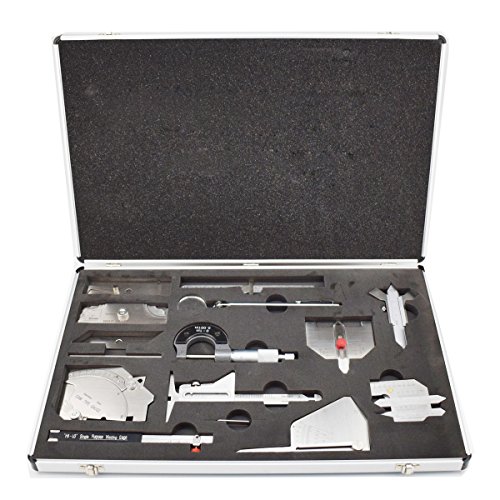
Most ruler are INCH size, some angle measurement are Metric size.

MG-11 GAUGE SET: Metal Weld Fillet Gages Set (7PCS), It has wide measurement range, meets various kinds of needs. Checking fillet leg size and fillet throat size. Increments standard and metric equivalents etched into the surface for clarity and easier reading.
Scheduling, Locations, and What to Bring on Test Day

If you’re booking a welding certification test, note that exams are offered only on Tuesdays and Thursdays with an 8:00 AM start, and you can make an appointment by phone or by submitting an inquiry on the facility’s website.
For efficient scheduling appointments, pick your preferred testing center—Baltimore, Beltsville, York, Scranton, Southern MD Welding School, or Arnold MD Welding School—and confirm the address and any site-specific rules before you arrive.
On test day preparations: arrive 15–30 minutes early with a valid picture ID and the required safety equipment (helmet, gloves, appropriate footwear, and any PPE specified by the site).
Bring proof of payment or appointment confirmation if provided. If you need directions or parking instructions, call the facility ahead; staff can also confirm any additional requirements unique to that location.
Following these steps minimizes delays and guarantees you’re ready to begin promptly at 8:00 AM.
Products Worth Considering

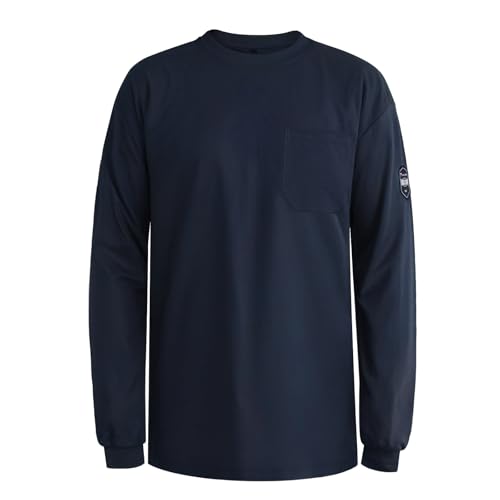
FR Materials: 5.5OZ Cotton Twill, FR treated, with FR buttons & threads. Clear FR tag on arms & bottom front. Neck tag with UL Certification details. Small FR sample included for customers to have a simple FR try

🔥【COW LEATHER WELDING BOOTS】: This welding working protect boots are made from 100% high-quality Nubuck Cow Leather, which provides a good mix of durability, and flexible with moderate heat and abrasion resistance. So it can effectively improve your work efficiency
Retest Policies and Additional Costs

When you don’t pass a welding certification position, you can schedule a retest on the same Tuesday or Thursday testing days; fees vary by standard and position — $250 per position for AWS D1.1 and $120 for ASME IX 6G (both Stick/MIG and TIG).
You’ll want clear retest strategies to minimize repeats and additional expenses. Plan which position to reattempt, arrive with the same welding parameters, and review failed acceptance criteria before your slot.
Have a clear retest plan: pick the position, match your welding settings, and review failed criteria beforehand.
- Confirm available retest slots the day you fail to secure preferred times.
- Budget per-position retest fees into your certification plan.
- Factor potential send-in test kit charges when practicing offsite.
- Prioritize technique fixes that directly address documented weld defects.
- Keep documentation of prior tests to speed exam administration.
You’re responsible for retest fees per position and any separate send-in kit costs. Avoid unnecessary attempts by using focused practice and correcting root-cause issues before you return.
Products Worth Considering

🎲Superior Processing: Our steel plates are all laser-cut, providing edge and overall flatness that is unmatched by other stamped and sheared components.

Father's Day Gift: If your father is an excellent welder, you can give this as a gift to him. He will be very happy.
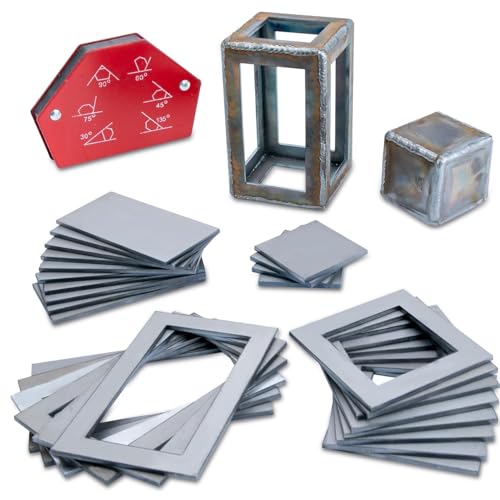
Richly Packed Welding Kit: This kit includes 10 pieces of 3x2-inch plates, 10 pieces of 2x2-inch plates, 10 pieces of 5x3-inch plates, and 10 pieces of 4x2-inch plates. You can weld them into basic 3x3x3-inch and 2x2x2-inch cubes, or create rectangular shapes like a 5x3x3-inch box or a 4x2x2-inch box. Perfect for beginners looking to enhance their welding skills.
Certification Portability: ATF Upgrade and Registry Benefits

When you add the ATF Upgrade ($155), AWS enters you into the certified welder registry and issues a portable certification card that verifies your status.
That registry entry increases your visibility to employers and makes it straightforward to transfer qualifications across regions and jobs.
Treat the card and registry record as essential credentials that can improve hireability and earning potential.
AWS Registry Entry
Because you can pay a modest $155 ATF Upgrade on top of your test fees, you’ll get entry into the AWS certified welder registry, an official AWS card, and a portable credential that employers across regions recognize.
The AWS registry centralizes your certification, documents expiration and scope, and supports certification benefits like wider recognition and verified skill records. You’ll use this to prove qualifications quickly during hiring or dispatch.
- Registry listing verifies your endorsed procedures and test dates
- Portable credential increases access to regional job markets
- Official AWS card serves as immediate proof of accomplishment
- Maintained records simplify renewals and specialty tracking
- Recognized certification often correlates with higher pay and advancement
Opting for the ATF Upgrade is a precise, cost-effective portability strategy.
Portable Certification Card
One clear way to make your welding credential truly portable is to add the AWS Accredited Test Facility (ATF) Upgrade for $155, which registers you in the AWS certified welder registry and issues an official AWS card as verifiable proof of certification.
By choosing the ATF Upgrade, you secure a compact, recognizable credential that travels with you across states and employers. The registry entry increases welding visibility to hiring managers and contractors, and the AWS card serves as immediate proof during job screenings.
These certification benefits improve your marketability, can speed hiring, and often justify higher pay. You’ll get standardized documentation that verifies scope, process, and acceptance criteria, reducing follow-up testing and administrative hurdles for employers.
Training and School Costs Versus Certification Fees

When you compare program tuition to certification exams, remember that welding school can run $5,000–$30,000 while an AWS test typically costs $460–$685 with retests around $120–$250 per position.
You’ll also need to budget $100–$2,500 for materials, safety gear, and equipment that aren’t always included in tuition.
Check community college options and financial aid or scholarships to lower your upfront training costs before you schedule exams.
Products Worth Considering

Brand new and unique design!

FLAME RESISTANT COTTON: Made entirely from durable 9 oz. flame-resistant cotton, this welding jacket offers protection against sparks and light spatter - perfect for light-duty MIG and TIG welding where moderate protection is needed.

Function: Genuine leather welding hoods are heat and fire resistant and protect your head, face and neck from shooting sparks, debris, sawdust and welding slag.
Program Tuition vs. Exams
Although training programs often demand the largest upfront outlay, you should separate tuition and equipment costs from certification fees to understand true investment and ROI.
For a clear program comparison and tuition breakdown, note tuition ranges $5,000–$30,000; schools may add $100–$500 for essential materials and safety gear. Certification exams are comparatively modest but recurring expenses.
- Typical certification (AWS D1.1) cost: $460–$520
- Retest fees: AWS $250 per position; ASME IX about $120
- Training extras often included in tuition: basic consumables and PPE
- Equipment (covered later) is a separate capital cost
- Budget for potential ATF upgrades and administrative fees
You should weigh program depth against exam frequency and retest risks.
Equipment and Materials
Beyond comparing tuition and exam schedules, you’ll also need to separate training-related equipment costs from certification fees to see the full financial picture.
You’ll pay $5,000–$30,000 for school in most cases, but plan separately for gear: basic safety gear and consumables can start near $100, while quality welding machines, helmets, clamps and gas setups can push that total toward $2,000.
Certification fees are distinct: expect about $460 for an AWS D1.1 test, rising to $615 with an ATF upgrade, plus potential retest costs of $120–$250 per position.
Send-in test kits offer an alternative logistical cost. Itemize training purchases versus exam charges so you can budget precisely and avoid unexpected outlays.
Financial Aid Options
If you’re weighing school costs against separate certification fees, focus first on which expenses each financial aid source will cover so you can prioritize aid applications and out-of-pocket planning.
You’ll see school tuition ($5,000–$30,000), certification exams ($460–$685 with ATF upgrade), materials ($100–$500) and machines ($500–$2,000) laid out so you can target assistance.
Use these funding resources to close gaps:
- Federal grants for tuition and approved program costs
- Low-interest student loans for remaining balance and equipment
- GI Bill® benefits covering veteran education expenses
- Scholarships (e.g., American Welding Society) for tuition or certification fees
- Combined aid packages to minimize net cost and cash payments
Assess each financial assistance option by covered expense and eligibility.
Financial Aid, Scholarships, and Cost‑Saving Strategies

When you explore funding for welding certification, prioritize grants, scholarships, and low‑interest loans because they cut your out‑of‑pocket costs and reduce long‑term debt. Federal grants and subsidized loans form a foundation, while the GI Bill® covers veterans and eligible dependents.
Prioritize grants, scholarships, and low‑interest loans for welding certification to lower costs and limit long‑term debt.
Institution‑specific awards (like MTI’s scholarships for high school seniors) plus external options from groups such as the American Welding Society provide targeted aid that can be stacked to maximize savings.
You should first seek financial assistance through FAFSA to qualify for federal grants and subsidized loans, then apply to school-based and external scholarship opportunities with clear deadlines and tailored essays.
Use a checklist to track award amounts, eligibility, and renewal requirements. Prioritize grants and scholarships before loans; accept low‑interest loans only to fill remaining gaps.
Also investigate employer tuition reimbursement, payment plans, and short-term trade school apprenticeships that offset costs while you gain experience.
Combine these tactics to minimize debt and accelerate certification.
Career Value: Salaries, Job Prospects, and Return on Investment

Now that you’ve mapped funding and cost‑saving options, consider what that investment delivers in the labor market: certified welders command a median wage of $47,540 (May 2022) with wide variation by region, experience, and industry—Detroit metro welder‑fabricators, for example, earn roughly $28,180 to $71,200 annually—so certification often translates directly into better pay and hireability.
You’ll find the welding job market rewards credentialed workers, especially in sectors like oil and gas, shipbuilding, and aerospace. A one‑semester Welding and Fabrication Technology certificate can speed entry into high‑demand roles.
- Faster placement in skilled-entry positions
- Higher starting pay and clearer promotion paths
- Preferential hiring by employers seeking certification benefits
- Access to specialized industries with premium wages
- Short training time with measurable ROI
Assess local demand and employer requirements to estimate your pay trajectory.
Certification benefits are concrete: improved job prospects, measurable wage gains, and a short pathway to technical careers that repay the initial cost.
Frequently Asked Questions
How Long Does a Certification Remain Valid Before Renewal Is Required?
Certification duration typically spans one to five years depending on the issuing body; your renewal timeline depends on industry standards and employer requirements, so you’ll need to track expiration dates and complete recertification or refresher testing accordingly.
Are Welding Certifications Recognized Internationally?
Yes — many welding certifications follow international standards and enjoy global recognition, but you’ll still need to verify specific country or employer acceptance, sometimes obtain additional endorsements, and meet local codes or equivalency procedures.
Can Employers Require Company-Specific Certifications?
Yes — you can. Like a tailor insisting on a custom fit, employers set company policies and certification requirements; you’ll follow specific tests, procedures, and documentation they mandate to meet their safety and quality standards.
Do Certification Bodies Offer Payment Plans?
Yes — many certification bodies offer payment options and financial assistance; you can choose installment plans, deferred payments, employer-sponsored billing, or scholarship/grant support. Check each agency’s terms, eligibility criteria, and repayment schedules before committing.
Will a Medical Exam Be Required for Certification Testing?
Usually no, you won’t need a full medical exam for certification testing, but you’ll face specific medical requirements (vision, hearing, cardiovascular) during the certification process; check your certifying body for precise, job-specific health criteria.
Conclusion
You’re closer than you think to making a clear choice: certification fees themselves typically run in the low hundreds, with ATF upgrades and retests adding predictable surcharges, while training and equipment drive the larger investments. Weigh immediate test costs against long‑term earning potential and portability. If you’ve budgeted for training, applied for aid, and picked the right certification for your goals, the payoff can arrive sooner than expected—yet one decisive step remains: which path will you take?
