
Welding certifications typically cost between $300 and $550. Specific certifications like AWS D1.1 and ASME IX are each priced at about $460. On top of that, budget for retest fees ($120 to $250), a non-refundable application fee of $60 for offline submissions, and potential training and equipment costs that can add up fast.
Quick Answer
- Most welding certifications cost between $300 and $550.
- AWS D1.1 and ASME IX certifications are each $460.
- Retest fees run $120 to $250 per position.
- Training programs range from roughly $2,800 to $15,000+ depending on specialization.
- Financial aid, scholarships, and AWS membership discounts can reduce your out-of-pocket costs.
Overview of Welding Certification Costs

Certification matters because it proves you meet industry requirements and safety standards. That credibility comes with a price, and knowing what to expect helps you plan ahead.
For most certifications, you’ll pay between $300 and $550. Popular options like AWS D1.1 and ASME IX are both priced at $460. There’s also a $60 non-refundable application fee for paper submissions and a $60 seat fee per part for Prometric testing. If you need to retest, set aside another $120 to $250 per position.
Breakdown of Common Certification Fees

Knowing the specific fees for each certification makes it easier to compare your options and budget accurately.
Understanding welding certification fees is crucial for effective budgeting and advancing your professional development.
Here’s a breakdown of common certification fees:
- AWS D1.1 Certification: $460 for 3/8 thick vertical and overhead welding; $615 with ATF Upgrade. See the American Welding Society certification page for the full list of available credentials.
- Retest Fee (AWS D1.1): $250 per position if you need a second attempt.
- ASME IX Certification: $460 for a 6G position using stick/MIG or TIG; retest fee is $120.
- General Certification Fees: Typically $300 to $550, depending on the specific certification.
These costs reflect the financial commitment involved. Solid exam preparation up front can save you from paying retest fees later.
Products Worth Considering


Additional Costs to Consider

The test fee is just one part of the picture. Several other costs can affect your total budget.
Training programs are often the biggest line item. Tuition can start around $2,800 and climb past $15,000 for specialized tracks like underwater welding.
You’ll also need quality tools and safety equipment, which typically runs $500 to $1,500. Factor in ongoing equipment maintenance as well, since those costs add up over time.
If you don’t pass on the first try, retraining and retesting fees are usually around $120. And don’t forget living expenses during training, especially if you’re attending a program away from home.
Products Worth Considering

【Complete Set】: The package includes 48 pieces of welding coupons with welding magnets, can welding 2 dice, 2 cube frames, 2 cuboid frames, and 2 cuboids, a complete tools to improve welding skills quickly.

Payment Options for Certification
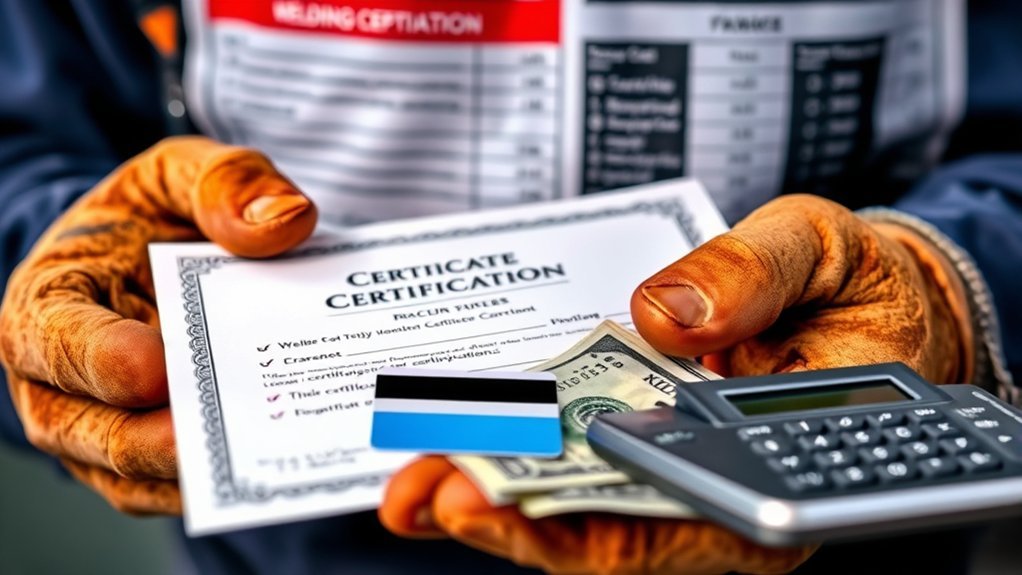
A few payment options can make the cost more manageable:
- Upfront Payments: Full payment is due with your application. Non-online submissions include a $60 non-refundable fee.
- Payment Plans: Many schools offer flexible plans so you can spread costs over time.
- Membership Benefits: A 1-year AWS Individual Membership can get you discounted rates on certification tests, which normally run $300 to $550.
- Additional Fees: Watch for extra costs tied to practical exams or retesting, which vary by certification code and testing facility.
Financial Aid and Scholarships for Welding Certifications
The cost of certification doesn’t have to come entirely out of pocket. Several forms of financial aid and scholarships are worth looking into.
Federal grants and low-interest loans are available to eligible students. Veterans and their dependents may qualify for significant support through the GI Bill®, which can cover welding training costs. Some welding schools, like MTI, offer dedicated scholarship opportunities for high school seniors entering the field.
Annual welding competitions often award scholarships too, giving you a chance to earn funding while demonstrating your skills. The American Welding Society also runs external scholarship programs that can help offset certification costs.
Products Worth Considering

🧲 Sticks to Toolboxes & Welders – Heavy-duty magnetic welding chart adheres to metal surfaces like your welding table, toolbox, or wall for instant reference while working.

Richard Finch, Welder's Handbook: A Complete Guide to MIG, TIG, Arc & Oxyacetylene Welding, "Completely Revised and Updated Edition!" paperback

Used Book in Good Condition
Frequently Asked Questions
How Long Do Welding Certification Courses Typically Take?
Welding certification courses range from a few weeks to several months, depending on the program. You’ll cover both hands-on practice and theory to build the skills each credential requires.
Are Online Welding Certification Programs Available?
Yes, online training and exam-prep programs exist and offer real flexibility. That said, the hands-on performance tests for official certification still need to be completed in person at an approved school or testing facility.
What Is the Validity Period of Welding Certifications?
Many welding certifications stay valid as long as you weld regularly in that process without a break longer than six months. Some credentials, like certain inspector certifications, are issued for a set period (often three years) and require renewal. Check the specific rules of your certifying organization to stay current.
Can I Transfer My Welding Certification to Another State?
There’s no universal transfer system, but widely recognized credentials like AWS or ASME qualifications are generally accepted across states. Each employer or state agency may have its own requirements, and some projects or jurisdictions may still ask for additional testing or local verification.
Do I Need Previous Experience to Enroll in Certification Courses?
No prior experience is required to enroll. That said, having some background knowledge can help you get more out of the program and put you in a stronger position for job opportunities once you’re certified.
Conclusion
Getting certified is one of the more direct paths to better job prospects and higher pay in welding. Costs vary, but understanding the full picture — test fees, training, equipment, and potential retesting — puts you in control of your budget. With payment plans, membership discounts, and financial aid programs available, there are real ways to manage the expense. It’s a worthwhile investment in a career with strong long-term demand.
