You rely on a multimeter to diagnose charging systems, check batteries, test fuses, and trace electrical faults quickly and safely. Choosing the right meter matters because DC accuracy, safety ratings, measurement functions, and durability determine how useful the tool will be for the jobs you actually perform. This guide compares dependable options ranging from a rugged professional meter to an inexpensive tester for occasional DIY automotive checks.
Affiliate Disclosure: As an Amazon Associate I earn from qualifying purchases. This article contains affiliate links, and we may earn a commission if you purchase through them at no extra cost to you.
Quick Verdict
Fluke 87V MAX: Best for professionals who want a rugged, weather-resistant meter with advanced measurement capability.
Fluke 179 Kit: Best for technicians who want a versatile True-RMS multimeter plus an AC clamp meter and temperature probe in one service package.
Klein MM400: Best value for electricians and experienced DIYers who want auto-ranging plus temperature, capacitance, frequency, and duty-cycle measurements.
AstroAI AM33D: Best for basic battery-voltage, fuse, continuity, resistance, and simple low-voltage troubleshooting on a smaller budget.
Top Picks
|
Category |
Product |
Why It Fits |
|---|---|---|
|
🏆 Best Heavy Duty |
IP67 construction, True-RMS capability, advanced measurements, and rugged field durability. |
|
|
💼 Best Service Kit |
True-RMS multimeter, AC clamp meter, temperature probe, leads, and clips in one professional kit. |
|
|
🎯 Best Value for Electricians |
Auto-ranging with a broad measurement set for automotive, residential, and light-industrial troubleshooting. |
|
|
💰 Best Budget |
A straightforward manual-ranging meter for basic voltage, resistance, continuity, and DC-current checks. |
Selection Criteria
For automotive work, start with the measurements you will actually use. Reliable DC voltage measurement is important for checking batteries and charging voltage, while resistance and continuity functions help with fuses, wiring, switches, and basic circuit troubleshooting. Current measurement can also be useful, but you must understand whether a meter measures AC current, DC current, or both and follow its input limits carefully.
True-RMS becomes more valuable when you are measuring AC or non-sinusoidal electrical signals. It is an advantage on the Fluke professional meters, but it is not required for every routine 12-volt battery or charging-system voltage check.
Safety category ratings, fused current inputs, lead quality, drop protection, and environmental protection matter more as the work becomes more demanding. Practical features such as auto-ranging, temperature, frequency, capacitance, Min/Max recording, and clamp measurements can also reduce the number of separate tools you need.
Before You Buy
- Confirm whether you need basic DC automotive measurements or advanced AC/industrial functions.
- Check whether current measurement is AC, DC, or both.
- Choose a CAT rating appropriate for the electrical environment in which the meter will be used.
- Check whether temperature probes, clamps, clips, cases, or specialty leads are actually included.
- For frequent outdoor or harsh-jobsite use, consider ingress and drop protection.
Fluke 87V MAX

Best For: Professional technicians, demanding workshops, and field users who prioritize rugged construction and advanced diagnostic capability.
You get a worksite-ready multimeter designed for demanding environments. The Fluke 87V MAX combines True-RMS AC measurements with IP67 protection and a rugged housing, making it particularly attractive when your meter will face dust, moisture, drops, or regular field use.
It measures AC and DC voltage, AC and DC current, resistance, frequency, capacitance, continuity, and temperature. Its broader feature set also makes it more suitable than a basic meter when you need to investigate changing signals or capture intermittent electrical behavior.
What People Say
Buyer feedback summarized for this roundup generally emphasizes the meter’s rugged construction, dependable measurements, and professional feel. Its biggest drawback is simple: it offers far more capability than many occasional DIY users need, so buyers should choose it for durability and advanced diagnostics rather than basic battery checks alone.
Overall Sentiment: Positive

Versatility
This meter covers battery and charging-voltage checks, continuity and wiring diagnostics, temperature measurements, AC troubleshooting, frequency measurements, and many industrial electrical tasks. That range makes it useful when your work extends beyond basic vehicle maintenance.
Problem Solving
Min/Max recording, temperature measurement, True-RMS AC capability, and a wide measurement range can help when troubleshooting intermittent faults or electrically noisy equipment. For automotive work, use only the measurement procedures appropriate to the vehicle system and follow the vehicle service information when checking sensitive electronics.
Why You’ll Like It
- IP67 construction suits harsh or wet working environments
- True-RMS capability improves AC measurements on non-linear signals
- Measures AC/DC voltage and current plus resistance, frequency, capacitance, and temperature
- Rugged construction is designed for demanding professional use
Who Should Avoid It?
If your main jobs are occasional battery-voltage checks, fuse testing, and continuity checks, a simpler meter can provide the functions you need without paying for advanced capabilities you may rarely use.
Check Product Details on Amazon
AstroAI AM33D
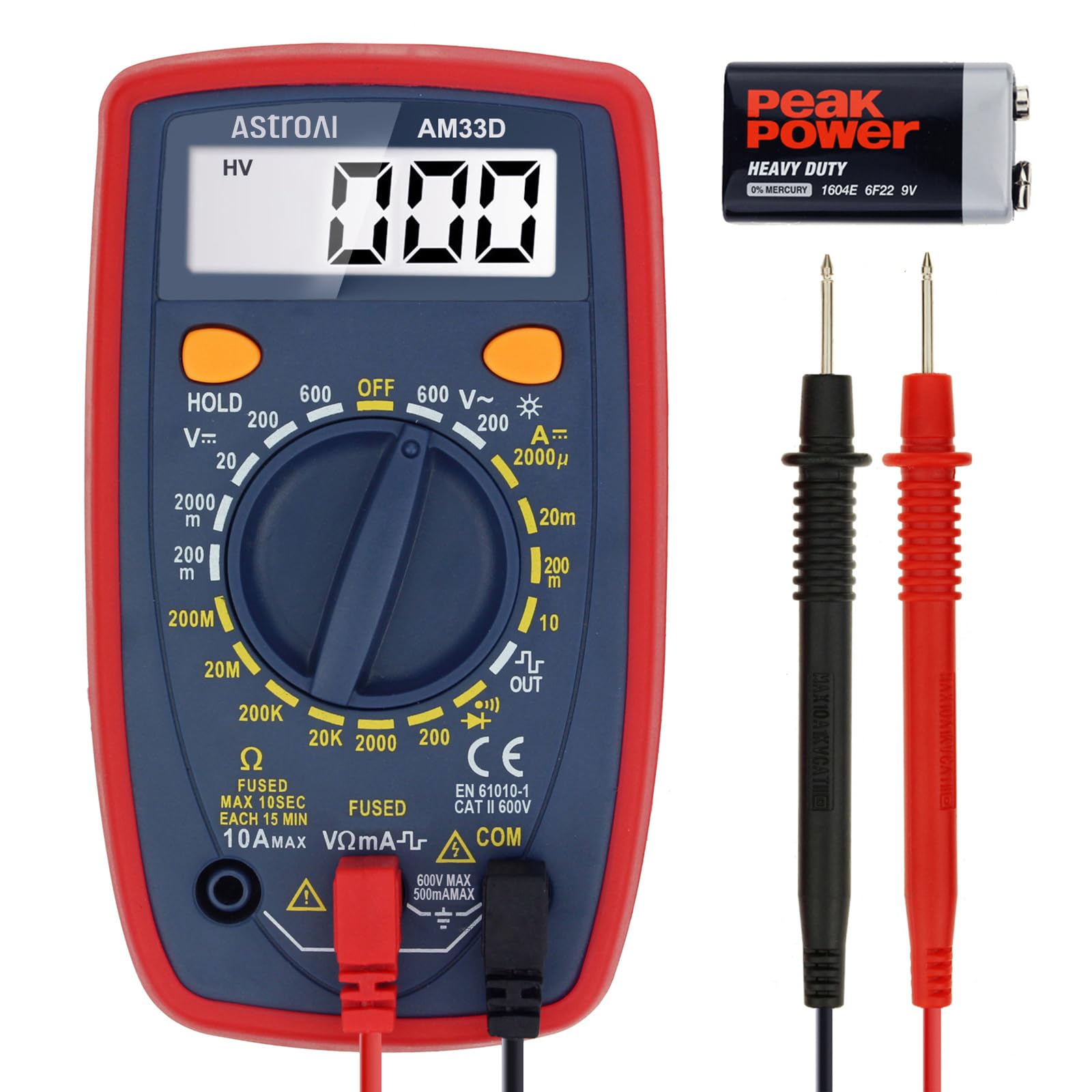
Best For: Beginners and occasional DIY users who mainly need basic automotive and household electrical checks.
You get a compact 2000-count manual-ranging tester that covers essential measurements without the complexity of a professional instrument. It measures AC/DC voltage, DC current, resistance, continuity, and diodes, making it suitable for many first-pass checks around a vehicle.
Its limitations are important. The AM33D is manual-ranging, does not measure AC current, and does not provide advanced functions such as temperature, frequency, capacitance, or True-RMS measurement. For a dead-battery check, fuse test, continuity check, or simple wiring diagnosis, however, that basic feature set may be all you need.
What People Say
Buyer feedback summarized for this roundup generally highlights the meter’s simplicity and usefulness for everyday measurements. Its strongest appeal is basic functionality in a compact format, while experienced technicians may quickly outgrow its manual ranging and limited measurement set.
Overall Sentiment: Positive

Versatility
It works for routine vehicle voltage checks, basic fuse and wiring diagnosis, continuity testing, resistance measurement, and simple household troubleshooting. It is best viewed as an entry-level meter rather than a substitute for a professional diagnostic instrument.
Problem Solving
For a no-start or electrical issue, the AM33D can help you determine whether battery voltage is low, whether a fuse has continuity, or whether a basic circuit has an obvious open connection. Its straightforward feature set keeps simple diagnostic jobs manageable.
Why You’ll Like It
- Compact 2000-count design is easy to store in a toolbox or vehicle
- Measures AC/DC voltage for common voltage checks
- Measures DC current, resistance, continuity, and diodes
- Manual controls keep the feature set straightforward for basic troubleshooting
Who Should Avoid It?
Choose a more advanced model if you specifically need auto-ranging, True-RMS measurements, AC current measurement, temperature, capacitance, frequency, or professional jobsite durability.
Check Product Details on Amazon
Klein MM400
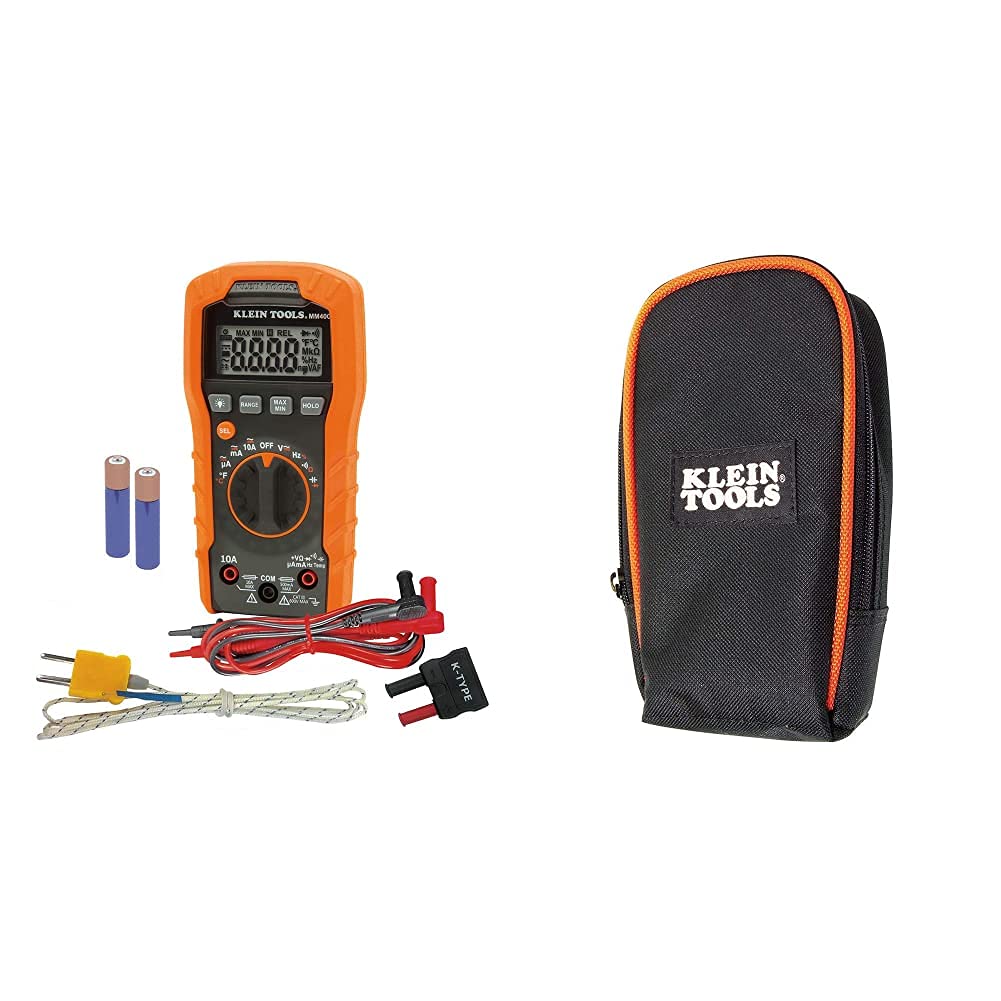
Best For: Electricians, experienced DIYers, and automotive users who want more functions than a basic meter without moving to a premium industrial model.
The MM400 is an auto-ranging multimeter that measures up to 600V AC/DC voltage, 10A AC/DC current, and 40 MΩ resistance. It also measures temperature, capacitance, frequency, and duty cycle and tests diodes and continuity.
That combination gives you substantially more diagnostic flexibility than an entry-level meter while keeping the interface relatively straightforward. It is CAT III 600V rated and is built to withstand a 3.3-foot (1 m) drop.
What People Say
Buyer feedback summarized for this roundup generally emphasizes the practical feature set and approachable controls. Its broad range of functions makes it attractive for users who move between automotive wiring, household electrical work, and general troubleshooting.
Overall Sentiment: Positive

Versatility
You can use it for vehicle electrical work, voltage and current measurements, temperature checks, continuity testing, frequency measurements, capacitance checks, and many residential or light-industrial troubleshooting jobs.
Problem Solving
Auto-ranging reduces the amount of manual range selection needed during troubleshooting. Temperature, frequency, and duty-cycle functions also give experienced users additional ways to investigate electrical and sensor-related problems when those measurements are appropriate.
Why You’ll Like It
- Auto-ranging simplifies routine measurements
- Measures AC/DC voltage and AC/DC current
- Includes temperature, capacitance, frequency, duty-cycle, diode, and continuity functions
- CAT III 600V rating and jobsite-oriented construction
Who Should Avoid It?
If you specifically need True-RMS AC measurement, IP67 environmental protection, or the extra ruggedness of a premium industrial meter, consider the Fluke 87V MAX instead.
Check Product Details on Amazon
Fluke 179 Kit

Best For: Service technicians who want a professional True-RMS multimeter, temperature measurement, and an AC clamp meter together.
The Fluke 179 IMSK combines the Fluke 179 True-RMS digital multimeter with the Fluke 323 True-RMS clamp meter, temperature probe, test leads, and alligator clips. The 179 measures AC/DC voltage, AC/DC current, resistance, capacitance, frequency, continuity, diodes, and temperature.
The included Fluke 323 clamp is useful for AC current measurements up to 400A, but it is important to understand that the 323 does not measure DC current through its clamp. That means you should not buy this kit expecting the clamp itself to perform typical DC automotive alternator-output or parasitic-draw measurements.
What People Say
Buyer feedback summarized for this roundup generally highlights the convenience of combining a professional multimeter, clamp meter, temperature capability, and accessories in one package. The main buying consideration is whether you will actually benefit from the AC-only current clamp.
Overall Sentiment: Positive

Versatility
The Fluke 179 itself covers a broad range of electrical and electronic troubleshooting tasks, including AC/DC voltage, AC/DC current through the meter’s appropriate inputs, resistance, frequency, capacitance, continuity, and temperature. The 323 adds convenient non-contact AC current measurement for suitable electrical circuits.
Problem Solving
This kit can reduce the need to purchase separate instruments when your work includes both general electrical troubleshooting and AC clamp-current measurements. For vehicle DC-current diagnostics, however, use a measurement method and instrument specifically designed for the required DC current range.
Why You’ll Like It
- Fluke 179 provides True-RMS AC measurements and a broad diagnostic feature set
- Fluke 323 adds clamp measurement of AC current up to 400A
- Temperature probe supports thermal troubleshooting
- Kit includes test leads and alligator clips for service work
Who Should Avoid It?
If your main goal is measuring automotive DC current with a clamp, the included Fluke 323 is not the right clamp for that task because its clamp-current function is AC-only.
Check Product Details on Amazon
FAQ
What Should I Look For in an Automotive Multimeter?
Start with accurate DC voltage measurement for batteries and charging systems, resistance and continuity for wiring and fuses, and a safety rating appropriate to the environments in which you will use the meter. Auto-ranging can make troubleshooting faster, while temperature, frequency, capacitance, and True-RMS AC functions become more useful for advanced work.
Also check current-measurement capability carefully. Some meters measure AC and DC current through test leads, while some clamp meters measure only AC current. Never assume a clamp can measure automotive DC current unless its specifications explicitly say so.
How Do I Test a Car Battery and Alternator?
For a basic battery-voltage check, set the meter to the correct DC-voltage function and measure across the battery terminals while following the meter and vehicle manufacturer’s procedures. Charging-system voltage can also be checked with the engine running, but the acceptable values and diagnostic steps depend on the vehicle and charging-system design.
If you are investigating alternator ripple or more complex charging problems, follow the vehicle service procedure and use a meter with the appropriate AC measurement capability. Do not rely on a single universal voltage number for every vehicle.
Do I Need a True-RMS Multimeter for Car Repair?
Not for every task. Basic battery-voltage, charging-voltage, resistance, and continuity checks can be performed with a suitable conventional digital multimeter. True-RMS is most valuable when accurately measuring AC or non-sinusoidal signals and becomes more important as your diagnostic work grows more advanced.
Can Every Clamp Meter Measure Automotive DC Current?
No. Clamp meters may measure AC current, DC current, or both depending on their design. For example, the Fluke 323 included with the Fluke 179 service kit measures AC current through its clamp but does not provide DC clamp-current measurement.
Are There Common Safety Mistakes To Avoid?
Yes. Do not measure resistance or continuity on an energized circuit. Before measuring current, verify that the leads are connected to the correct meter jacks and that the expected current is within the meter, input, fuse, and lead ratings.
Inspect the meter and leads for damage before use, select the correct function before connecting to the circuit, and follow both the meter instructions and the vehicle or equipment service information. A multimeter is only one part of a safe diagnostic workflow.
Safety Note
High-current measurements require particular care. Never place a conventional meter’s current input directly across a battery or other voltage source. Use the correct measurement method and equipment for the expected current, and consult qualified service information when you are unsure.
Customer Preferences
Your best choice depends more on the job than on the number of functions printed on the meter. Choose the Fluke 87V MAX when ruggedness and advanced professional capability matter most. Choose the Fluke 179 Kit when you want a professional multimeter plus an AC clamp meter and temperature accessories in one package.
The Klein MM400 is a strong middle-ground option for users who want auto-ranging and a broad feature set without moving to the most rugged premium tier. The AstroAI AM33D makes more sense when your needs are limited to basic voltage, resistance, continuity, diode, and DC-current checks.
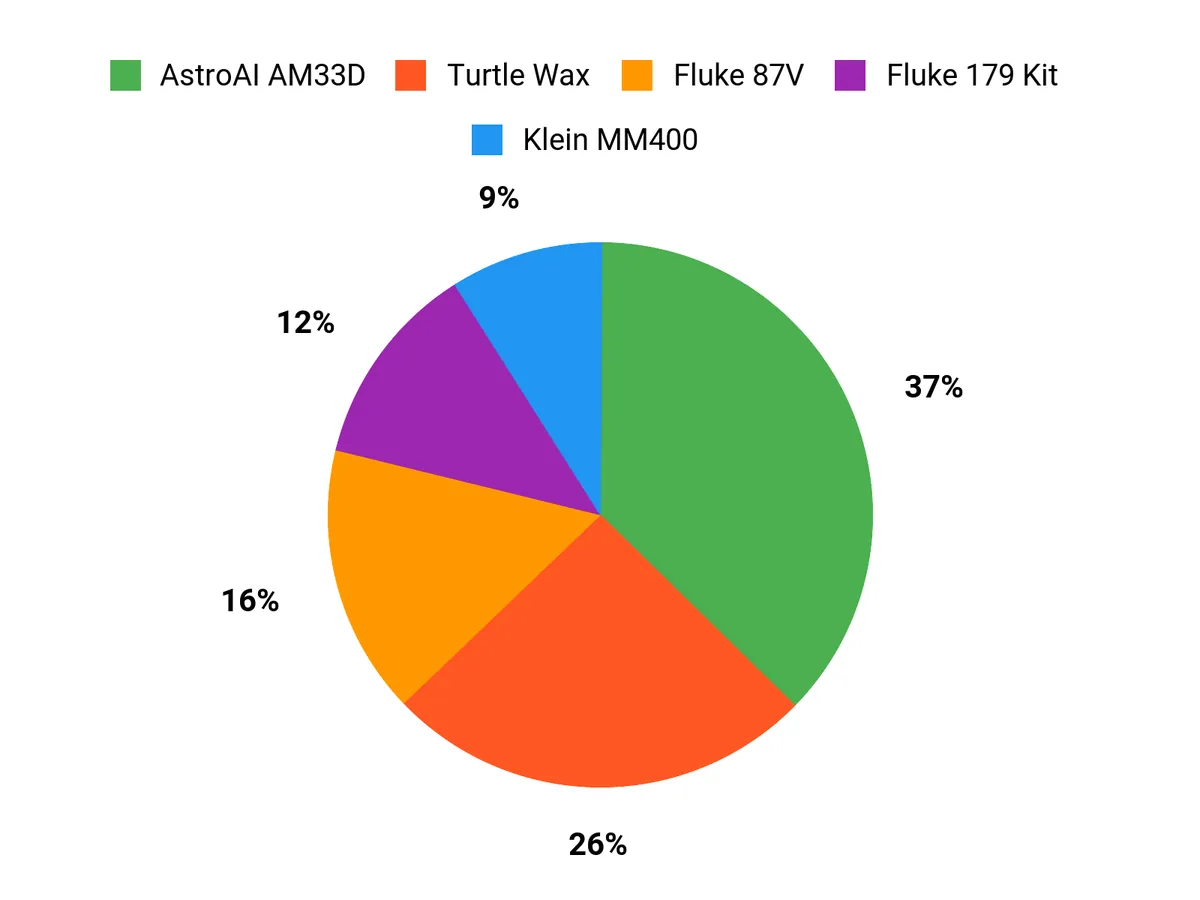
Wrapping Up
If you work in demanding environments or need a meter that can handle both automotive diagnostics and broader professional electrical work, the Fluke 87V MAX is the strongest heavy-duty choice in this group. Its rugged construction and broad measurement capabilities make the most sense when the meter will be used frequently.
The Fluke 179 Kit gives technicians a capable True-RMS DMM together with temperature accessories and a Fluke 323 AC clamp meter. Just remember that the included clamp is for AC current rather than DC clamp-current measurements.
The Klein MM400 offers a useful balance of auto-ranging, AC/DC voltage and current, temperature, capacitance, frequency, duty cycle, and continuity functions. For occasional battery, fuse, and wiring checks, the simpler AstroAI AM33D covers the fundamentals without loading the meter with advanced features you may never use.
The best choice is the meter whose measurement capability, safety rating, and durability match your actual work—not simply the model with the longest specification list.
| Fluke 87V MAX True-RMS Digital Multimeter | AstroAI Digital Multimeter Tester 2000 Counts | Klein Tools MM400 Multimeter | Fluke 179 Industrial Multimeter Service Kit | |
|---|---|---|---|---|
| Product Image |
|
|
|
|
| Best For | Heavy-duty professional use | Basic DIY automotive checks | Electricians and advanced DIY | Professional service kit |
| Ranging | Automatic and manual functions | Manual | Auto-ranging | Automatic and manual ranging |
| Voltage | Up to 1000V AC/DC | AC/DC voltage measurement | Up to 600V AC/DC | 179: Up to 1000V AC/DC |
| Current Capability | AC/DC current through meter inputs within rated limits | DC current only | Up to 10A AC/DC through meter inputs | 179 measures AC/DC current; 323 clamp measures AC current up to 400A |
| True-RMS | Yes, for AC measurements | No | No | Yes, Fluke 179 and Fluke 323 AC measurements |
| Safety Rating | CAT III 1000V / CAT IV 600V | CAT II 600V / CAT III 300V | CAT III 600V | 179: CAT III 1000V / CAT IV 600V; 323: CAT III 600V / CAT IV 300V |
| Notable Features | IP67, temperature, frequency, capacitance, Min/Max, rugged construction | 2000 counts, resistance, continuity, diode testing | Temperature, capacitance, frequency, duty cycle, diode and continuity | Temperature probe, True-RMS DMM, AC clamp meter, test leads and alligator clips |
| Check Price on Amazon | Check Price on Amazon | Check Price on Amazon | Check Price on Amazon |
Disclosure: As an Amazon Associate I earn from qualifying purchases. Affiliate links may generate a commission for us at no additional cost to you.