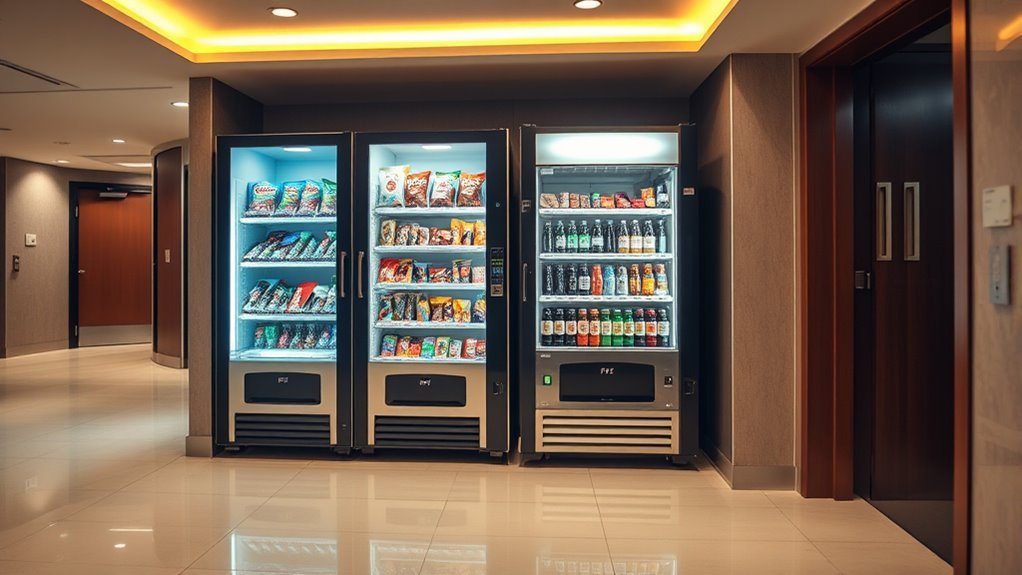
Last Updated: July 2026 | Reviewed by Hospitality Operations Specialist
In 2026, purchasing a new hotel vending machine typically costs between $3,800 and $8,600, while professionally remanufactured units range from $3,250 to $4,950. However, total installed cost depends heavily on payment hardware, telemetry subscriptions, site preparation, and whether the hotel buys equipment directly or partners with a third-party vending operator under a revenue-share model.
Quick Answer
Current U.S. dealer listings place standard new snack, drink, and combination vending machines between about $3,800 and $8,600. Professionally remanufactured models cost $3,250 to $4,950. Adding cashless readers ($300–$500), delivery/freight ($300–$800), dedicated electrical work ($200–$600), and initial inventory ($400–$800) brings the complete initial investment for a hotel-owned unit to $5,000–$11,000 per machine.
Key Takeaways
- A machine’s base purchase price accounts for only 60%–70% of total year-one setup and operating expenses.
- Hotel-owned equipment yields 100% of net profits but requires staffing for stocking and repairs; operator-managed programs eliminate capital expenditure in exchange for a 10%–25% revenue commission.
- Cashless payment and telemetry boost sales by 25%–40%, but incur monthly connection fees ($10–$15/machine) plus processing fees (5%–6%).
- Target machine density is roughly 1 combination machine per 50–75 guest rooms in properties without 24/7 pantry markets.
- Accessibility (ADA reach range), calorie labeling (20+ units), electrical circuits, and contract termination rules must be verified prior to installation.
How Much Does a Hotel Vending Machine Cost in 2026?
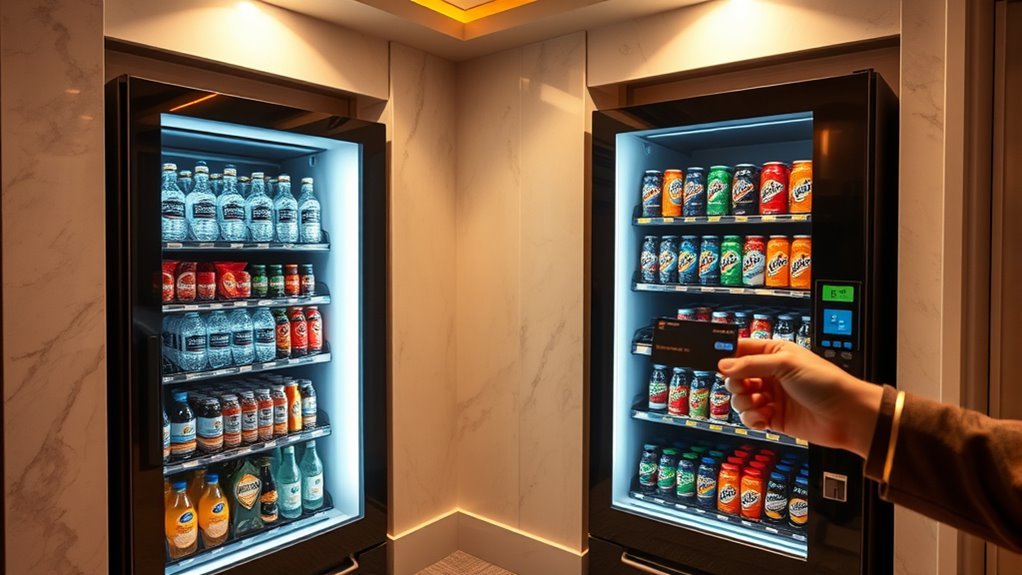
Equipment pricing varies based on capacity, internal refrigeration, touch-screen interfaces, payment hardware, and warranty coverage. The most practical benchmark is derived from active baseline commercial dealer listings.
As of mid-2026, commercial catalog listings illustrate standard price ranges across major machine categories:
| Machine category | Current listed examples | Typical hotel use |
|---|---|---|
| New snack machine | About $3,849–$7,758 | Packaged snacks, candy, pastries, and travel essentials |
| New cold-drink machine | About $5,690–$8,242 | Water, soft drinks, juice, and energy drinks |
| New snack-and-drink combo | About $5,343–$8,553 | Hotels needing both categories in one compact footprint |
| AI smart cooler | About $3,449–$8,000 | Flexible product layouts, grab-and-go meals, and cashless checkout |
| Hot-drink or coffee machine | About $4,500–$9,646 | Lobbies, meeting spaces, and espresso/hot beverage service |
| Professionally remanufactured machine | About $3,250–$4,930 | Lower purchase cost with core system testing and limited warranty |
Note: Advertised prices usually omit sales tax, card reader hardware ($300–$500), monthly telemetry subscriptions ($10–$15), custom graphics wraps ($250–$500), initial wholesale stock ($400–$800), freight ($300–$600), and white-glove inside delivery ($150–$350).
The correct budget is the complete installed and operating cost, not merely the machine’s online purchase price.
Choose the Ownership Model Before Comparing Prices
Hotels do not always need to buy vending equipment directly. The chosen financial model dictates capital expenditure, labor requirements, maintenance risk, and profit retention.
| Model | Who owns the machine? | Hotel responsibility | Main tradeoff |
|---|---|---|---|
| Hotel-owned | The hotel | Purchasing, stocking, pricing, maintenance, refunds, accounting, and compliance | 100% revenue retention and complete product control, but full labor and repair liability |
| Financed or leased | Lender / Lease company | Monthly lease payments ($100–$250/mo) plus full daily operational management | Spreads capital cost over 36–60 months, but increases long-term total equipment expense |
| Operator-managed | Third-party vending operator | Providing dedicated floor space, electricity, facility access, and contract oversight | Zero capital outlay and zero maintenance hassle, but hotel receives only a 10%–25% commission share |
ENERGY STAR’s vending-machine guidance notes that full-service operators commonly furnish equipment and service under multiyear contracts. Hotels opting for this model should negotiate strict service response windows, minimum product quality standards, and transparent commission auditing terms.
Key Factors Influencing Hotel Vending Machine Pricing
Every commercial quote should be evaluated across these crucial cost drivers:
- Capacity and machine density: Standard hotel units hold 300 to 600 items. Plan for approximately 1 combination machine per 50–75 rooms if no central market exists.
- Refrigeration systems: Fully refrigerated drink or fresh food machines require sealed compressors and cost $1,500–$2,500 more than ambient snack units.
- Payment hardware: Modern guest expectations require multi-option bezels handling contactless credit cards, Apple Pay, Google Pay, and cash. Integrated readers add $300–$500 per unit.
- Telemetry & cellular connection: Remote management boards report inventory levels and faults real-time. Expect a recurring cellular connectivity charge of $10–$15/month per machine.
- Guaranteed drop sensors: Infrared laser sensors verify that a product falls into the bin before settling payment, reducing guest refund requests at the front desk by over 90%.
- ADA compliance design: Lower operable controls (15 to 48 inches reach range) and one-handed delivery flap operation ensure legal compliance without retrofitting costs.
- Warranty coverage: Standard quotes include 1–2 years on parts; confirm whether compressor/refrigeration loops carry 5-year extended protection and whether labor/travel fees are included.
- Freight and white-glove placement: Commercial units weigh 600–850 lbs. Standard curbside freight drops at the loading dock; “inside delivery” to an upper guest floor adds $200–$400.
Breakdown of Vending Machine Types for Hotels
Select equipment based on property layout, guest demographic, available square footage, and electrical infrastructure.
| Type | Best use | Advantages | Watch for |
|---|---|---|---|
| Snack vending machine | Dry packaged food, candy, and travel toiletries | Lower power draw, ambient temp, highly flexible coil sizing | Proper coil pitch for bulky travel items to prevent jams |
| Drink vending machine | High-volume bottled water, sodas, and sports beverages | High beverage capacity and strong profit margins on water | Higher continuous electricity draw and compressor maintenance |
| Combo vending machine | Guest floors or properties with space for only one unit | Snacks and cold drinks served from a single footprint | Lower overall capacity per product category vs. two standalone units |
| Coffee or hot-drink machine | Lobbies, meeting foyers, and early-morning departure areas | High price-per-cup potential and strong guest satisfaction | Requires dedicated plumbing line, daily cleaning, and sanitation checks |
| Smart cooler | Boutique hotels or open lobbies wanting premium grab-and-go | Unrestricted shelf sizing for fresh salads, sandwiches, and premium drinks | Monthly platform software fees and shrinkage/theft monitoring requirements |
| Micro market | Properties with 120+ rooms and secure, monitored lobby space | Highest average order value and extensive retail product variety | Higher upfront capital ($12,000–$25,000) and security camera integration |
Essential Hidden Costs for Installing Hotel Vending Machines
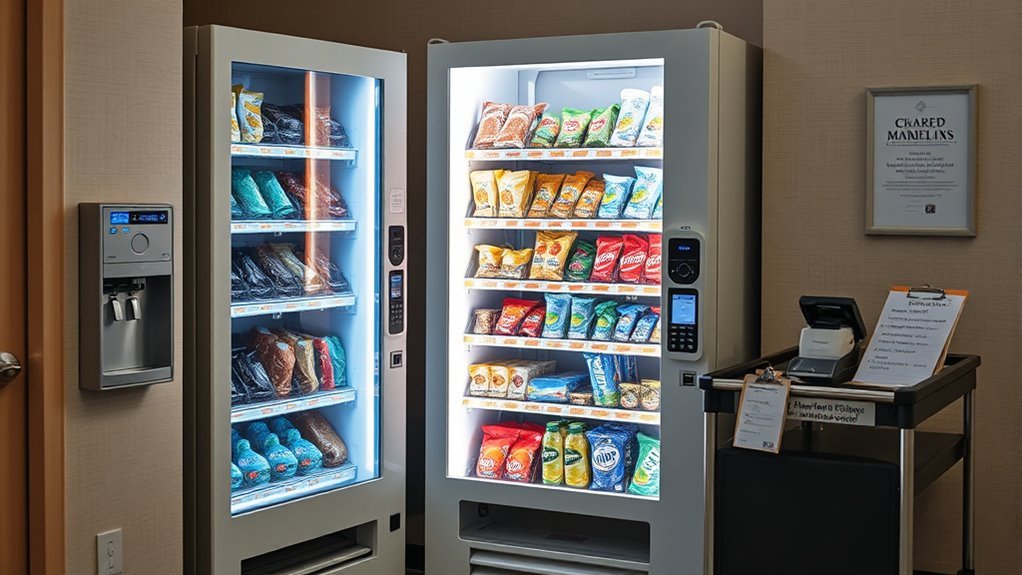
When creating an operational budget, look beyond base equipment costs. Account for these essential line items:
- Initial inventory investment: Stocking a full combination machine costs roughly $400 to $800 at wholesale prices.
- Freight & lift-gate service: Commercial shipping averages $300–$600 depending on distance and carrier fuel surcharges.
- Inside white-glove delivery: Navigating elevators, narrow corridors, or doorways costs $150–$350 in specialized rigging labor.
- Dedicated electrical work: Installing a dedicated NEMA 5-15R, 115V/20A grounded outlet costs $200–$600 per drop if electrical work is needed.
- Payment gateway and processing fees: Credit/debit card transactions incur 5% to 6% in total fees (combining gateway per-transaction fees and merchant interchange).
- Cellular telemetry subscriptions: Remote inventory tracking platforms (e.g., Nayax, Cantaloupe) cost $10 to $15 per month per reader.
- Electricity consumption: Refrigerated drink machines draw 300 to 500 kWh monthly, adding roughly $35–$60 per month to utility bills depending on local commercial rates.
- Property & liability insurance: Commercial policy riders covering equipment damage, theft, and food product liability add $100–$250 annually.
- Routine maintenance reserve: Budget $250–$400 annually per unit for coin mechanism recalibration, door seal replacements, bill acceptor updates, and cooling coil cleaning.
- Internal staffing labor: Factor in 2 to 4 hours per week per machine for inventory purchasing, restocking, price updates, cash drops, and front-desk refund reconciliation.
- Product spoilage and shrinkage: Allocate 3% to 5% of gross revenues to cover expired products, damaged packaging, or misvends.
Warning: Never sign an operator revenue-share contract until it defines explicit calculations for “gross sales.” Ensure commissions are calculated before card processing deductions, sales tax subtractions, or administrative service fees.
Choosing Between New and Used Hotel Vending Machines
New machines offer current payment architecture, full factory warranties, lower energy consumption, and high reliability. Remanufactured units reduce initial cash outlay but require strict vetting.
Cost Considerations
Evaluate overall life-cycle economics rather than sticker price alone:
- Base machine price and state sales tax
- Freight, lift-gate, and final placement fees
- MDB (Multi-Drop Bus) compatibility for modern cashless card readers
- Telemetry software and processing rates
- Initial inventory loading
- Warranty length (parts vs. labor coverage)
- Expected repair frequency and technician travel charges
- Annual electrical energy efficiency ratings
Current dealer listings for professionally remanufactured machines show baseline ranges of $3,250 to $4,950. Avoid unvetted “as-is” secondary-market units that lack modern MDB control boards or factory cooling tests.
Reliability and Upgrades
Perform a thorough physical and operational audit before taking delivery of used equipment:
- Verify MDB protocol support (version 3.0 or higher) to guarantee compatibility with current credit card and mobile payment devices.
- Inspect refrigeration compressors, condenser coils, fans, and door gaskets for wear, frost buildup, or refrigerant leaks.
- Test all drop sensors, motor coils, bill validators, coin mechanisms, and keypad responses using actual hotel inventory samples.
- Check cabinet condition for rust, structural frame damage, cracked interior shelves, or lock tampering.
- Confirm parts availability for the specific make and model through major U.S. commercial vending distributors.
- Review warranty terms in writing: ensure coverage includes refrigeration components for at least 90 days to 1 year.
Pro Tip: Pre-test every coil with your actual guest inventory prior to floor deployment. Bottled juices, energy drinks, wide chip bags, and boxed travel toiletries require specific coil pitches and drop shims to prevent product hangs.
Installation, Accessibility, and Compliance
Ensuring compliance with federal ADA accessibility standards, electrical codes, and food disclosure regulations prevents costly post-installation penalties.
Accessibility (ADA Compliance)
The U.S. Access Board ADA Standards govern physical placement and operable controls:
- Reach range: All operable parts (card reader, coin slot, keypad, selection buttons, and delivery flap) must be between 15 inches minimum and 48 inches maximum above the finished floor.
- Clear floor space: Provide a clear, level floor space of at least 30 inches by 48 inches positioning a forward or parallel approach for wheelchair users.
- Operable controls: Controls must be usable with one hand without tight grasping, pinching, or twisting of the wrist, requiring no more than 5 lbs of force.
- Corridor clearance: Ensure open machine doors or guest approaches do not encroach upon required emergency egress corridor widths.
Food and Calorie Labeling
The FDA Vending Machine Labeling Rule requires operators who own or operate 20 or more vending machines to display clear calorie declarations for packaged foods. Hotel operators managing fewer than 20 units are exempt federally, but should verify municipal or state public health display rules.
Electrical and Energy Requirements
Standard commercial vending machines require a standard dedicated 115V AC, 60 Hz, 15A or 20A circuit with a grounded NEMA 5-15R receptacle. Avoid using extension cords or ungrounded adapters.
When selecting refrigerated units, review ENERGY STAR vending criteria. Certified models utilize low-power eco-modes, LED illumination, and efficient compressors that reduce standby electricity consumption by up to 30%–40%.
Understanding Revenue Potential From Hotel Vending Machines
Vending earnings vary dramatically depending on occupancy rates, guest demographics, pricing power, and placement visibility.
Industry data from NAMA’s convenience services census indicates robust consumer demand for automated retail. However, hotel revenue models must be calculated using property-specific operational inputs.
Occupancy, guest conversion rate, item pricing, and uptime drive monthly profits far more than generic industry averages.
Estimate Monthly Gross Sales
Apply this property baseline formula:
Example Scenario: A 150-room midscale hotel operating at 70% average monthly occupancy:
- 150 rooms × 70% occupancy × 30 days = 3,150 occupied room-nights
- 3,150 room-nights × 6% capture rate = 189 purchasing room-nights
- 189 purchasers × 1.4 items = ~265 items sold monthly
- 265 items × $2.50 average price = $662.50 monthly gross revenue
Calculate Net Operating Contribution
Subtract operating costs to determine actual monthly profit retention:
Using the $662.50 gross revenue example above:
- Gross Sales: $662.50
- Cost of Goods Sold (40% average wholesale cost): -$265.00
- Payment & Gateway Fees (5.5%): -$36.44
- Cellular Telemetry Fee: -$12.00
- Estimated Electricity Draw: -$40.00
- Spoilage & Refund Reserve (3%): -$19.88
- Net Monthly Operating Contribution: ~$289.18
If initial installed equipment costs totaled $6,500, simple capital payback is achieved in approximately 22.5 months ($6,500 ÷ $289.18/mo).
How to Finance Your Hotel’s Vending Machines
Evaluate the three standard funding mechanisms based on available capital and internal maintenance labor:
| Option | Best suited to | Critical questions to ask |
|---|---|---|
| Outright capital purchase | Hotels with available reserve capital and staff to stock/service machines | What warranty parts/labor is included, and what are local technician service call rates? |
| Equipment lease/financing | Properties preserving cash flow while retaining operational control | What is the APR, lease term (36–60 mo), documentation fee, and $1 buyout terms? |
| Full-service operator agreement | Hotels seeking zero upfront capital spend and zero ongoing maintenance labor | What is the commission percentage (10%–25%), restocking frequency, and repair SLA response window? |
When negotiating an operator-managed contract, demand specific Service Level Agreement (SLA) clauses in writing:
- Restocking schedule: Guaranteed 48-hour restocking triggers or automated telemetry alerts when stock falls below 20%.
- Maintenance SLA: Maximum 24-hour response time for technical service calls or refrigeration faults.
- Commission structure: Minimum 15% to 20% gross revenue commission paid monthly or quarterly with detailed itemized sales reports.
- Contract term & cancellation: 12 to 24-month terms with a 30-day performance cure clause for unaddressed machine downtime.
- Product pricing caps: Agreement capping guest retail prices at reasonable local market benchmarks.
Best Practices for Maximizing ROI From Hotel Vending Machines
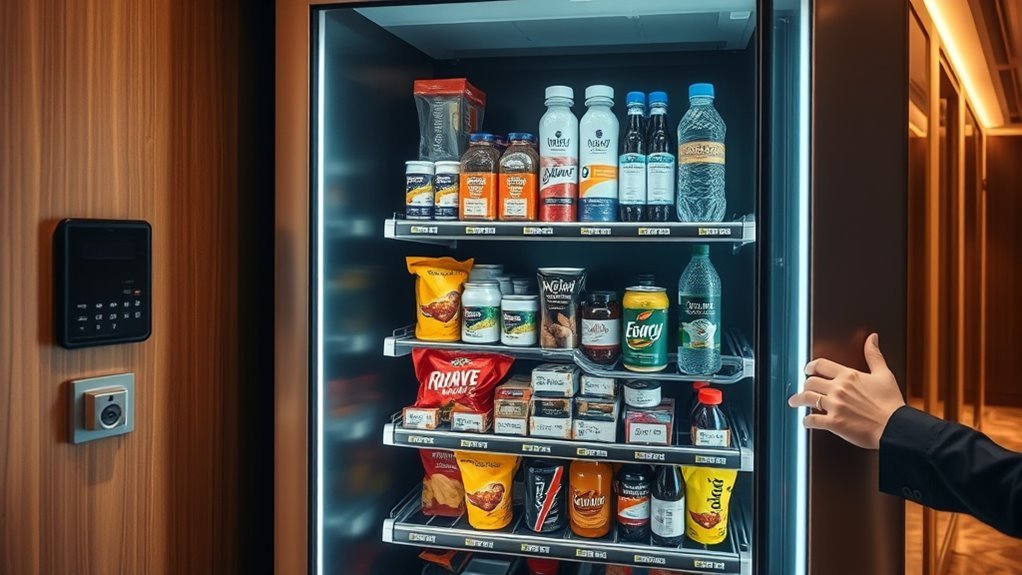
Maximizing revenue requires combining strategic product selection, high-foot-traffic placement, and high equipment uptime.
Product Selection Strategy
Tailor product inventory to specific guest profiles:
- Business travel properties: Bottled water, premium energy drinks, cold brew cans, protein bars, phone chargers, pain relievers, and travel toiletries.
- Family-focused hotels: Fruit juices, familiar snack chips, chocolate packs, kid-friendly sodas, and travel-sized sunscreen.
- Extended-stay locations: Microwavable meal bowls, larger multi-serve beverages, laundry detergent pods, and personal care items.
- Resort & leisure properties: Electrolyte hydration drinks, premium snacks, pool accessories, and high-end bottled waters.
Monitor real-time sales telemetry via vendors like Nayax Telemetry Solutions to track turn rates, stockouts, and gross profit margins per coil.
Optimal Machine Placement
Prime high-conversion hotel placements include:
- High-traffic ground floor lobby alcoves near main guest elevators.
- Central ice/vending bays situated on major guest room floors.
- High-volume amenity zones adjacent to fitness centers, guest laundry rooms, or outdoor pool decks.
- Late-night zones accessible when hotel restaurant or pantry outlets are closed.
Verify that chosen sites feature clear wall space, dedicated 115V electrical outlets, adequate cellular signal strength for payment readers, and unobstructed ADA access routes.
Pro Tip: Conduct a 60-to-90-day single-unit pilot before buying equipment for multiple guest floors. Track actual purchase conversion rates, electricity costs, and restocking labor before expanding fleet size.
Keep the Machine Available
Machine downtime immediately forfeits guest sales and increases front-desk complaints. Establish routine operational checklists:
- Schedule regular inventory replenishment based on automated telemetry reorder thresholds.
- Rotate stock systematically during every reload to clear near-expiry items.
- Sanitize delivery bins, touchscreens, keypads, and bill acceptors weekly.
- Inspect refrigeration condenser coils quarterly to clear dust and maintain energy efficiency.
- Audit front-desk refund logs weekly to identify recurring misvends or bill-validator rejections.
Frequently Asked Questions
How much does a hotel vending machine cost in 2026?
Current U.S. dealer listings place standard new snack, drink, and combination machines between about $3,800 and $8,600. Professionally remanufactured models commonly cost $3,250 to $4,950. Freight, cashless card readers, electrical work, and initial inventory usually add $1,200 to $2,500 in setup costs.
Should a hotel buy a vending machine or use an operator?
Buying equipment gives the hotel 100% profit retention and full product control, but requires staff labor for stocking and repairs. An operator-managed contract requires zero capital investment and zero maintenance labor, but the hotel retains only a negotiated 10% to 25% revenue commission.
What is the average monthly revenue of a hotel vending machine?
Revenue depends heavily on occupancy and placement. A typical 150-room midscale hotel with 70% occupancy averages $500 to $900 in gross monthly sales per primary lobby combination machine, producing roughly $200 to $400 in net monthly operating profit after product and operating costs.
What hidden costs should a hotel include in a vending budget?
Key hidden expenses include freight shipping ($300–$600), white-glove inside delivery ($150–$350), cashless payment hardware ($300–$500), monthly telemetry cellular connections ($10–$15/mo), card processing fees (5%–6%), dedicated electrical drops ($200–$600), and initial product stock ($400–$800).
Is a used vending machine worth buying for a hotel?
A professionally remanufactured machine with modern MDB cashless compatibility, tested cooling, and a written warranty is a sensible value ($3,250–$4,950). Unvetted “as-is” used machines carry significant risk of obsolete control boards, cooling leaks, and lack of credit card reader compatibility.
How many vending machines does a hotel need?
Plan for approximately 1 combination machine per 50 to 75 guest rooms if no central market exists. Start with one high-visibility lobby unit during a 60-to-90-day pilot before deploying additional units to individual guest floors.
Conclusion
Installing a hotel vending machine provides reliable 24/7 guest amenities while generating recurring incremental revenue. In 2026, baseline equipment purchases range from $3,800 to $8,600 for new units and $3,250 to $4,950 for certified remanufactured models. Incorporating setup fees, payment readers, telemetry, and initial stock establishes a realistic turnkey budget of $5,000 to $11,000 per machine.
Before committing capital, weigh the financial control of direct hotel ownership against the zero-capital simplicity of an operator-managed program. Executing a 60-to-90-day single-unit pilot provides the concrete occupancy, turnover, and net contribution data required to guide long-term amenity investments.
Sources
- eVending vending-machine catalog — baseline advertised commercial U.S. equipment prices, accessed mid-2026
- eVending used and remanufactured machines — certified remanufactured equipment examples and warranty structures
- ENERGY STAR vending-machine guidance — operator contract guidelines and energy-efficiency standards
- U.S. Access Board ADA Accessibility Standards — physical reach range, clear floor space, and operable control rules
- FDA vending-machine labeling requirements — federal calorie disclosure regulations for commercial operators
- NAMA convenience services industry census — U.S. convenience services market benchmarks and machine operational data