

You’ll pay $15 for an Illinois resident annual fishing license (ages 16+), $7.75 for a senior, and $31.50 if you’re a non‑resident 16 or older; a new reduced option offers $5 for eligible returning residents and $10 for eligible non‑residents. Licenses run through March 31 and renew starting March 1. Exemptions apply for children under 16, disabled veterans, certain property owners and active military. Continue for details on purchase, renewals and exceptions.
Who Must Hold an Annual Fishing License in Illinois

If you’re 16 or older, you must hold a valid Illinois fishing license to fish in state waters, regardless of whether you’re a resident or non‑resident.
You’re subject to clear fishing license requirements: anyone 16+ needs a license, non‑residents must purchase one, and licenses expire March 31 annually.
Eligibility criteria for exemptions are specific — residents with certain disabilities, active military personnel, and adults fishing with children under 16 may qualify for exemptions.
Non‑residents under 16 and disabled veterans are exempt.
If you own or rent property with flowing water, you can fish that water without a license, but subdivision lake residents are excluded from this exception.
You must present proof of residency when applying for a resident license.
Licenses renew yearly; plan to renew before April 1 to remain compliant.
Follow these rules precisely to avoid fines and guarantee you meet Illinois statutory requirements for legal fishing.
Resident Annual License Rates and Eligibility

When you’re a resident 16 or older, Illinois requires a $15.00 annual fishing license for access to state waters, with proof of residency (30+ days) required at purchase; seniors can get a discounted Senior Fishing License for $7.75 annually, and property owners or tenants with flowing water on their land may fish without a license (subdivision lake residents aren’t eligible). You must carry the license while fishing; those under 16 are exempt. The requirements support compliance with fishing regulations and outline license benefits like statewide access and reduced senior fees.
| Category | Requirement | Benefit |
|---|---|---|
| Resident (16+) | $15.00; 30+ day proof | State waters access |
| Senior | $7.75 | Discounted fee |
| Property with flowing water | No license needed | On-property fishing |
Follow documentation rules at purchase to confirm eligibility. These rates and conditions are precise, data-driven guidance to meet regulatory obligations and maximize license benefits.
Products Worth Considering

Collectible Tag

Showcase your passion for fishing with intricately etched designs
Non‑Resident Annual License Rates and Restrictions

Although you’re not exempt, non‑residents pay $31.50 for an annual Illinois fishing license and must carry it to fish state waters (non‑residents under 16 are exempt).
Non‑residents age 16 and up must buy a $31.50 annual Illinois fishing license and carry it while fishing.
You’ll follow clear non resident requirements: buy the $31.50 annual license, keep proof while fishing, and know that lifetime or combination hunting‑fishing licenses aren’t available to you.
You must also adhere to specific fishing regulations for each waterbody.
- Purchase: $31.50 annual non‑resident license required for ages 16+; carry proof while fishing.
- Exemptions: Non‑resident anglers under 16 may fish without a license.
- Restrictions: No lifetime or combination licenses issued to non‑residents; buy annual only.
- Compliance: Follow Illinois fishing regulations, which include season, size, and creel limits that vary by water.
You’ll minimize citations by carrying your license and reviewing local regulations before each outing.
New Reduced‑Fee Option and Eligibility Criteria

You’ll see the new reduced annual fee is $5 for Illinois residents and $10 for non‑residents, down from $14.50 and $31 respectively.
You qualify if you’re 26 or older and haven’t bought a fishing license in the past 10 years.
You can apply online or at licensed vendors using proof of age and prior license history to receive the reduced rate.
Products Worth Considering

FISHING LICENSE HOLDER W/ZIP CLOSURE

Material :High-Quality Metal Aluminum With High Gloss Stamped Metal License Plate.Lightweight, Waterproof,Anti-Rust And Very Durable.

Add a touch of humor and flair to your car with this funny "Weekend Hooker" front license plate. Perfect for the bass fishing enthusiast, this custom car tag is a great gift for men, especially for dads, husbands, or any fishing fanatic. Whether you're an outdoorsman or just enjoy a good laugh, this novelty license plate is sure to bring a smile to your face and enhance your fishing-themed car decor. Let your personality shine on the road with this fun and unique accessory.
Reduced Annual Fee
Starting this year, Illinois offers a new reduced annual fishing license that charges residents $5 (down from $15) and non‑residents $10 (down from $31.50) to encourage lapsed anglers back to the sport.
You’ll see this cut designed to revive fishing communities and boost outdoor recreation by lowering the cost barrier. The fee targets adults who haven’t held a license in a decade, aiming to convert lapsed interest into measurable participation gains.
Expected outcomes include thousands of new reduced‑fee licenses and increased local economic activity.
- Eligibility baseline: adults 26+ with no license in 10 years.
- Resident fee: $5 (previously $15).
- Non‑resident fee: $10 (previously $31.50).
- Goal: increase participation and revitalize local economies.
Who Qualifies
Building on the reduced annual fee described above, here’s who can take advantage: Illinois residents aged 26 and older who haven’t bought any fishing license in the past 10 years qualify for the $5 rate, and non‑residents meeting the same age-and-license gap qualify for the $10 rate.
You’ll qualify if you meet both criteria—age 26+ and no license purchases in the previous decade—effective January 1.
The policy targets lapsed anglers to shift fishing demographics by lowering cost barriers; veterans and seniors still retain their existing discounts alongside this option.
The sharp fee cut aims to increase participation and deliver clear license benefits: affordability, simplified re-entry into regulated fishing, and measurable expansion of statewide angler numbers.
How to Apply
If you qualify—meaning you’re 26 or older and haven’t bought an Illinois fishing license in the past 10 years—you can apply for the reduced annual fee ($5 for residents, $10 for non‑residents) either online through the Illinois DNR website or in person at designated vendors; have a valid ID and proof of residency ready, and expect the online process to verify your purchase history before charging the discounted rate.
- Gather documents: valid photo ID, proof of residency, and personal details for the application process.
- Online option: create/login to your Illinois DNR account, submit info, system checks eligibility requirements, then pay the reduced fee.
- In‑person option: visit a designated vendor, present documents, staff confirm eligibility and process payment.
- Keep confirmation as proof of purchase and compliance.
How and Where to Purchase an Annual License
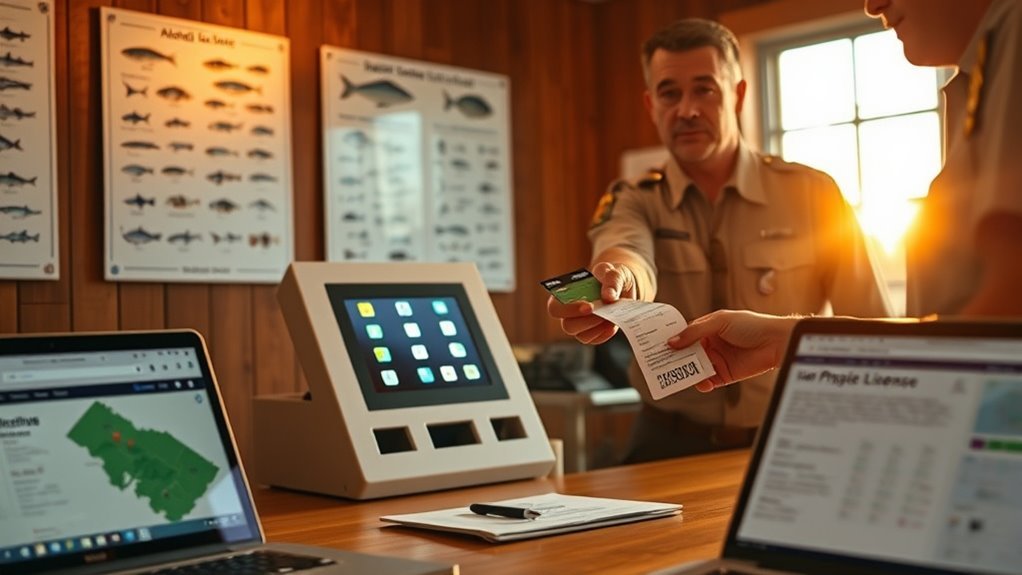
You can buy your annual license online through the Illinois DNR website for quick electronic processing or at stores like Walmart and local bait shops for same‑day paper proof.
If you’re claiming resident pricing, have a driver’s license or state ID ready at purchase.
For lifetime licenses you’ll complete and mail a printed form to the DNR Lifetime License office and expect up to 90 days for processing.
Online Through DNR
When you’re ready to buy an annual Illinois fishing license, go to the Illinois DNR site at https://exploremoreil.com, where residents can purchase a license for $15 and non‑residents for $31.50.
You’ll complete an online application, upload proof of residency for resident rates (driver’s license or ID), and choose from secure payment methods (credit or debit).
- Navigate to the DNR site and select “Buy License.”
- Complete the online application fields and attach ID for resident verification.
- Pay with accepted payment methods; transactions are immediate and secure.
- Your license is effective on purchase date and expires March 31 of the following year.
This process is fast, transparent, and document-driven.
In-Store Retailers
Many Illinois anglers buy annual fishing licenses in person at retailers like Walmart, local bait shops, and sporting goods stores. You can visit fishing vendors for immediate license availability; resident annual licenses cost $15, non-resident $31.50. Bring a driver’s license or state ID to verify residency when required. Payment methods vary by retailer—cash and credit/debit are commonly accepted. Check store hours before you go to avoid wasted trips.
| Retailer type | Typical notes |
|---|---|
| Walmart | Wide availability, card accepted |
| Bait shops | Local service, variable hours |
| Sporting goods | Staff assistance, card OK |
| Convenience stores | Limited hours, cash/card |
| Outdoor chains | Multiple locations, reliable |
Plan ahead: confirm license availability and ID requirements with the vendor.
Mail-in Lifetime Forms
If you’d rather avoid online or in-person purchase, Illinois offers a mail-in option by submitting the printed lifetime-license form from the DNR website; complete the form, include payment and any required ID photocopies, and mail it to the address on the form for processing (lifetime requests can take up to 90 days).
You’ll get lifetime benefits once processed; use the mail in process only if you accept the wait.
- Download the lifetime form from the Illinois DNR site and print.
- Complete all fields, attach photocopies of required ID (proof of residency for residents).
- Include payment (check or money order) as instructed; non-resident and resident annual costs are $31.50 and $15 respectively.
- Mail to the address shown; allow up to 90 days for processing and confirmation.
Lifetime Licenses vs. Annual Licenses: Differences and Costs
Although annual and lifetime fishing licenses both let you fish legally, their costs and renewal rules make them very different choices: you should weigh lifetime benefits and a direct cost comparison before deciding.
Annual and lifetime fishing licenses both permit legal fishing, but differing costs and renewals mean compare benefits before choosing.
An Illinois resident annual license costs $15; non-residents pay $31.50. Annual licenses expire March 31 and require renewal each year.
A resident lifetime license costs a one-time $435 fee, granting fishing rights indefinitely and eliminating yearly fees, though it requires annual verification.
From a pure cost comparison, a resident who buys annual licenses would break even with a $435 lifetime purchase in 29 years (435 ÷ 15 ≈ 29). If you’re a non-resident, the break-even point is shorter (435 ÷ 31.50 ≈ 13.8 years).
Seniors and super seniors have lower annual rates ($7.75 and $1.50), which change those calculations substantially.
Choose lifetime if you expect many remaining years of active fishing; choose annual if your fishing frequency or residency status is uncertain.
Products Worth Considering

Team colored license plate measures a standard 6-inches by 11.5-inches

Team colored license plate measures 6-inches by 11.5-inches

Durable and long-lasting license plate measures a standard 6-inches by 11.5-inches
Age, Disability, and Other License Exemptions

1 clear rule: anyone 16 or older needs a valid Illinois fishing license, while youth under 16 are exempt. You should know the primary license exemptions and how they fit into fishing regulations so you don’t pay or carry a credential unnecessarily.
- Residents with Class 2 or 2A disabilities and veterans with ≥10% service-connected disability can fish license-free; veterans must present a disability card.
- Active-duty military personnel on leave are exempt while on leave; carry proper military ID.
- Property owners or tenants may fish flowing waters on their own property without a license, but residents in subdivisions with private lakes are excluded.
- Children under 21 who are Illinois residents may fish without a license only when accompanied by a licensed adult.
These points summarize legal exceptions; follow local rules and retain required IDs. Use this concise guide to apply license exemptions correctly within Illinois fishing regulations.
Renewal Dates, Validity Periods, and What to Do If You Lose Your License

After confirming whether you qualify for an exemption, you’ll want to note Illinois’ renewal and validity schedule so you don’t lapse: annual fishing licenses expire March 31, renewal sales open March 1, and any license purchased on or after March 1 is valid through the following March 31.
Plan purchases during March to maximize coverage; this is a core license renewal tip for fishing season preparation. Renew before March 31 to remain legal; enforcement checks require you to carry both your license and a valid Illinois photo ID to verify ownership.
Plan purchases in March to maximize coverage. Renew before March 31 and carry your license plus a valid Illinois photo ID.
If you lose your license, obtain a duplicate online: there’s a $3 reprint fee, but you can request a free online reprint within five days of purchase. Document purchase receipts and note your customer ID to speed up duplicates.
Use calendar reminders each February to review exemptions, confirm ID validity, and complete renewal steps so you enter the next season with uninterrupted coverage.
State Regulations That Apply When Using an Annual Fishing License

Because an annual Illinois fishing license only establishes your permission to fish, you still have to follow statewide rules on seasons, bag and size limits, gear restrictions, and special regulations for certain waters; carry a valid Illinois photo ID to match the license, and remember that all anglers 16 and older need a license (with specific exemptions), non-residents face different fee and eligibility limits, and licenses always expire March 31 so you must renew annually to remain compliant.
You pay $15 as a resident or $31.50 as a non‑resident; non‑residents can’t buy lifetime or combo hunting/fishing licenses.
For clear license compliance, observe these points:
- Carry photo ID plus your license; licenses lack photos and ID verifies ownership.
- Know seasonal openings, bag/size limits, and special‑water rules before you fish.
- Confirm gear restrictions (lines, bait, tackle) applicable to the waterbody.
- Renew by March 31 (licenses bought after March 1 extend to next March 31); exemptions apply for youth and certain veterans/property owners.
Follow fishing regulations precisely to avoid fines and protect resources.
Frequently Asked Questions
Can I Use My Annual License for Ice Fishing Tournaments?
Yes — you can use your annual license for ice fishing tournaments if state ice fishing regulations allow tournament participation; verify tournament eligibility, any required permits or endorsements, and adhere to catch limits, reporting, and safety rules before competing.
Are Mobile Apps Accepted as Proof of License in Enforcement Stops?
Yes — officers often accept mobile app verification as valid during stops, but you should check local license enforcement policies because acceptance varies by jurisdiction, app compatibility, and whether the displayed verification meets required metadata and timestamps.
Does the Annual License Cover Fishing From Private Property Only?
You’re not limited to private property; the annual license usually covers public waters too. Investigate regulations to confirm specifics — private property regulations and fishing rights clarification vary by state, so check local agency rules and boundaries.
Are There Discounts for Purchasing Multiple Licenses at Once?
Yes — you can get bulk purchase discounts and family license options in some jurisdictions; check your state agency for rates, eligible group sizes, required documentation, and automated price breaks to determine overall savings precisely.
How Are Refunds Handled if I Move Out of State Mid-Year?
Like a dock cut loose in autumn, you follow the refund request process: you’ll submit proof, they’ll apply out of state regulations, prorate or deny based on rules, and you’ll get notice and payment if eligible.
Conclusion
You’re set to stay safe, sensible, and solvent when selecting a seasonal license: secure the suitable statewide pass, spot resident versus nonresident rates, see if reduced fees or lifetime options suit you, and satisfy age or disability exemptions. Swiftly shop online or at vendors, safeguard renewal dates, and save a duplicate if you lose your card. Stay steady with state statutes, show proof when required, and sport sustainable, smart fishing practices.
