
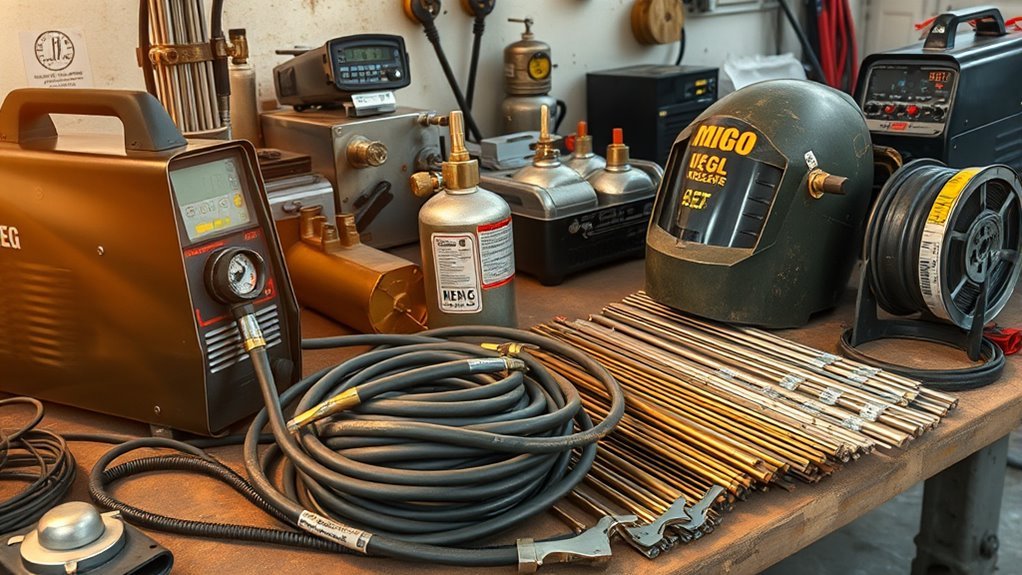
Welding equipment cost ranges from about $150 for a small, light-duty machine to more than $10,000 for advanced professional systems. Your real starting budget must also cover power requirements, a torch or gun, shielding gas where needed, consumables, protective equipment, ventilation, metal-preparation tools, and future maintenance. The best value is the machine that supports your materials and workload without making you pay for processes you will not use.
Last updated: August 10, 2026. Manufacturer examples, safety references, and key pricing claims were rechecked against current U.S. sources.
Quick Answer
A basic welding machine may cost about $150–$600, while capable hobby and small-shop equipment commonly costs $600–$3,000. Professional TIG and multiprocess systems can reach $3,000–$10,000 or more. A complete setup usually adds PPE, gas equipment, consumables, clamps, ventilation, and possibly a new electrical circuit.
Key Takeaways on Welding Equipment Costs
Key Takeaways
- Stick is usually the least expensive process to start. A practical beginner kit often costs about $350–$1,200.
- MIG is easy to learn and useful for general fabrication. Plan roughly $700–$2,300 for a machine, basic gas setup, consumables, PPE, and hand tools.
- TIG costs more when you need AC output for aluminum. A usable AC/DC TIG setup commonly requires about $1,300–$4,000.
- Multiprocess pricing depends on the included processes. Some low-cost machines provide flux-core, DC TIG, and stick, while full AC/DC systems cost much more.
- The machine is only one part of the budget. Include electrical work, gas, ventilation, PPE, torches, pedals, spool guns, grinders, clamps, and replacement consumables.
- Prices change frequently. Compare package contents, warranty terms, dealer support, and current promotions—not only the advertised machine price.
A lower-priced welder is not a bargain if you must immediately replace its torch, add missing controls, install a new circuit, or stop work repeatedly because its duty cycle is too low.

These Stanley MaxSteel straight aviation snips are built for clean, controlled cutting through sheet metal and other tough materials. Serrated cutting edges help prevent slippage for more accurate results, while the double pivot action delivers increased cutting power with less effort. Designed for dependable performance, they are a practical choice for metalworking, HVAC tasks, and general workshop use.

Die With Zero offers a fresh perspective on personal finance by encouraging readers to use money intentionally to create memorable life experiences instead of simply accumulating wealth. Written by Bill Perkins, this book combines practical guidance with a motivating philosophy to help readers align spending, saving, and life goals for a more fulfilling future.

The DeLonghi Water Filter helps reduce scale buildup and unwanted impurities that can affect your coffee machine's performance and taste. Its active carbon and ion-exchange technology helps improve brew consistency, maintain flavor, and reduce the need for frequent descaling. Designed as an OEM authorized replacement part, it fits select DeLonghi models for reliable everyday maintenance.
Welding Equipment Cost by Process: MIG, TIG, Stick and Multiprocess

The four common choices are MIG, TIG, stick, and multiprocess equipment. Each process has different machine, accessory, consumable, and skill requirements.
| Process | Planning Range | Best Fit | Main Added Costs |
|---|---|---|---|
| MIG or flux-core | Machine: about $150–$4,500+; common hobby/small-shop setup: about $700–$2,300 | General repairs, automotive work, fabrication, and beginner training | Wire, tips, liners, gas cylinder and regulator for gas MIG, or flux-core wire for gasless work |
| TIG | Machine: about $500–$12,000+; common AC/DC setup: about $1,300–$4,000 | Precise work on thin steel, stainless steel, aluminum, and visible welds | Torch, foot or fingertip control, argon, regulator, tungsten, filler rod, and sometimes a water cooler |
| Stick | Machine: about $150–$6,500+; practical starter package: about $350–$1,200 | Outdoor repair, farm work, structural steel, and less-clean material | Electrodes, electrode holder, leads, chipping tools, brushes, and grinding equipment |
| Multiprocess | Machine: about $120–$10,000+ depending on included processes and output | Users who regularly need more than one process but want a smaller equipment footprint | Process-specific torches, guns, controls, gas equipment, cables, and optional aluminum accessories |
MIG is often easiest for a beginner, but “MIG-capable” does not mean every package is ready for gas-shielded welding or aluminum. Aluminum MIG normally requires suitable wire, drive components, shielding gas, and often a spool gun or push-pull system.
TIG offers excellent control, but check whether the machine is DC-only or AC/DC. DC TIG is commonly used for steel and stainless steel. Conventional TIG welding of aluminum generally calls for AC output, which raises the machine price.
Stick welding remains attractive for outdoor and heavy repair because it does not require an external shielding-gas cylinder. Multiprocess equipment can save floor space, but the included process names do not guarantee that every torch, pedal, regulator, or gun is included.
Warning: Welding can expose you to metal fumes, ultraviolet and infrared radiation, electric shock, fire, hot metal, noise, and flying particles. Follow the machine manual, complete a hazard assessment, use adequate ventilation, remove combustibles, and select suitable PPE. A respirator may be required when ventilation and work practices do not adequately control exposure; it is not a substitute for proper fume control. Review OSHA’s welding hazard guidance before setting up a work area.
Detailed Cost Breakdown: MIG Welders
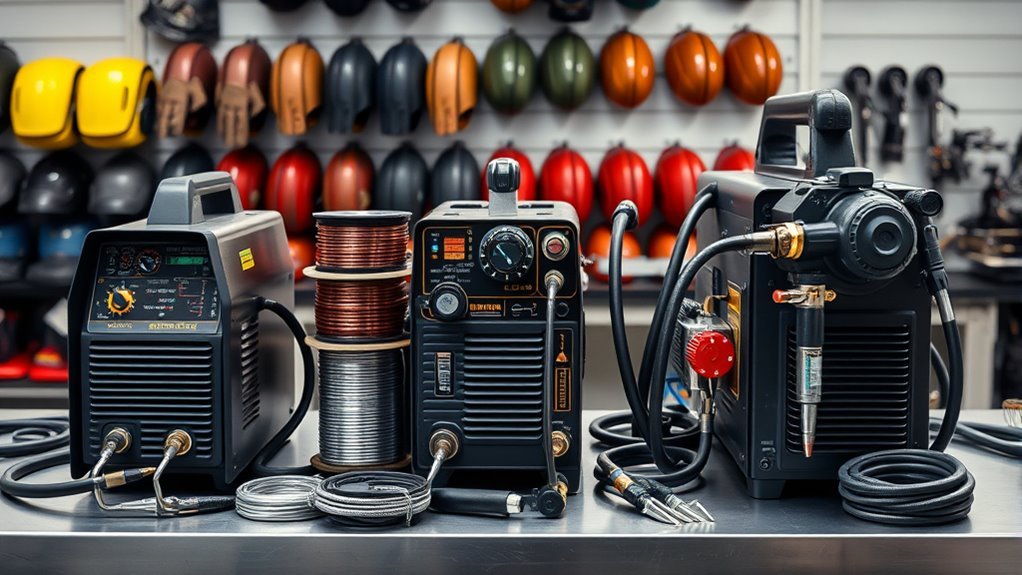
MIG and flux-core equipment covers a wide price range. Small 120V flux-core machines may cost about $150–$350. Better-controlled 120V or dual-voltage MIG machines commonly fall around $400–$1,600, while professional shop machines can cost $1,600–$4,500 or more.
| MIG Tier | Machine Planning Range | Typical Use |
|---|---|---|
| Basic flux-core | $150–$350 | Small steel repairs and occasional home use |
| Hobby gas MIG | $400–$900 | Automotive panels, furniture, brackets, and general fabrication |
| Dual-voltage prosumer | $700–$1,600 | Thicker material, longer jobs, and more control |
| Professional shop | $1,600–$4,500+ | Frequent fabrication, higher output, pulsed MIG, and greater duty cycle |
A complete gas-MIG setup may need a cylinder, regulator or flowmeter, gas hose, wire, spare contact tips, nozzles, drive rolls, liner, gloves, helmet, jacket, pliers, clamps, grinder, fire extinguisher, cart, and ventilation. These items can add several hundred dollars before electrical work. For a current gas-specific budgeting example, see our 75/25 welding gas cost guide.
For aluminum, confirm the machine’s output range and approved feeding method. A spool gun may add several hundred dollars. Production aluminum work may call for a more expensive push-pull system.
Pro Tip: Compare what is in the box. A $900 machine that includes a quality gun, regulator, dual-voltage adapter, drive rolls, and usable work clamp may cost less to put into service than a $700 machine with several required accessories missing.
Detailed Cost Breakdown: TIG Welders

TIG machine prices depend heavily on output type. Basic DC TIG/stick inverters may begin around $500–$1,500. AC/DC TIG machines suitable for common aluminum work often cost around $850–$3,000. Professional systems with greater output, advanced waveform controls, water cooling, automation connections, or high duty cycles can cost $3,000–$12,000 or more.
Do not assume the advertised price includes a complete TIG setup. For example, a power source may ship without a TIG torch, foot control, regulator, hose, or gas cylinder. Review the “included” and “not included” lists before comparing two machines.
| Feature | Why It Affects Cost |
|---|---|
| DC-only output | Usually costs less and is commonly used for steel and stainless steel |
| AC/DC output | Adds the AC functions commonly required for aluminum TIG |
| High-frequency start | Starts the arc without touching the tungsten to the work |
| Pulse, balance and frequency controls | Provide more control over heat input and AC arc behavior |
| Air- or water-cooled torch | Water cooling supports demanding work but adds a cooler, hoses, coolant, and maintenance |
| Duty cycle | Higher output for longer periods requires more robust internal components and cooling |
Quality controls can improve consistency, but they do not automatically reduce total costs. A simpler machine may be the better purchase when you only weld mild steel occasionally. An AC/DC package becomes worthwhile when aluminum is a regular part of the job. For a narrower machine-and-service breakdown, see our TIG welder cost guide.
Detailed Cost Breakdown: Stick Welders

Portable stick welders remain one of the least expensive ways to start welding. Small inverter machines can cost about $150–$500. More capable dual-voltage or professional portable models commonly cost $500–$1,200, while heavy shop and industrial power sources may cost several thousand dollars.
Stick welding is useful outdoors and on thicker steel because it does not depend on an external shielding-gas cylinder. It still requires correct electrodes, adequate leads, an electrode holder, work clamp, chipping hammer, wire brush, grinder, fire-safe work area, and PPE.
Price Ranges Overview
- $150–$300: Light repairs, training, and intermittent use. Check output limits, lead length, electrode compatibility, and duty cycle.
- $300–$700: Better portable inverters, dual-voltage options, improved arc controls, and more usable output.
- $700–$1,200: Professional portable machines with stronger support, improved components, and higher rated performance.
- $2,000–$6,500+: Heavy shop, high-output, or industrial stick equipment.
The lowest purchase price is not always the lowest cost per working hour. Short leads, weak clamps, limited parts support, and a low duty cycle may lead to early upgrades.
Setup and Consumables
A practical starter package often costs about $350–$1,200, depending on the machine and the tools you already own. Budget for:
- Stick power source, electrode holder, work lead, and suitable input plug
- Electrodes matched to the material, polarity, machine output, and application
- Welding helmet, safety glasses, gloves, fire-resistant clothing, and suitable footwear
- Chipping hammer, wire brush, grinder, discs, clamps, and welding magnets
- Fire extinguisher, welding screen, ventilation, and safe metal storage
Electrode prices vary by classification, diameter, package weight, brand, and storage requirements. Avoid using a single per-pack figure as a general budget. Low-hydrogen electrodes may also require controlled storage for code work.
Detailed Cost Breakdown: Multiprocess Welders
Multiprocess equipment ranges from compact machines offering flux-core, DC TIG, and stick to professional units with gas MIG, pulsed MIG, AC/DC TIG, and advanced controls. Because “multiprocess” covers very different packages, process names and included accessories matter more than the label alone.
Upfront Purchase Price
- $120–$750: Light-duty units that may combine flux-core, DC TIG, and stick. TIG torches or controls may be optional.
- $750–$2,500: Prosumer MIG, flux-core, DC TIG, and stick systems.
- $1,500–$5,000: More complete systems, including some AC/DC TIG models, stronger aluminum support, or professional controls.
- $4,000–$10,000+: High-output professional and industrial systems.
Current manufacturer examples show how quickly prices and packages can change:
| Model | Current Price / Status | Processes |
|---|---|---|
| Miller Multimatic 215 PRO | Current model; check current distributor price | MIG, flux-core, DC stick, and DC TIG |
| Lincoln POWER MIG 215 MPi | $1,999 MSRP | MIG, flux-core, stick, and DC TIG |
| Miller Multimatic 255 | $500 manufacturer rebate through authorized distributors through September 30, 2026; check current distributor price | MIG, pulsed MIG, flux-core, DC TIG, and stick |
Note: These U.S. manufacturer examples were rechecked August 10, 2026. Lincoln currently publishes a $1,999 MSRP for the POWER MIG 215 MPi. Miller’s current Multimatic family features the 215 PRO, while the Multimatic 255 page currently advertises a $500 rebate through authorized distributors for purchases through September 30, 2026. Dealer prices, taxes, freight, package contents, promotions, and availability can change.
Feature-Driven Cost Drivers
AC/DC TIG, pulsed MIG, synergic controls, high-frequency starting, larger wire spools, dual-voltage input, generator compatibility, data logging, automation connections, water cooling, and high duty cycles raise the purchase price.
Built-in plasma cutting is less common than marketing language may suggest. Check whether the machine truly includes a plasma power source and torch or whether plasma cutting requires separate equipment.
Buy the processes you will use. A strong MIG/stick machine may provide better performance and serviceability than an inexpensive unit that claims three or four lightly supported processes.
Long-Term Ownership Expenses
Long-term costs include process-specific torches, guns, cables, shielding gas, filler material, tips, nozzles, liners, drive rolls, tungsten, electrodes, cooling equipment, software, training, scheduled maintenance, repairs, and downtime.
Advanced machines can reduce setup time and improve repeatability, but their displays, control boards, sensors, and specialty components may cost more to repair. Local service and parts availability should be considered before purchase.
Factors That Drive Welding Equipment Prices
Machine price is driven by usable output, input power, process capability, duty cycle, included accessories, controls, construction, warranty, and service support.
| Cost Driver | What to Check |
|---|---|
| Output and material thickness | Rated output at the input voltage you will use—not only maximum advertised amperage |
| Duty cycle | The stated amperage and voltage at which the duty-cycle percentage applies |
| Input power | 120V, 240V, single-phase, three-phase, breaker size, receptacle, and generator requirements |
| Included equipment | Torch, gun, pedal, regulator, leads, work clamp, drive rolls, plugs, and adapters |
| Controls | Pulse, AC balance, AC frequency, synergic programs, memory, and automation support |
| Service network | Local repair center, parts availability, warranty exclusions, and turnaround time |
How Duty Cycle Affects Price
Duty cycle is the percentage of a 10-minute period that a welder can operate at a stated output without overheating. A 30% duty cycle at 200 amps means three minutes of welding followed by seven minutes of cooling under the specified test conditions.
The rating must be read with its amperage and input voltage. A machine may have a higher duty cycle at a lower output. Frequent long welds justify paying for more cooling capacity and a higher rated duty cycle. Miller provides a detailed duty-cycle explanation.
Electrical Installation Costs
A welder that operates on 120V may plug into a suitable household circuit, but full output can be limited. A 240V machine may require a dedicated breaker, receptacle, correctly sized conductors, permit, and licensed electrician. Three-phase machines are normally unsuitable for a home shop unless that service is already available.
Do not use an undersized extension cord or change plugs without following the manufacturer’s instructions and applicable electrical codes. Obtain a local quote before buying a machine that requires electrical upgrades.
Ongoing Operating and Maintenance Expenses
Operating costs depend more on hours of use and process than on the machine’s sticker price. Track actual consumption rather than applying a fixed annual amount.
| Expense | Examples | Budget Method |
|---|---|---|
| Filler material | MIG wire, flux-core wire, TIG rod, and stick electrodes | Track pounds used per month and cost per pound |
| Shielding gas | Argon and argon-based mixtures | Record cylinder fees, rental or lease, refills, and delivery |
| Torch and gun parts | Tips, nozzles, diffusers, cups, collets, liners, and drive rolls | Keep a replacement log by process and material |
| Power | Welder, fume extractor, grinder, compressor, and water cooler | Estimate input kW × operating hours × local electricity rate |
| Maintenance and repairs | Cleaning, feeder service, fans, switches, cables, boards, torches, and calibration where required | Follow the manual and maintain a reserve for unplanned repairs |
| PPE and safety | Lenses, gloves, protective clothing, hearing protection, respiratory equipment, filters, and fire controls | Replace damaged or expired items and follow the applicable safety program |
Shielding-gas costs vary by cylinder size, supplier, region, contract, and whether the cylinder is purchased, exchanged, leased, or rented. Ask the supplier about deposits, ownership documentation, testing responsibility, delivery charges, and refill availability before choosing a cylinder.
Keep vents, fans, cables, connectors, wire feeders, torches, hoses, and regulators in the condition specified by the manufacturer. Do not open or repair high-voltage internal components unless you are qualified to do so.

This hardcover edition by Eric Metaxas offers a compelling look at the origins of the United States during the Colonial Period. It blends historical narrative with engaging storytelling, making it appealing for readers interested in American history, early nation-building, and the ideas that shaped the country. A strong choice for history enthusiasts, students, and anyone exploring the foundations of the nation.

This compact electric kettle quickly boils up to 1 liter of water with 1500 watts, making it ideal for tea, French press coffee, and fast hot water needs. The BPA-free glass carafe features easy-to-read markings, a wide opening for simple cleaning, and a built-in mesh filter to help keep mineral scale out of your cup. With auto shutoff, boil-dry protection, and cordless serving, it offers a convenient and stylish way to heat water for smaller kitchens, dorms, and apartments.

This combo kit helps women trying to conceive track fertile days and check for pregnancy with convenient at-home testing. The ovulation strips help monitor LH surge progression and are easy to read, while the pregnancy strips provide quick results with simple line interpretation. Designed for ease of use and dependable family planning support, it offers a practical way to stay on top of your fertility journey.
Recommended Starter Setups and Budget Estimates
There is no single “complete starter kit” price. A $600 stick package, a $1,500 MIG setup, and a $4,500 AC/DC TIG or premium multiprocess package serve different users. Set the budget after identifying the material, thickness, location, input power, expected hours, and required process.
Basic Budget Setup
Planning range: $350–$1,200.
This tier fits occasional steel repair and basic training. A stick or flux-core machine usually provides the simplest route.
- 120V or dual-voltage stick or flux-core machine
- Suitable leads, holder or gun, and work clamp
- Starter supply of electrodes or wire
- Helmet, safety glasses, gloves, fire-resistant clothing, and footwear
- Brush, chipping hammer, grinder, discs, and clamps
- Fire extinguisher, welding screen, and suitable ventilation
This package is not automatically suitable for structural, pressure, code, or safety-critical work. Those jobs require approved procedures, qualified personnel, inspection, and equipment matched to the governing requirements.
Mid-Range Starter Kit
Planning range: $1,200–$3,000.
This tier fits serious hobbyists, automotive work, maintenance, and small fabrication. It may include a dual-voltage gas-MIG machine or a capable DC TIG/multiprocess unit.
- Dual-voltage welder with usable duty cycle at the required output
- Gas cylinder arrangement, regulator or flowmeter, and hose where required
- Quality torch or gun and spare consumables
- Metal-preparation and finishing tools
- Better clamps, cart, welding table, and screens
- PPE and ventilation selected for the materials and process
Before buying, verify whether the machine needs a dedicated 240V circuit and whether aluminum requires an extra spool gun or AC TIG capability.
Professional Starter Package
Planning range: $3,000–$10,000+.
This tier fits a small commercial shop, frequent fabrication, advanced TIG, aluminum work, pulsed MIG, or higher-output multiprocess use.
- Professional power source with sufficient output and duty cycle
- Process-specific torches, guns, pedals, coolers, and aluminum equipment
- Fume extraction or engineered ventilation
- Gas storage and handling equipment
- Consumable inventory and spare wear parts
- Electrical installation, work tables, fixturing, and material-handling equipment
- Training, qualification testing, inspection tools, and service support
Commercial buyers should estimate downtime, labor, rework, service response, and replacement-part availability. Those costs can outweigh a modest difference in purchase price.
How to Calculate Total Cost of Ownership
Do not assume that ownership will automatically cost two or three times the machine price. Calculate it from your expected use:
Total ownership cost = machine + required accessories + electrical work + ventilation + gas equipment + consumables + energy + PPE + training + maintenance + repairs + downtime − resale value.
Build a one-, three-, or five-year worksheet with these lines:
- Machine and freight
- Taxes and dealer fees
- Electrical installation
- Gas cylinder, lease, regulator, and initial fill
- Torches, guns, pedals, spool guns, coolers, and carts
- PPE, screens, ventilation, and fire protection
- Monthly wire, rods, electrodes, gas, tips, nozzles, tungsten, and grinding discs
- Power consumption
- Training and qualification testing
- Scheduled service and repair reserve
- Estimated resale value
Divide the result by expected productive welding hours or completed jobs. This gives a more useful cost-per-hour or cost-per-job figure than the purchase price alone.
Industrial and Automated Welding System Costs
Automated welding costs cannot be estimated from a power-source price alone. A complete system may require a robot, controller, positioner, safety enclosure, fume extraction, sensors, seam tracking, tooling, programming, integration, operator training, inspection equipment, and production support.
Small mechanized systems may cost tens of thousands of dollars, while engineered robotic cells can reach six figures or more. Obtain a written system quote based on part geometry, cycle time, weld procedure, production volume, inspection requirements, and integration scope.
Calculate payback from labor savings, throughput, scrap reduction, repeatability, maintenance, consumables, programming, and expected uptime. Automation is not automatically cheaper when volume is low or parts change frequently.
When Renting or Outsourcing Makes More Sense
Renting can be cheaper when you need a high-output welder, engine-driven machine, specialty TIG system, wire feeder, or positioner for one short project. It also lets you test a process before committing to a purchase.
Outsourcing may make more sense when the work is safety-critical, code-regulated, infrequent, beyond your electrical capacity, or dependent on expensive inspection and qualification. Compare the contractor’s quote with the complete cost of buying equipment, learning the process, preparing the site, qualifying the weld, and correcting mistakes.
Tips for Buying New vs. Used Welding Equipment
Used equipment can reduce the upfront cost, but repairs, missing accessories, obsolete parts, damaged leads, and uncertain warranty coverage can erase the savings.
Before buying a used welder:
- Record the model and serial number and confirm that manuals and parts remain available.
- Ask for the original receipt, service records, warranty terms, and reason for sale.
- Inspect the case, plug, input cord, leads, connectors, work clamp, torch, gun, feeder, fan, and displays.
- Look for overheating, heavy grinding dust, corrosion, cracked insulation, loose connections, gas leaks, and unauthorized modifications.
- Test every advertised process at realistic output when possible.
- Check wire feeding, gas valves, remote controls, polarity connections, and thermal protection.
- Price every missing torch, gun, pedal, regulator, adapter, cable, and consumable before agreeing to the sale.
- Confirm whether the warranty applies to a later owner. Do not assume that it transfers.
Buy new when warranty coverage, predictable support, financing, tax documentation, or minimum downtime matters most. Consider used equipment when you can test it properly, verify parts support, and reserve money for repairs.
Frequently Asked Questions
How much does a complete welding setup cost?
A practical basic setup often falls around $350–$1,200 for stick or light flux-core work. A more capable hobby or small-shop setup commonly lands around $1,200–$3,000. Professional AC/DC TIG, pulsed MIG, or premium multiprocess packages can reach $3,000–$10,000 or more after accessories, ventilation, gas equipment, and electrical work.
What is the cheapest welding process to start with?
Stick welding is usually the lowest-cost entry because it does not need a shielding-gas cylinder or wire feeder. A practical stick starter package often costs about $350–$1,200. Flux-core can also start cheaply and may be easier for some beginners, but the best choice depends on the material, location, and type of repair.
Is MIG or TIG cheaper for a beginner?
MIG is usually cheaper and simpler for a beginner who wants general fabrication capability. A hobby gas-MIG machine may cost about $400–$900 before the cylinder, PPE, hand tools, and consumables. TIG often costs more when AC output, a foot control, argon, and aluminum capability are required.
Is welding equipment covered by homeowners’ insurance for hobby use?
It may be covered as personal property when it is used as a hobby, but coverage depends on the policy, cause of loss, deductible, exclusions, valuation method, and personal-property limits. Business use may have low limits or be excluded. Review your policy and ask the insurer whether valuable equipment needs an endorsement or separate business coverage. The National Association of Insurance Commissioners recommends reviewing limits and exclusions rather than assuming an item is fully covered.
Can I ship a welder internationally without special permits?
An electric welding power source does not automatically require a special permit, but it still needs correct customs documentation, classification, packaging, and destination-country compliance. Remove compressed-gas cylinders unless the carrier accepts them under applicable hazardous-material rules. Cylinders, fuel, certain batteries, and contaminated equipment may face additional restrictions. Check the carrier, customs authority, and destination rules before shipping. In the United States, PHMSA regulates shipments of compressed gases in cylinders.
What certifications or qualifications are recommended for professional welding?
The correct credential depends on the job, process, material, position, industry, employer, and governing code. AWS offers individual credentials such as the Certified Welder program. ASME BPVC Section IX covers welding, brazing, and fusing qualifications for applicable code work. ISO 9606 addresses welder qualification testing, and ISO 14732:2025 addresses operators and setters for mechanized or automatic welding. Ask the employer or contract administrator which qualification is required before paying for a test.
Are there health risks beyond burns and fumes?
Yes. Welding can involve ultraviolet and infrared radiation, eye injury, electric shock, fire, hot metal, noise, awkward posture, compressed gas, and exposure to hazardous coatings or metals. Fume composition changes with the base metal, filler, coating, and process. Use source extraction or suitable ventilation, follow the safety data and machine manual, and obtain professional respiratory guidance when exposure cannot be controlled adequately. NIOSH provides current information on welding fumes and manganese.
How do warranty transfers work for used welders?
Warranty terms vary by manufacturer, product, country, and sale date. Some warranties protect only the original purchaser, while others may follow the serial number or require the original receipt. Before buying, ask the manufacturer to confirm the remaining coverage in writing. Provide the model, serial number, purchase date, receipt, and seller information. Do not treat an unverified warranty as part of the machine’s value.
Is a 120V welder enough for home use?
A 120V welder can handle many light repairs, sheet metal jobs, and hobby projects when connected to a suitable circuit. Output and duty cycle are usually lower than on 240V. Thick material, long welds, larger electrodes, spray transfer, and high-output TIG may require 240V. Compare the rated output on 120V—not only the machine’s maximum output on 240V.
Should I buy, lease, or rent a shielding-gas cylinder?
The best option depends on local supplier rules and how often you weld. Ownership may avoid recurring rental charges but requires acceptable ownership records and access to exchanges or testing. Leasing or renting may provide easier exchanges and supplier-managed cylinder compliance but adds recurring fees. Compare deposits, annual charges, refill prices, delivery, cylinder size, and exchange availability.
Conclusion
Welding equipment costs range from a few hundred dollars for basic home equipment to more than $10,000 for advanced professional machines. Start with the material, thickness, process, input power, and expected workload. Then price the complete setup, including gas, torches, controls, consumables, PPE, ventilation, electrical work, and maintenance.
Stick offers the lowest-cost entry for many repairs. MIG balances ease, speed, and versatility. TIG costs more when aluminum and advanced control are required. Multiprocess equipment is valuable when you will genuinely use several processes. Compare complete packages, rated output, duty cycle, service support, and lifecycle cost rather than choosing by maximum amperage or machine price alone.
Next step: Write down your material, maximum thickness, welding location, available input power, and expected hours of use. Use those five inputs to choose the process first, then compare the complete installed setup cost.
Sources
- Occupational Safety and Health Administration: Welding, Cutting and Brazing Hazards — supports the safety, ventilation, radiation, electrical, fire, and PPE guidance.
- MillerWelds: Duty Cycle—What It Is and Why It Is Important — supports the duty-cycle definition and buying guidance.
- Miller Multimatic 215 PRO Product Page — supports the current model, included processes, and package information.
- Lincoln Electric POWER MIG 215 MPi Product Page — supports the current $1,999 MSRP and DC TIG, MIG, flux-core, and stick process capabilities.
- American Welding Society Certified Welder Program — supports the professional-certification guidance.
- National Association of Insurance Commissioners: Homeowners Insurance — supports the explanation of personal-property limits and policy-specific coverage.
- Miller Multimatic 255 Product Page — supports the current process list, package contents, and $500 rebate available through September 30, 2026.
- ASME 2025 Boiler and Pressure Vessel Code — confirms BPVC Section IX covers welding, brazing, and fusing qualifications.
- ISO 14732:2025 — confirms the current standard for qualification testing of welding operators and weld setters for mechanized and automatic welding.
- NIOSH: Welding Fumes and Manganese — supports the welding-fume and manganese health-risk guidance.

This versatile makeup brush set includes essential face and eye tools plus two blending sponges for smooth, polished application. Designed with soft synthetic bristles and an ergonomic handle, it helps create even coverage with cream, liquid, powder, and eyeshadow products. The included latex-free sponges expand when wet for a seamless, full-coverage finish and are easy to clean and maintain.

Post-it Super Sticky Easel Pads are designed to keep ideas visible and organized during meetings, training sessions, brainstorming, and project planning. The large premium paper resists marker bleed-through and sticks securely to many surfaces, then repositions without surface damage. A sturdy backcard and portable handle make them easy to move between rooms and use with most easel stands.

The LG LT1000P is a genuine replacement refrigerator water filter designed to deliver cleaner, fresher-tasting water and ice for your household. Certified to meet NSF standards, it helps reduce a wide range of contaminants while ensuring a proper fit and reliable performance in compatible LG refrigerators. With a recommended replacement cycle of several months and support for substantial water volume, it offers dependable filtration and peace of mind.
