
Most mainstream standalone welding helmets in the United States cost about $60 to $600 in current retail listings. Branded passive helmets often sit near $60 to $100, basic auto-darkening models commonly run about $60 to $200, and stronger mid-range or professional helmets move into the $200 to $600+ range. Specialty standalone helmets can exceed $1,000, while welding PAPR systems often start around $1,500 and can rise above $3,000.
Last updated: August 10, 2026. Price ranges were rechecked against current U.S. retailer listings, and safety references were rechecked against OSHA, ISEA, ISO, and manufacturer sources.
Quick Answer
A practical 2026 budget is about $60 to $100 for a branded passive helmet, $60 to $200 for a basic auto-darkening helmet, $200 to $400 for a mid-range model, and $400 to $600 or more for mainstream professional equipment. Specialty standalone helmets can exceed $1,000, and welding PAPR systems often start around $1,500 and can exceed $3,000.
Key Takeaways
- Many hobbyists can find a useful auto-darkening helmet for about $60 to $200, while frequent welders may benefit from the $200 to $400 tier.
- A higher price does not automatically mean better basic protection. The helmet still needs the correct ratings, filter shade, fit, and condition.
- Professional models mainly add better optics, larger viewing areas, more sensors, stronger headgear, and easier controls.
- Budget for replacement cover lenses, batteries, sweatbands, headgear, and compatible accessories.
- For occupational welding, use the helmet over suitable primary eye protection such as protective spectacles or goggles, following the applicable PPE requirements and hazard assessment.
How Much Does a Welding Helmet Cost?
Welding helmet prices vary by lens type, construction, viewing area, controls, accessories, and intended use. The ranges below are an August 10, 2026 snapshot of current U.S. listings from major retailers and welding-supply sellers. They are budget bands, not fixed MSRPs, and prices can change with graphics, rebates, model revisions, promotions, and stock.
| Helmet category | Typical cost | Common buyer | What the price may include |
|---|---|---|---|
| Passive fixed-shade helmet | About $60-$100 | Students, occasional welders, and people who prefer a simple lens | Fixed filter shade, basic ratchet headgear, and replaceable cover lens |
| Basic auto-darkening helmet | About $60-$200 | DIY users, beginning welders, and light-duty shop work | Auto-darkening filter, variable shade on many models, sensitivity or delay controls, and two to four sensors depending on the model |
| Mid-range auto-darkening helmet | About $200-$400 | Frequent hobbyists, students, mechanics, and shop welders | Better headgear, wider shade range, larger view, grind mode, and improved optics |
| Professional auto-darkening helmet | About $400-$600+ | Full-time welders and specialized fabrication work | Premium optics, large ADF, advanced modes, external controls, stronger headgear, and more accessories |
| Specialty premium standalone helmet | Can exceed $1,000 | Precision or specialty welders who need unusual optics or viewing technology | Specialized ADF geometry, advanced optics, specialty controls, and premium replacement parts |
| PAPR or supplied-air system | Often $1,500-$3,000+ | Work requiring a properly selected respiratory-protection system | Helmet, blower or air connection, breathing tube, filters, battery, charger, and related components |

This hardcover cookbook offers fast, approachable recipes designed for busy days and low-energy nights. Caroline Chambers focuses on simple, flavorful meals that help you get dinner on the table without overthinking it. It's a practical pick for home cooks who want quick weeknight inspiration and minimal-fuss cooking.

The DeLonghi Water Filter helps reduce scale buildup and unwanted impurities that can affect your coffee machine's performance and taste. Its active carbon and ion-exchange technology helps improve brew consistency, maintain flavor, and reduce the need for frequent descaling. Designed as an OEM authorized replacement part, it fits select DeLonghi models for reliable everyday maintenance.

This daily devotional helps parents pray purposefully for their children through a full year of Scripture readings, reflections, and guided prayer prompts. Written to encourage faithful family discipleship, it offers practical, biblically grounded support for parents who want to shape their prayers around God's Word. A foreword by Sinclair B. Ferguson adds trusted theological insight and encouragement.
Verified August 2026 U.S. Retail Examples
These listings show why a single universal price range can be misleading. They are examples checked during this update, not endorsements, and sale prices can change after publication.
| Current example | Listing price checked | What it shows |
|---|---|---|
| Jackson HSL1/HSL2 passive helmets | $62.05-$71.30 | Branded fixed-shade helmets can sit near the bottom of the mainstream range. |
| Miller Black Classic ClearLight ADF | $140.10 | A branded entry auto-darkening helmet can fall well below $200. |
| Miller Digital Elite / Digital Infinity | $343.15-$399.30 | Feature-rich mainstream ADF helmets cluster around the upper mid-range. |
| Lincoln VIKING 3350 4C | $475-$525 | Mainstream professional helmets commonly move into the $400-$600 band. |
| 3M Speedglas G5-02 | $1,099 | Specialty standalone optics can push a non-respiratory helmet above $1,000. |
| Current PAPR welding-helmet collection | Examples from about $1,479 to above $3,000 | Respiratory systems belong in a separate budget class from standalone helmets. |
Note: Graphic shells and limited-edition designs can cost more than the plain version of the same helmet even when the lens and performance specifications are identical.
Factors That Influence Welding Helmet Cost
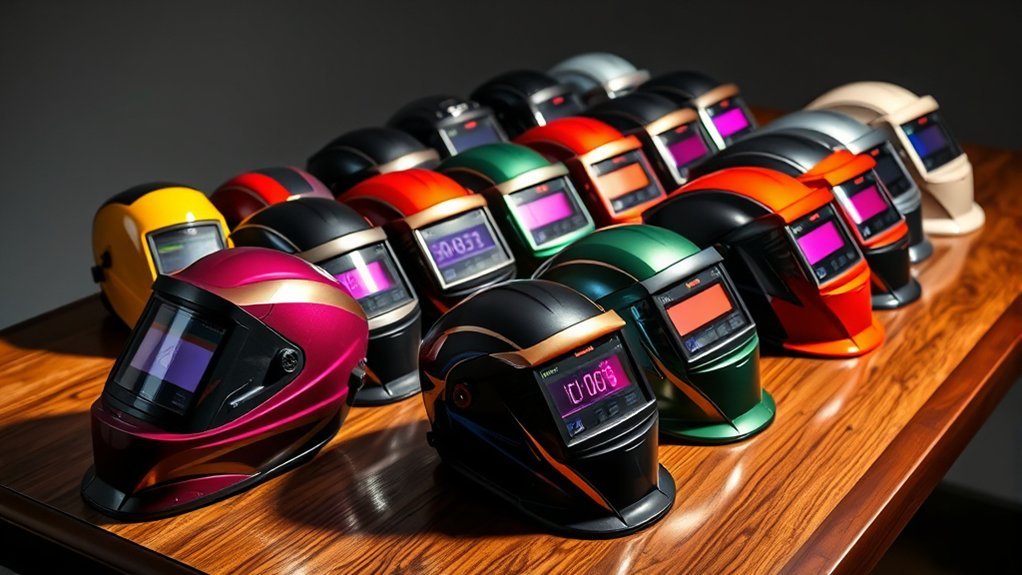
The lens mechanism is only one part of the price. Two helmets with similar shade ranges can cost very different amounts because of their optics, controls, construction, comfort, and accessories.
Passive or Auto-Darkening Lens
A passive helmet uses a fixed dark filter. You normally position the torch, lower the helmet, and then strike the arc. It has no electronic switching system, so it is simple and usually affordable.
An auto-darkening filter, commonly called an ADF, stays in a lighter state before welding and darkens after its sensors detect an arc. This can make positioning, tack welding, and repeated starts easier. It does not remove the need to select the correct shade range or follow the manufacturer’s instructions.
Viewing Area and Optical Quality
A larger viewing area can make it easier to see the joint, workpiece, surroundings, and body position. Premium models may also offer better color recognition and less visual distortion. These improvements can reduce frustration during long sessions, but the largest window is not always best if it makes the helmet heavy or poorly balanced.
Number and Placement of Arc Sensors
Basic ADF helmets may have two sensors, while more advanced models often have four. Extra sensors can help when part of the workpiece, torch, fixture, or body blocks one sensor. Low-amperage TIG welding also requires an ADF that can respond reliably to the intended arc.
Shade, Sensitivity, and Delay Controls
Variable-shade controls let you select an appropriate filter setting within the helmet’s supported range. Sensitivity controls affect how readily the lens reacts to an arc. Delay controls affect how quickly the lens returns to the light state after the arc stops.
More expensive helmets may provide separate weld, cut, grind, and specialty modes. These controls are useful only when they match the work you actually perform.
Headgear and Weight Distribution
Comfort becomes more valuable when the helmet is worn for several hours. Better headgear may provide multiple adjustment points, wider support pads, improved balance, replaceable sweatbands, and easier tension control.
A lightweight shell is not automatically comfortable. A slightly heavier helmet may feel better if the weight is balanced closer to the head.
Replacement Parts and Accessories
Cover lenses, batteries, sweatbands, headgear, magnifying lenses, hard-hat adapters, neck covers, and respiratory components can increase the long-term cost. Before buying, check whether replacement parts are easy to find and reasonably priced.
Affordable Welding Helmet Options
An affordable helmet can be suitable for occasional use when it fits properly, supports the required filter shade, is in good condition, and has the correct manufacturer markings and documentation. In the August 2026 snapshot, branded passive models started in the low-$60 range, while retail auto-darkening choices also appeared below $100.
Passive models such as the Jackson HSL series and other fixed-shade helmets remain useful for welders who value simple construction. They have fewer electronic parts and can be a practical choice when one fixed shade suits the work.
Budget auto-darkening models can provide variable shade settings, grind mode, and sensitivity controls. However, you should examine the control layout, sensor count, low-amperage rating, replacement-lens availability, warranty, and headgear quality instead of buying by price alone.
Warning: For occupational welding, OSHA guidance says welding helmets or faceshields should be used over primary eye protection such as protective spectacles or goggles. Never look at a welding arc without the appropriate helmet or shield and filter shade.
Avoid unmarked helmets with unclear documentation or no available replacement parts. A low price is not useful if the lens cannot be verified, the headgear will not hold its position, or replacement cover plates are unavailable.
Mid-Range Welding Helmet Selections
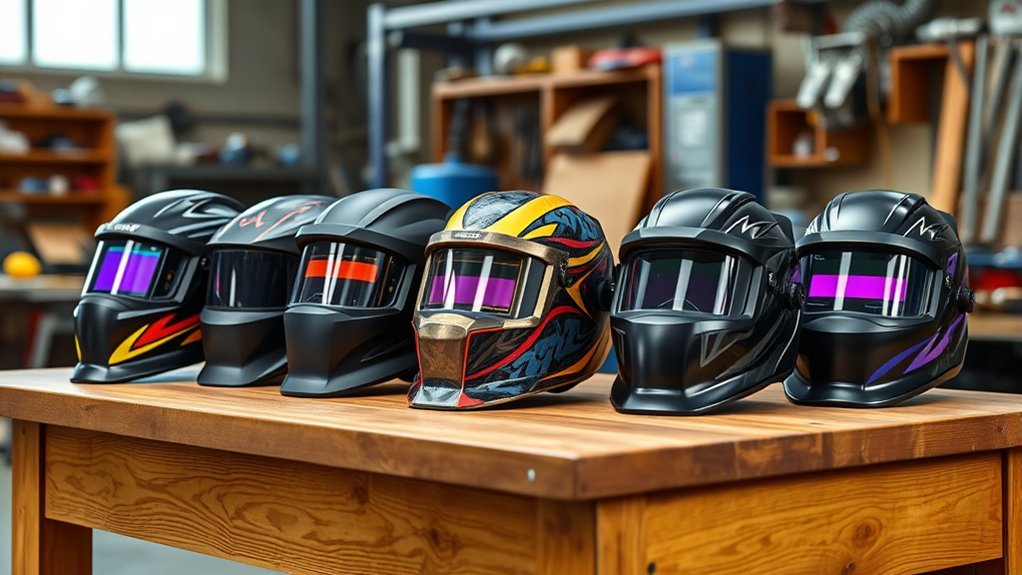
For this guide, the mid-range is about $200 to $400. Current examples in that band include mainstream auto-darkening helmets with stronger optics, larger viewing areas, better headgear, and more complete controls. This tier often suits welding students, serious hobbyists, mechanics, and people who weld regularly but do not need a respiratory helmet system.
Common Mid-Range Choices
The exact product lineup changes, but this tier includes many mainstream auto-darkening helmets from Lincoln Electric, Miller, Jackson Safety, Hobart, Forney, and similar manufacturers. Some premium passive helmets and specialty fiber-shell helmets can also fall within this range.
Instead of choosing by brand name alone, compare the complete specification:
- Supported welding and cutting processes
- Variable-shade range
- Low-amperage TIG rating
- Viewing-area dimensions
- Number and location of sensors
- Grind-mode operation
- Optical clarity information
- Helmet weight and balance
- Replacement cover-lens cost
- Warranty and service support
Key Features Worth Paying For
A wider shade range is valuable when you switch between welding and cutting processes. External controls can save time when they are protected against accidental movement. Four sensors may help when welding around fixtures or in positions where one sensor can be blocked.
Improved headgear is often one of the most noticeable upgrades. Try the helmet with your normal safety glasses, respirator, welding cap, or hearing protection. Check whether the shell stays raised when needed and lowers smoothly without excessive tension.
Pro Tip: Before choosing a helmet, check the price and availability of its inside and outside cover lenses. An inexpensive helmet can become frustrating when its correctly sized replacement lenses are difficult to find.
Premium Welding Helmets for Professionals
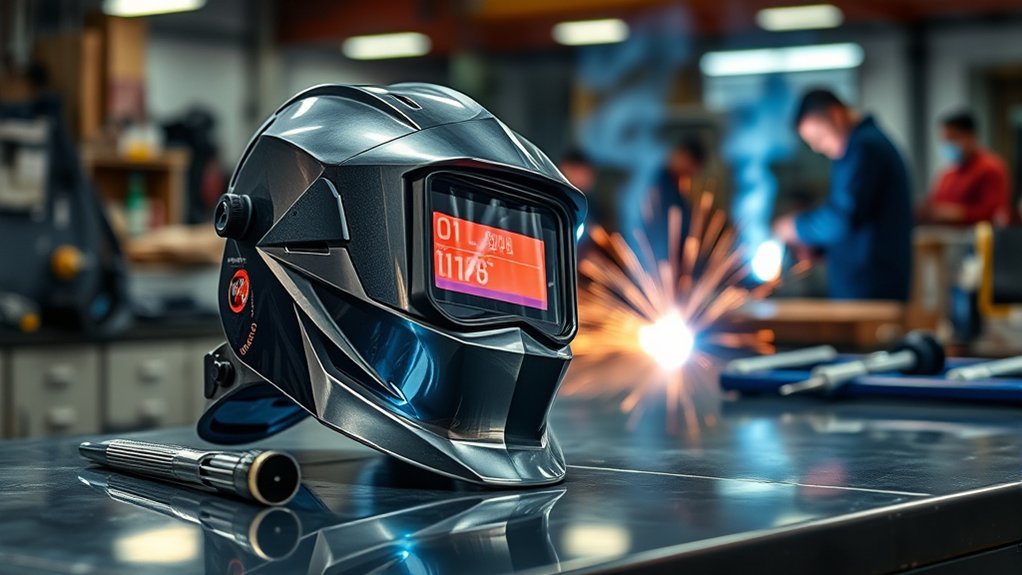
Mainstream professional standalone helmets commonly land around $400 to $600 or more in current listings. Popular product families include the Lincoln Electric VIKING series, Miller Digital Elite and Digital Infinity lines, and 3M Speedglas helmets. Specialty designs are a separate tier: the 3M Speedglas G5-02, for example, was listed at $1,099 during this update.
The higher price usually pays for workflow and comfort improvements rather than permission to ignore basic safety requirements. Common premium features include:
- Larger viewing areas: More visibility around the weld and work area.
- Improved optics: Better contrast, color recognition, or optical-class performance.
- Four arc sensors: More detection coverage when welding around obstacles.
- Advanced modes: Dedicated settings for welding, cutting, grinding, or difficult arc conditions.
- Better headgear: More adjustment points and improved weight distribution.
- Easier controls: External buttons, memory settings, or automatic sensitivity functions.
- Accessory support: Magnifying lenses, hard-hat adapters, neck protection, and replacement parts.
A premium helmet is most useful when it solves a real problem, such as neck fatigue, a restricted view, unreliable low-amperage detection, frequent process changes, or the need for compatible head and respiratory protection.
High-Tech Welding Helmets and Features
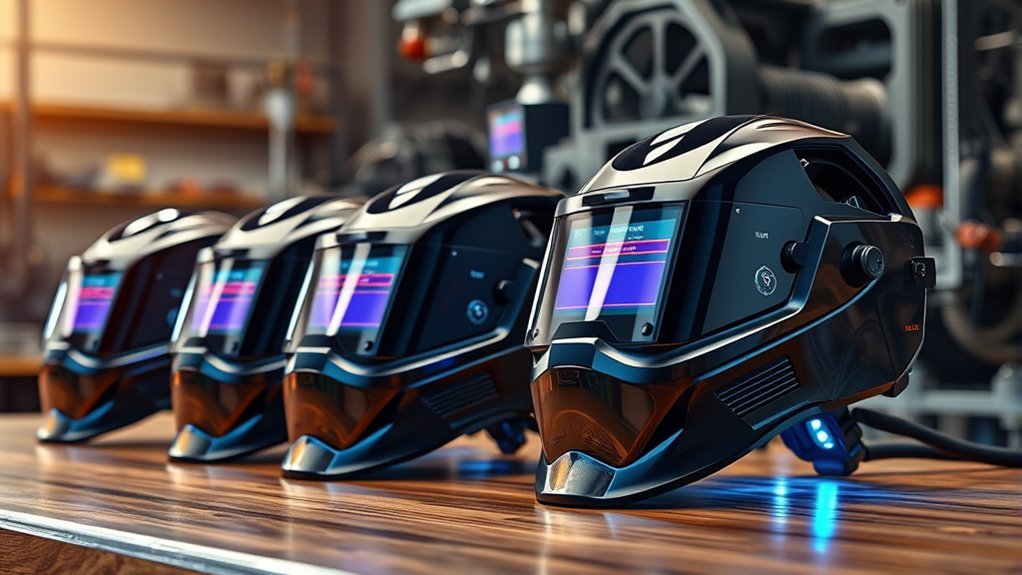
High-tech helmets may offer digital controls, automatic sensitivity adjustment, memory settings, curved filters, side windows, flip-up grinding shields, color-optimized lenses, and specialty arc-detection modes.
For example, the 3M Speedglas G5-02 uses a curved auto-darkening filter, four sensors, and a wide field of view. Features of this type can help specialized welders, but they also increase the purchase and replacement cost.
Switching speed varies by model. A fast specification may sound impressive, but it should not be considered by itself. The filter also needs reliable sensors, suitable sensitivity, the correct shade range, clear optics, proper maintenance, and compatibility with the intended process.
Solar-assisted ADFs may still use replaceable or non-replaceable batteries, depending on the model. Check the manual instead of assuming that a solar panel eliminates battery maintenance.
Custom Welding Helmets and Personalization
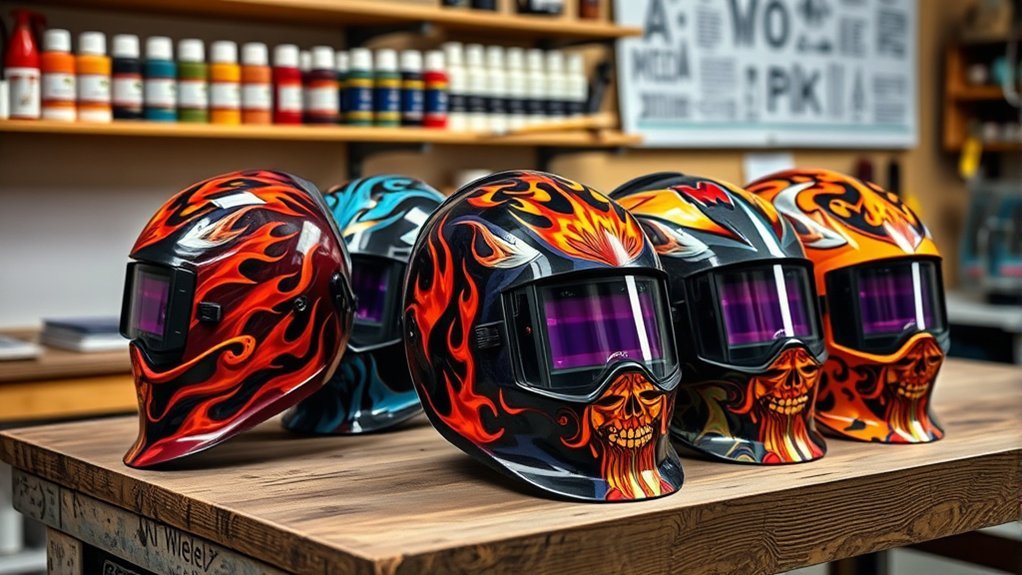
Custom graphics, leather components, specialty shells, decals, and limited-edition designs can raise the price without changing the lens specifications. Custom leather helmets may also cost more because of the labor, material, and design work involved.
Common personalization options include:
- Printed shell designs: Flames, flags, patterns, logos, and themed graphics.
- Leather coverings: Custom-cut leather pieces for appearance or additional coverage.
- Replacement headgear: Upgraded suspension systems and sweatbands.
- Magnifying lenses: Compatible magnification plates for close work.
- Neck and head covers: Manufacturer-approved accessories for additional coverage.
Do not block the ADF sensors, controls, vents, warning labels, or manufacturer markings. Avoid drilling, cutting, painting, heating, or modifying the shell unless the helmet manufacturer specifically permits the change.
How Much Should You Spend on a Welding Helmet?
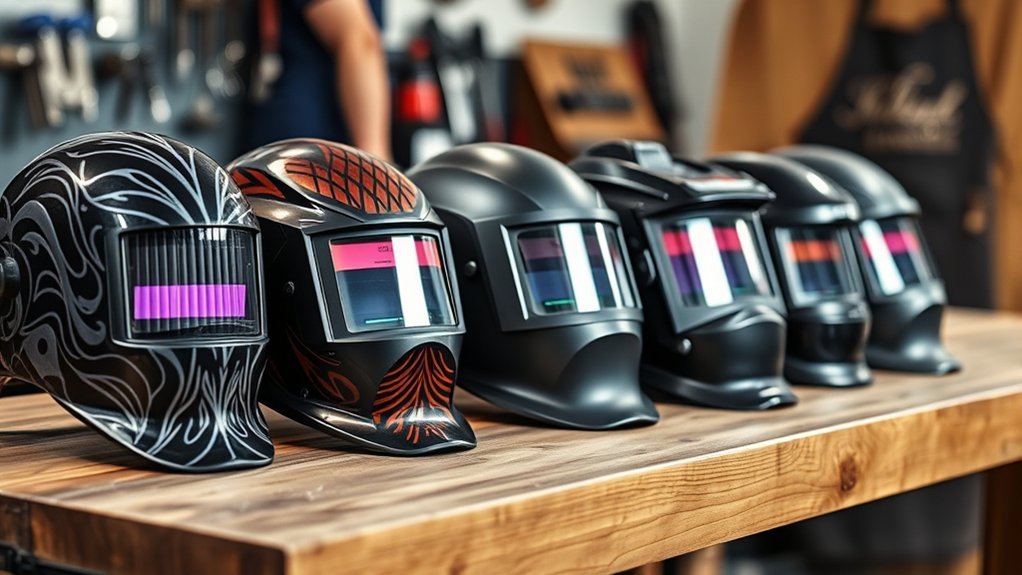
The safest buying decision is not always the cheapest or the most expensive helmet. Start with the required protection, then pay more only for features that improve fit, visibility, comfort, compatibility, or productivity.
A higher price may buy a better view and more comfortable headgear, but proper ratings, shade selection, fit, inspection, and primary eye protection remain essential at every price level.
When a Budget Helmet May Be Enough
For occasional work, about $60 to $200 can cover a branded passive helmet or many basic auto-darkening options. The better choice is the one that supports your process and shade range, carries traceable markings and instructions, fits correctly, and has available replacement parts.
When a Mid-Range Helmet Makes Sense
A budget around $200 to $400 makes sense when you weld frequently, switch between processes, need reliable low-amperage response, want a larger view, or find basic headgear uncomfortable.
When a Premium Helmet Is Worth the Cost
A budget around $400 to $600 or more may be worthwhile when you wear the helmet for full shifts, perform precision work, need specialty controls, require hard-hat integration, or benefit from a wider and clearer view. Specialty standalone helmets can cost more than $1,000 when their optics or design solve a specific workflow problem.
When a Respiratory System Is Needed
Current PAPR welding-helmet listings often begin around $1,500 and can rise above $3,000, but a respiratory system should never be selected simply because it is the most expensive option. Respiratory protection must be based on the actual hazard, workplace assessment, applicable rules, required protection factor, fit requirements, and a complete respiratory-protection program.
Passive vs. Auto-Darkening Welding Helmets
| Feature | Passive helmet | Auto-darkening helmet |
|---|---|---|
| Lens operation | Stays at one fixed dark shade | Changes from a light state to the selected dark state |
| Typical cost | Usually lower | Usually higher |
| Positioning | The helmet is often raised while positioning | The work can be viewed through the light-state lens |
| Electronics | No ADF electronics or batteries | Uses sensors, controls, and a power source |
| Best fit | Simple, repetitive work using a suitable fixed shade | Frequent starts, tack welding, varied processes, and easier setup visibility |
Both types can provide appropriate protection when they are correctly selected, properly marked, undamaged, and used with the correct filter shade. Auto-darkening mainly adds convenience and workflow benefits.

Aegend Swim Goggles are designed to help swimmers enjoy a clear, comfortable, and secure fit in the pool. Built for adults and youth, they aim to reduce leaking and provide full eye protection for training, recreation, and water sports. Their versatile design makes them a practical choice for men and women looking for dependable swim eyewear.

This retractable car window shade helps block UVA and UVB rays to make rides more comfortable and protected for passengers. It includes a White Hot heat alert that turns white when the car is too hot, plus dual installation options for a secure fit in many vehicles. The safe-view mesh supports visibility while helping reduce glare, and the easy one-push retraction makes it simple to use when needed.

This RENPHO smart scale helps you monitor weight, BMI, body fat, and 13 total body metrics with easy app sync for ongoing health tracking. It connects to popular fitness platforms, supports unlimited users, and includes Baby Mode for infants or pets, making it a versatile choice for families. Built with precise sensors and durable tempered glass, it offers reliable daily measurements and progress insights in the RENPHO Health app.
Welding Helmet Safety Standards
In the United States, OSHA 29 CFR 1910.133 governs occupational eye and face protection and incorporates specific earlier ANSI/ISEA Z87.1 editions by reference. Separately, the current voluntary ANSI/ISEA edition is Z87.1-2025, published in January 2026. Do not assume that the newest voluntary edition automatically replaces the edition incorporated into an OSHA rule; employers should confirm the standard and workplace requirement that applies.
For international occupational welding protectors, ISO 16321-2:2021 remains the published current edition as of this update, although ISO has begun work on a second edition. ISO 4871 is not a welding-helmet standard.
Look for permanent product markings, a traceable manufacturer, a clear model number, instructions, supported shade ranges, replacement-part information, and documentation for the applicable standard.
For occupational use, OSHA’s PPE selection guidance says welding helmets or faceshields should be used only over primary eye protection such as protective spectacles or goggles. The helmet provides face and radiation protection; the primary eye protection remains important when the hood is raised or particles can enter from the side or below.
How to Choose the Correct Filter Shade
The proper filter shade depends on the welding or cutting process, arc current, electrode size, and sometimes material thickness. OSHA’s eye and face protection standard lists minimum protective shades for common operations.
| Operation | Arc current or condition | OSHA minimum shade |
|---|---|---|
| Shielded metal arc welding | Less than 60 amps | 7 |
| Shielded metal arc welding | 60-160 amps | 8 |
| Shielded metal arc welding | 160-250 amps | 10 |
| Shielded metal arc welding | 250-550 amps | 11 |
| Gas metal arc or flux-cored arc welding | Less than 60 amps | 7 |
| Gas metal arc or flux-cored arc welding | 60-500 amps | 10 |
| Gas tungsten arc welding | Up to 150 amps | 8 |
| Gas tungsten arc welding | 150-500 amps | 10 |
| Torch brazing | Not based on arc current | 3 |
Start with a shade that is too dark to see the weld zone clearly. Move to a lighter shade only until you can see the work without going below the applicable minimum. Follow the helmet manual, employer requirements, and the full OSHA table for the exact operation.
OSHA also requires helmets or hand shields during arc welding and arc cutting operations, with limited exceptions described in the regulation. See the official welding, cutting, and brazing requirements.
Additional Welding Helmet Costs
The purchase price is only part of the total cost. Common replacement and accessory expenses include:
- Outside cover lenses: These protect the ADF or filter from sparks, spatter, scratches, and debris.
- Inside cover lenses: These protect the inner surface of the filter.
- Batteries: Some ADFs use replaceable coin cells, while others use sealed or solar-assisted power systems.
- Headgear: Ratchets, suspension assemblies, pivot parts, and adjustment bands wear over time.
- Sweatbands: Frequent users may replace these regularly for comfort and hygiene.
- Magnifying lenses: A compatible magnifying plate may help with close detail work.
- Hard-hat adapters: These allow approved helmet and hard-hat combinations.
- Respiratory components: PAPR filters, prefilters, batteries, breathing tubes, seals, and chargers can create significant ongoing costs.
Before purchasing, compare the cost of a replacement ADF with the cost of the complete helmet. On some inexpensive models, replacing a damaged filter can cost almost as much as buying another helmet.
Welding Helmet Buying Checklist
- Identify the work: List the welding, cutting, brazing, and grinding processes you will perform.
- Check the shade range: Confirm that it covers the amperage and processes you use.
- Verify markings: Look for clear manufacturer and applicable standard information.
- Confirm low-amperage performance: This is especially important for low-amp TIG work.
- Try the fit: Wear your normal safety glasses, welding cap, respirator, or hearing protection.
- Check the view: Make sure the window is large enough without creating excessive weight.
- Test the controls: Shade, sensitivity, delay, grind mode, and memory settings should be easy to understand.
- Inspect replacement support: Check cover lenses, batteries, headgear, and ADF availability.
- Read the warranty: The shell, headgear, and ADF may have different warranty periods.
- Follow workplace rules: Employer requirements may be stricter than the minimum information on a retail page.
Frequently Asked Questions
Are welding helmets covered by insurance or warranties?
Manufacturer warranties may cover defects for a stated period, but coverage differs among the shell, headgear, electronics, and auto-darkening filter. Damage from misuse, impact, heat, modification, or normal wear may be excluded. Insurance or employer reimbursement depends on the policy, workplace, and circumstances, so there is no universal coverage rule.
How often should I replace my welding helmet?
There is no universal three-to-five-year replacement schedule. Inspect the helmet before use and replace damaged parts immediately. Remove it from service if the shell is cracked or heat-damaged, the filter or cover plates are badly scratched, the ADF does not operate reliably, the controls fail, or the headgear cannot hold the helmet securely.
Can I use a welding helmet for grinding or cutting?
Use it for grinding only when the manufacturer identifies a suitable grind mode or clear grinding shield. Grind mode normally disables auto-darkening, so return the helmet to the correct welding setting before striking an arc. Continue wearing suitable safety glasses or goggles for particle and impact protection.
What safety standards should a welding helmet meet?
For U.S. occupational use, start with the applicable OSHA requirements. OSHA 29 CFR 1910.133 incorporates specific earlier ANSI/ISEA Z87.1 editions, while ANSI/ISEA Z87.1-2025 is the current voluntary edition published by ISEA. Internationally, ISO 16321-2:2021 remains the current published edition for occupational welding protectors as of this update. ISO 4871 is a machinery-noise standard and does not apply to welding helmets.
How do I properly maintain my welding helmet?
Follow the model’s instructions. Keep the sensors and cover lenses clean, use only approved cleaning methods, replace scratched or damaged cover plates, inspect the shell and headgear, test the ADF before welding, and store the helmet where it will not be crushed, overheated, or exposed to damaging chemicals. Manufacturer maintenance resources, such as the 3M Speedglas care and maintenance guides, show how requirements vary by model.
Is an auto-darkening welding helmet worth the extra cost?
It is often worth the extra cost when you make frequent starts, tack weld, change positions, or switch between processes. The lighter pre-weld state can make setup easier. A passive helmet can still be a good choice for simple, repetitive work when its fixed shade is appropriate.
Can a cheap welding helmet still be safe?
A lower-cost helmet can provide appropriate protection when it has valid markings and documentation, supports the required filter shade, fits correctly, remains undamaged, and is used with suitable primary eye protection. Do not rely only on a marketplace description or an unverified certification logo.
Do I need safety glasses under a welding helmet?
For occupational welding, OSHA PPE selection guidance says welding helmets or faceshields should be used only over primary eye protection such as protective spectacles or goggles. The helmet protects the face and filters welding radiation, while primary eye protection helps guard the eyes when the helmet is raised and when particles can enter around the hood.
Related Welding Cost Guides
If the helmet is one part of a larger equipment budget, compare our welding startup cost guide and used welding machine cost guide. Those pages cover machine, PPE, consumable, and used-equipment costs beyond the helmet itself.
Conclusion
Most mainstream standalone welding helmets cost about $60 to $600 in current U.S. listings. Branded passive helmets often sit near $60 to $100, basic auto-darkening models can fall around $60 to $200, mid-range models commonly fit the $200 to $400 band, and mainstream professional helmets often cost $400 to $600 or more. Specialty standalone helmets can exceed $1,000, while PAPR welding systems often start around $1,500 and can rise above $3,000.
Start with the required protection, filter shade, fit, and workplace rules. Then compare viewing area, headgear, sensor performance, controls, replacement parts, and long-term cost. A well-chosen mid-range helmet is often enough for a frequent hobbyist, while a professional model can be worthwhile for full-time work and specialized welding.
Sources
- OSHA 29 CFR 1910.133: Eye and Face Protection — filter-shade selection, standard incorporation, and workplace eye-protection requirements.
- OSHA 1910 Subpart I Appendix B — PPE selection guidance stating that welding helmets or faceshields should be used over primary eye protection.
- OSHA 29 CFR 1910.252: Welding, Cutting, and Brazing — welding helmet, eye-protection, and filter requirements.
- International Safety Equipment Association: ANSI/ISEA Z87.1-2025 Update — publication of the current voluntary U.S. eye and face protection standard edition.
- ISO 16321-2:2021 — current published international requirements for occupational welding protectors.
- 3M Speedglas G5-02 Product Information — curved ADF, sensor, shade, and viewing technology.
- 3M Speedglas Care and Maintenance Resources — inspection, maintenance, and replacement-part guidance.
- Cyberweld: Jackson Passive Lens Welding Helmets — August 2026 retail examples for branded passive helmets.
- Cyberweld: Miller Welding Helmets — August 2026 retail examples for entry, mid-range, and professional ADF helmets.
- Baker’s Gas: Lincoln VIKING 3350 Helmets — August 2026 professional-helmet price examples.
- Baker’s Gas: PAPR Welding Helmets — current respiratory welding-system price examples.

This multi-purpose restoring cream helps soothe and support weakened, irritated skin while moisturizing areas affected by dryness, cracking, and daily discomfort. Formulated with copper, zinc, panthenol, and hyaluronic acid, it helps purify, calm, and restore the skin barrier for use on both face and body. Fragrance-free and non-comedogenic, it is suitable for the whole family and designed for high-tolerance care.

This hardcover book celebrates the art of gathering with inspiring table settings, thoughtful traditions, and practical ideas for hosting memorable meals. Written by Shea McGee, it offers beautiful design inspiration alongside approachable guidance for creating warm, welcoming spaces for family and friends. It's a charming resource for anyone who loves entertaining, home styling, and making everyday moments feel special.

This compact Bible study guide helps readers explore Scripture with clarity and confidence. Written by Matt Whitman, it offers a fast, approachable companion for understanding key themes, context, and practical insights from the Bible. Its paperback format makes it easy to carry, reference, and use for personal study or group discussion.
