
As of August 10, 2026, the Harrisburg branches of Airgas and Linde do not publish a walk-in price for a 125 cubic foot 75/25 welding gas cylinder on their public location pages. For a current comparison point, Northern Tool lists a 125 CF C25 fill or exchange at $69.99 at participating stores, while its 125 CF cylinder is $499.99 with gas sold separately. Because local cylinder policies, fees, and availability vary, call the Harrisburg supplier before you drive over and ask for the total out-the-door price.
Last updated: August 10, 2026
Quick Answer
- A verified Harrisburg-specific 125 CF C25 refill price is not publicly posted by the local Airgas or Linde location pages as of August 10, 2026.
- As a current retail benchmark, Northern Tool lists a 125 CF 75/25 Argon/CO2 fill or exchange for $69.99 at participating stores.
- Northern Tool currently lists its 125 CF cylinder itself at $499.99, with gas sold separately.
- Before visiting a Harrisburg supplier, ask whether your cylinder can be refilled or exchanged and whether handling, testing, rental, delivery, or other charges apply.
- For runtime, divide the cylinder capacity in cubic feet by your actual flowmeter setting in CFH. A 125 CF cylinder at 20 CFH provides about 6.25 hours of continuous gas flow.
Overview of 75/25 Welding Gas
75/25 welding gas, also called C25, combines 75% Argon and 25% Carbon Dioxide. It is commonly used as a shielding gas for MIG welding mild steel.
According to Miller Electric’s shielding-gas guidance, C25 is a common choice for mild steel because it provides good arc characteristics, a good bead profile, and relatively low spatter.
It is especially useful for hobby fabrication, automotive repair, and other mild-steel MIG work where weld appearance and manageable spatter matter. If you want broader nationwide pricing rather than Harrisburg-specific information, see our 75/25 welding gas cost guide.
How Much Does 75/25 Welding Gas Cost in Harrisburg, PA?
There is no reliable public Harrisburg branch price for a 125 CF C25 refill or exchange that can be quoted as a citywide rate as of August 10, 2026. Airgas and Linde both operate welding-gas locations in Harrisburg, but their public branch pages direct customers to contact the store for product availability rather than publishing a C25 refill price.
For comparison, Northern Tool currently lists a 125 CF 75/25 Argon/CO2 fill or exchange for $69.99. The listing is for gas only, with the cylinder purchased or exchanged separately, and the service is limited to participating retail locations.
Northern Tool also lists its 125 CF Thoroughbred Argon/CO2 cylinder at $499.99, with gas sold separately. Treat both figures as current comparison benchmarks, not guaranteed Harrisburg prices.
| Price Check | Published Benchmark | Harrisburg Guidance |
|---|---|---|
| 125 CF C25 fill/exchange | $69.99 at participating Northern Tool stores | Call Airgas or Linde for a current local quote |
| 125 CF cylinder | $499.99 at Northern Tool; gas sold separately | Compare local ownership, lease, and exchange options first |
Products Worth Considering

All HP cylinders come with a 10 year hydrotest date stamped.

All HP cylinders come with a 10 year hydrotest date stamped.
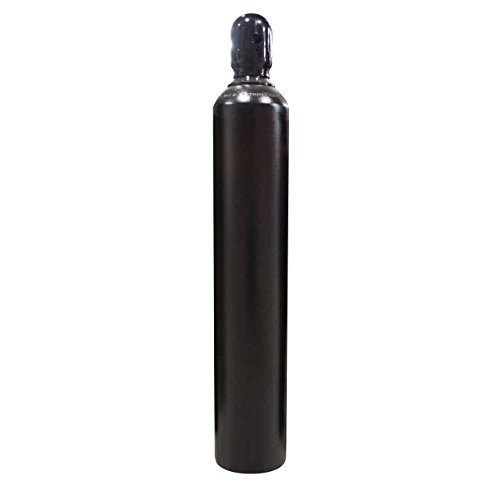
All HP cylinders come with a 10 year hydrotest date stamped.
What Affects the Cost of C25 Welding Gas?
The final cost is more than the advertised gas price. Ask the supplier for the complete out-the-door amount before comparing quotes.
The main variables are:
- Cylinder size: A larger cylinder carries more gas and can reduce how often you make refill or exchange trips.
- Fill versus exchange: Some programs swap your empty cylinder for another full cylinder rather than filling your exact bottle.
- Cylinder ownership: The supplier may have different rules for customer-owned, leased, rented, or supplier-branded cylinders.
- Cylinder condition and qualification: A supplier may inspect the cylinder and may have additional requirements if it is out of its required qualification period.
- Additional charges: Depending on the supplier, the total can include handling, hazardous-material, testing, rental or lease, delivery, and tax charges.
- Local availability: The gas blend and cylinder size you need may not be in stock on the day you visit.
The most useful comparison is therefore the total cost to leave the store with a usable full cylinder, not the gas price by itself.
Common C25 Tank Sizes and Price Benchmarks

Common owner-cylinder sizes include small portable bottles and larger 80 CF and 125 CF cylinders. Published retail pricing shows why you should compare the gas charge separately from the cylinder purchase price.
As of August 10, 2026, Northern Tool’s gas-cylinder listings show examples including:
- 20 CF C25 fill/exchange: $47.99 at participating locations.
- 80 CF C25 exchange: $69.99 at participating locations.
- 125 CF C25 fill/exchange: $69.99 at participating locations.
These are retailer benchmarks rather than Harrisburg market averages. A larger cylinder can be more convenient for frequent welding because you make fewer supplier trips, but cylinder purchase, rental, handling, and exchange policies can change the real long-term cost.
Products Worth Considering

All HP cylinders come with a 10 year hydrotest date stamped.

Welding Gas to Your Door - Get PrimeWeld's industrial grade Argon welding gas delivered right to your door. We offer different mixtures for any application, and you can purchase a tank without worrying about costly rental fees or wasted trips out to your local welding supply shop.

APPLICATION: The ARCCAPTAIN gas pressure regulator can be used with argon, helium, and carbon dioxide gas tanks.
Refilling or Exchanging vs. Purchasing a New Tank
If you already own a cylinder that the supplier accepts, paying for the gas fill or exchange generally requires a much smaller immediate outlay than buying another cylinder. The decision changes if the supplier will not accept the cylinder, the cylinder requires testing, or a rental or lease program better fits your usage.
Cost Comparison Analysis
Use this framework instead of comparing one refill number with one purchase number:
- Already own an accepted cylinder: Ask for the fill or exchange price plus every required fee.
- Do not own a cylinder: Compare buying a cylinder with the supplier’s lease or rental program.
- Own an older or unfamiliar cylinder: Give the supplier the cylinder size, ownership markings, and qualification date before making the trip.
- Weld frequently: Compare the annual cost and convenience of a larger cylinder rather than focusing only on the first fill.
Refilling and Exchange Limitations Explained
Cylinder rules are supplier-specific. Do not assume that every Harrisburg shop will refill your exact cylinder or that every shop follows the same exchange policy.
Before visiting, ask whether the supplier accepts customer-owned cylinders, whether it performs a fill or an exchange, whether proof of ownership is required, and whether cylinder testing or qualification affects the transaction.
| Question | Refill / Exchange | Buy New |
|---|---|---|
| Upfront cost | Usually limited to gas and applicable service charges if your cylinder is accepted | Includes the cylinder purchase plus gas |
| Cylinder policy | Supplier must accept your cylinder or exchange program | Starts with a cylinder approved for that seller’s program |
| Testing concerns | Cylinder condition and qualification can affect acceptance | New cylinder avoids an immediate older-cylinder qualification issue |
| Best fit | Usually the first option to price if you already own an accepted cylinder | Useful if you need to establish ownership or your old cylinder cannot be accepted |
What Extra Welding-Gas Fees Should You Ask About?
Do not compare suppliers using the gas charge alone. Ask each shop to quote the total out-the-door price for your exact cylinder and situation.
Possible charges to ask about include:
- Gas fill or exchange charge: The cost of the C25 contents.
- Handling or hazardous-material charges: Ask whether any apply to the transaction.
- Cylinder testing or qualification charges: These may matter with an older customer-owned cylinder.
- Rental or lease charges: Relevant if you do not own the cylinder.
- Delivery charges: Relevant if the gas is delivered rather than picked up.
- Taxes and other store charges: Include them when comparing competing quotes.
For a deeper comparison of ownership and rental arrangements, see our 75/25 welding gas bottle rental cost guide.
How Long Does a C25 Welding Gas Tank Last?
A simple estimate is:
Continuous gas-flow hours = cylinder capacity in CF ÷ flow rate in CFH.
For example, a 125 CF cylinder flowing at 20 CFH gives approximately 6.25 hours of continuous gas flow. At 25 CFH, the same cylinder gives approximately 5 hours.
Calculating Gas Duration
Use three steps:
- Find the cylinder capacity: For example, 80 CF or 125 CF.
- Read your actual flowmeter setting: Use the CFH setting you are running for the job rather than assuming one universal value.
- Divide capacity by flow: 80 CF ÷ 20 CFH = about 4 hours; 125 CF ÷ 20 CFH = about 6.25 hours.
This is an estimate of continuous gas flow, not elapsed shop time. Actual project time can be much longer because the arc is not running continuously.
How Does Flow Rate Affect Tank Life?
Higher gas flow consumes the cylinder faster. For a 125 CF cylinder:
- At 15 CFH: approximately 8.3 hours of continuous flow.
- At 20 CFH: approximately 6.25 hours.
- At 25 CFH: approximately 5 hours.
Use the settings recommended for your welding equipment, joint, process, and working conditions rather than lowering flow simply to save gas. Poor shielding can lead to weld contamination or porosity.
Tank Size Considerations
A larger cylinder mainly buys convenience and more welding time between supplier visits.
- 80 CF at 20 CFH: About 4 hours of continuous gas flow.
- 125 CF at 20 CFH: About 6.25 hours.
- Supplier trips: Frequent welders may benefit from the larger cylinder even when the refill price difference is small.
Do not use a single pressure reading as the only basis for planning a job. Watch your equipment normally and arrange a refill or exchange before a critical project if the remaining supply is uncertain.
Where Can You Buy or Refill C25 Welding Gas in Harrisburg?

Two verified welding-gas suppliers have Harrisburg locations:
- Airgas Store – Harrisburg: 2635 Sycamore St, Harrisburg, PA 17111; phone (717) 238-5520. The official location page lists industrial gases and welding supplies and advises customers to check the branch for specific availability.
- Linde Welding Gas & Equipment Center – Harrisburg: 2551 Paxton Street, Harrisburg, PA 17111; phone (717) 232-3173. Linde’s Harrisburg location lists industrial and welding gases among its offerings.
Neither public branch page provides a current 125 CF C25 walk-in price, so call before leaving home.
When you call, say that you need C25, 75% Argon / 25% CO2 and give the cylinder size. Then ask whether the shop fills or exchanges that size, whether your customer-owned cylinder is acceptable, and what the complete price will be.
Northern Tool’s published 125 CF C25 pricing is useful as a comparison benchmark, but verify that any retailer you plan to use actually offers the gas program at a convenient participating location before traveling.
Products Worth Considering

【Argon Hose Material & Fittings】15FT Argon hose designed for inert gas welding hose systems, compatible with Miller/Lincoln TIG/MIG welders and argon/CO2/Helium mixtures. Fits standard welding gas hose regulators, flow meters, and welding accessories, ensuring seamless integration with argon regulator setups
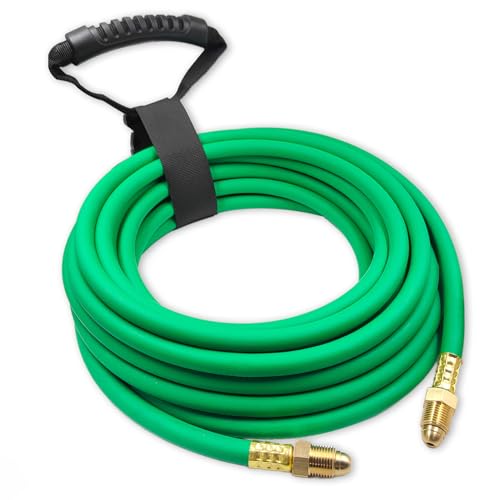
【Argon Hose Material & Fittings】30FT Argon hose designed for inert gas welding hose systems, compatible with Miller/Lincoln TIG/MIG welders and argon/CO2/Helium mixtures. Fits standard welding gas hose regulators, flow meters, and welding accessories, ensuring seamless integration with argon regulator setups

【Argon Hose Material & Fittings】5FT Argon hose designed for inert gas welding hose systems, compatible with Miller/Lincoln TIG/MIG welders and argon/CO2/Helium mixtures. Fits standard welding gas hose regulators, flow meters, and welding accessories, ensuring seamless integration with argon regulator setups
Alternatives to Traditional Welding Gas
If the cost or inconvenience of cylinder gas is the main problem, self-shielded flux-cored welding and stick welding are two processes that can work without an external shielding-gas cylinder.
Flux-Cored Welding Wire
Self-shielded flux-cored wire can be useful when:
- You weld outdoors: It is generally less vulnerable to wind disrupting an external shielding-gas envelope.
- You want to avoid a gas cylinder: The appropriate self-shielded wire supplies its own shielding system.
- Portability matters: You do not have to move a shielding-gas cylinder with the welder.
The trade-offs can include more smoke, spatter, and slag cleanup than gas-shielded MIG, depending on the wire and application.
Stick Welding Techniques
Stick welding, or Shielded Metal Arc Welding (SMAW), uses a flux-coated consumable electrode and does not require a separate shielding-gas cylinder.
It is widely used for repair, fabrication, and outdoor work. The correct electrode, polarity, amperage, joint preparation, and base material still matter, so it should be treated as a different welding process rather than a direct drop-in substitute for every C25 MIG job.
What Should You Ask a Harrisburg Welding-Gas Supplier Before You Go?
A two-minute phone call can prevent an unnecessary trip and gives you a much better price comparison than relying on an old online refill figure.
Ask these questions:
- Do you currently have C25, 75% Argon / 25% CO2, in my cylinder size?
- Do you refill my cylinder or exchange it for another cylinder?
- Do you accept customer-owned cylinders?
- Do you need proof of ownership or specific cylinder markings?
- Does the cylinder’s qualification date affect whether you will accept it?
- What is the complete out-the-door price, including gas and every required fee?
- If I do not own a cylinder, what are the purchase, rental, or lease options?
Write down the answers from each supplier and compare the same cylinder size and transaction type. That gives you a useful Harrisburg price comparison instead of mixing a gas-only exchange quote with the cost of buying a new cylinder.
Frequently Asked Questions
How Much Does a 125 CF C25 Refill Cost in Harrisburg, PA?
A verified citywide Harrisburg price is not publicly posted by the local Airgas or Linde branch pages as of August 10, 2026. As a current comparison benchmark, Northern Tool lists a 125 CF C25 fill or exchange at $69.99 at participating stores. Call the Harrisburg supplier for its current out-the-door quote.
Where Can I Get 75/25 Welding Gas in Harrisburg?
Airgas has a branch at 2635 Sycamore St, Harrisburg, PA 17111, and Linde has a Welding Gas & Equipment Center at 2551 Paxton Street, Harrisburg, PA 17111. Call first to confirm C25 cylinder size, availability, and current pricing.
How Long Does a 125 CF C25 Tank Last?
Divide the cylinder capacity by your actual flow rate. At 20 CFH, a 125 CF cylinder provides about 6.25 hours of continuous gas flow. At 25 CFH, it provides about 5 hours. Actual elapsed project time is usually longer because the gas is not flowing continuously during every minute in the shop.
Should I Refill, Exchange, Rent, or Buy a C25 Cylinder?
If you already own a cylinder the supplier accepts, start by pricing a fill or exchange. If you do not own one, compare the supplier’s purchase, rental, and lease options. Ask about cylinder qualification, ownership requirements, and all required charges before deciding.
Is 75/25 Argon/CO2 Good for MIG Welding Mild Steel?
Yes. C25 is a common shielding-gas choice for mild-steel MIG welding. It is valued for good arc characteristics, good bead appearance, and relatively low spatter compared with straight CO2.
What Safety Precautions Should I Take With a C25 Cylinder?
Secure compressed-gas cylinders so they cannot fall, protect the valve during transport and storage as required, and use the gas in a properly ventilated work area. Do not rely on smell to detect a leak. Argon and carbon dioxide can displace oxygen, creating an asphyxiation risk, especially in confined or poorly ventilated spaces. Follow the cylinder supplier’s SDS, your regulator instructions, and applicable workplace safety requirements.
For compressed-cylinder handling guidance, see the OSHA welding and compressed-gas cylinder requirements.
Conclusion
The most useful answer to the cost of 75/25 welding gas in Harrisburg, PA
