

As of August 10, 2026, complete stick welding lead packages in the current examples cost about $485 for 50 feet of total cable, $655 for 100 feet, and $1,055 for 200 feet. A Miller 2/0 set with 150 feet of total cable is about $1,925. The price you should pay depends on required amperage, duty cycle, total circuit length, cable size, connector fit, holder and work-clamp ratings, and shipping.
Affiliate disclosure: This page contains affiliate product links. We may earn a commission from qualifying purchases at no extra cost to you.
Quick Answer
As of August 10, 2026, assembled stick welding lead packages in the checked examples cost about $485 to $1,055 for 50 to 200 feet of total cable. A 150-foot Miller 2/0 set is about $1,925. Bulk cable can cost less upfront, but connectors, an electrode holder, a work clamp, lugs, tools, and assembly can narrow the difference.
Key Takeaways
- Package length may mean total cable in the welding circuit, not that both the electrode and work leads are that full length.
- Choose cable size from your power-source manual using maximum amperage, duty cycle, and the length definition used by that specific chart.
- A complete package costs more than bulk cable because it can include connectors, an electrode holder, a work clamp, and assembly.
- Fine-stranded copper cable with a durable EPDM jacket usually costs more but is easier to handle and better suited to welding service.
- Prices and sale labels change often, so compare specifications and delivered cost rather than relying on an old list price.
Last updated: August 10, 2026 — package prices, stock status, cable specifications, and safety references rechecked.
How this guide was checked: We compared current retailer listings, manufacturer cable specifications, and OSHA and Miller guidance. The product comparisons are specification- and price-based; they are not presented as hands-on durability tests.
Note: The package prices below were rechecked on August 10, 2026 and are examples from current retailer listings. Taxes, shipping, stock status, cable color, connector style, and promotions can change the final price.
Stick Welding Lead Cost Snapshot
The current complete-package examples range from $485 to $1,925. The price per total cable foot falls as the standard 1/0 packages get longer, but cable size and included hardware differ, so cost per foot is useful only after the set is electrically suitable for your welder.
| Current Example | Total Cable | Cable / Package Detail | Price | Approx. Price per Total Cable Foot |
|---|---|---|---|---|
| 50-ft complete package | 50 ft | 1/0 cable plus connectors, holder, and clamp | $485 | $9.70/ft |
| 100-ft complete package | 100 ft | 1/0 cable plus connectors, holder, and clamp | $655 | $6.55/ft |
| 200-ft complete package | 200 ft | Two 100-ft lengths of 1/0 cable plus connectors, holder, and clamp | $1,055 | $5.28/ft |
| Miller 043952 2/0 set | 150 ft | 100-ft electrode cable + 50-ft work cable; rated up to 300 A at 100% duty cycle | $1,925 | $12.83/ft |
Do not buy by price per foot alone. First size the cable for amperage, duty cycle, and the circuit-length definition in your power-source manual. Then compare delivered cost among sets that meet those requirements.
Factors Affecting Welding Lead Prices

Several factors determine how much stick welding leads cost. Length matters, but it is only one part of the price. A correctly sized 100-foot circuit can cost more than a longer circuit made with smaller cable because copper size, cable construction, and included hardware also affect the total.
Package Length and Actual Lead Length
Read the product description carefully. A package labeled “50 ft.” may contain 50 feet of total cable that is divided between the electrode lead and the work lead. It may not contain two separate 50-foot leads. A 200-foot package may contain two 100-foot cables. This distinction affects both reach and cable-size calculations.
Cable Gauge, Amperage, and Duty Cycle
Larger copper conductors cost more because they use more material and weigh more. Cable size must be selected for the welder’s maximum output, duty cycle, and the length basis used by the applicable cable chart. Miller Electric’s voltage-drop guidance notes that undersized weld leads can overheat, add resistance, and increase voltage drop, and it advises including the entire weld circuit when sizing cables. Use your exact power-source manual for the final cable size.
Gauge wording can be confusing. In American Wire Gauge, 2/0 is much larger than #2. Avoid describing 2/0 simply as a “higher gauge,” because larger AWG numbers normally indicate smaller conductors, while 1/0, 2/0, 3/0, and 4/0 become progressively larger.
Copper Construction and Insulation
Professional welding cable normally uses many fine strands of copper so it can flex without becoming difficult to route. Jacket material also matters. Kalas lists bare-copper conductors and EPDM insulation for both ToughFlex welding cable and FlexWhip welding cable. FlexWhip uses finer 34-gauge strands for extra flexibility.
Included Hardware and Connector Type
Complete lead sets may include an electrode holder, work clamp, cable lugs, and quick-connect plugs. Hardware size and quality affect cost. Check the amperage rating and connection style before buying. Common interfaces include DINSE-style plugs, Tweco-style connectors, studs, and lugs, and they are not automatically interchangeable.
Brand, Assembly, Shipping, and Availability
OEM sets from major welder manufacturers often cost more than bulk cable or third-party assemblies. A documented lead configuration, branded hardware, factory assembly, and stated current or duty-cycle ratings can raise the package price. Heavy copper cable can also create meaningful shipping charges, especially for 200-foot packages and 250-foot reels.
How Much Do Stick Welding Leads Cost?

Current listings show a wide price range because products with similar length labels may use different cable sizes or include different hardware. The table below compares assembled packages from the same retailer so the length and price differences are easier to understand.
Products Worth Considering

【2 Pack Welding Cable Connections】The LC-40 Cable Connector Set ensures secure and reliable connections between welding cables, welding cable connectors maintaining electrical integrity during operations. The cam-type action provides a positive stop and lock for added security

Package Including Premium Quality 2pcs CT-40FA welding terminals, 2pcs LC40 male cable connectors

Price Comparison Across Lengths
| Example Package | What the Length Means | Price Checked August 10, 2026 | Approx. Price per Total Cable Foot |
|---|---|---|---|
| 50 Ft. Stick Welding Leads Package | 50 feet of total 1/0 cable plus connectors, holder, and clamp | $485 | $9.70/ft |
| 100 Ft. Stick Welding Leads Package | 100 feet of total 1/0 cable plus connectors, holder, and clamp | $655 | $6.55/ft |
| 200 Ft. Stick Welding Leads Package | Two 100-foot lengths of 1/0 cable plus connectors, holder, and clamp | $1,055 | $5.28/ft |
| Miller 100′ Leads 2/0 Set | 100-foot electrode cable plus 50-foot work cable, 150 feet total | $1,925 | $12.83/ft |
In these examples, the standard 1/0 packages work out to about $9.70, $6.55, and $5.28 per foot of total cable at 50, 100, and 200 feet. The Miller set is about $12.83 per foot because it uses 2/0 cable, includes factory-assembled hardware, and is rated for up to 300 amps at a 100% duty cycle. These figures compare package economics only; cable size and electrical suitability come first.
Variants and Features Offered
Stick welding leads are sold in three main forms:
- Bulk cable: The lowest starting price, but it does not include connectors, a holder, a clamp, or assembly.
- Complete aftermarket packages: Cable and hardware are assembled or supplied as a kit. These are convenient when the connector style matches your machine.
- OEM cable sets: Manufacturer-branded assemblies with defined cable sizes, lead lengths, and current ratings. These usually carry the highest price.
For comparison, a current listing for 100 feet of Kalas 1/0 ToughFlex bulk cable is about $425. A 250-foot reel of 1/0 FlexWhip is listed around $1,075 and was sold out when checked on August 10, 2026. These cable-only prices exclude some or all assembly hardware. For a broader gauge-by-gauge view, see our welding cable pricing guide.
Compare Delivered Cost, Not Sticker Price
Sale prices can reduce the cost of a complete package, but the “regular” or crossed-out price is not always a useful comparison. Confirm that the cable size, total length, holder rating, clamp rating, and connector type match your welder before treating a discount as good value.
Pro Tip: Compare delivered cost per usable foot only after confirming the cable is large enough. A cheaper undersized lead can run hot, increase voltage drop, and provide worse value than a shorter correctly sized set.
How to Choose the Right Welding Cable Size
Cable size is a safety and performance decision, not just a budget choice. Use this process before ordering:
- Find the maximum welding amperage you expect to use, not only your usual setting.
- Check the duty cycle at that amperage. Continuous or high-duty work can require a larger conductor.
- Add both lead lengths together. A 50-foot electrode lead and a 50-foot work lead create a 100-foot welding circuit.
- Use the chart in your welder’s manual. Manufacturer charts can differ by machine and application.
- Match every component. The connectors, holder, clamp, and lugs must safely handle the selected amperage and cable size.
Note: The example chart below uses the combined copper length of the electrode and work leads. If both leads travel 100 feet, that is 200 feet of circuit cable for this chart. Other sizing tools may define distance differently, so follow the exact length definition in your power-source manual or chart.
The following values come from the copper-cable guide published at MillerWelds.ca and use combined circuit length. Treat them as worked examples, not as a substitute for the cable chart in your exact power-source manual.
| Welding Current | 100 ft or Less, 10% to 60% Duty Cycle | 100 ft or Less, 60% to 100% Duty Cycle | 150 ft, 10% to 100% | 200 ft, 10% to 100% |
|---|---|---|---|---|
| 150 A | #3 AWG | #3 AWG | #2 AWG | #1 AWG |
| 200 A | #3 AWG | #2 AWG | #1 AWG | 1/0 AWG |
| 300 A | #1 AWG | 1/0 AWG | 2/0 AWG | 3/0 AWG |
Products Worth Considering
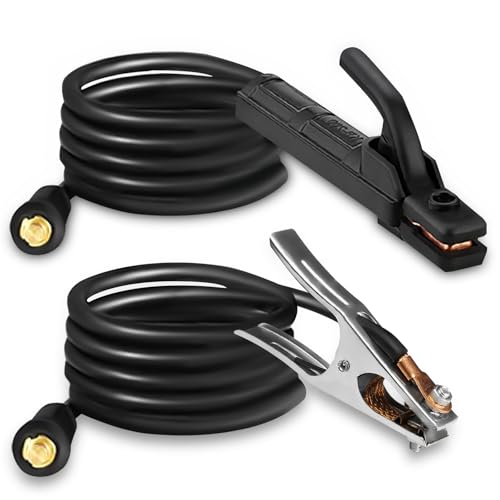
COMPLETE WELDING SET READY TO USE — Unlike standalone electrode holders that leave you searching for cables and ground clamps, this all-in-one set has everything you need: 300A electrode holder, 6.5ft welding cable, ground clamp, and Dinse 10-25 & 35-50 connector. Fully assembled with no tools required — just plug in and start welding in minutes. Rated 300A for consistent performance in home garage, farm, and light commercial stick welding applications.

EXTREME FLEXIBILITY FOR WELDING, ROBOTICS & AUTOMATION Designed with ultra-fine 34-AWG Class M copper stranding for maximum bendability and ease of routing in high-movement environments such as welding, robotics, CNC machinery, pipeline equipment, and industrial automation. Perfect for tight spaces and continuous-flex applications.

Heavy Duty Welding Lead Assembly manufactured with Made in USA Flex-A-Prene highly flexible cable. Cable Size: #2 AWG - 0.418" O.D.
ToughFlex vs FlexWhip vs Miller 2/0 Lead Set

The original options are not all the same product category. ToughFlex and FlexWhip are bulk welding-cable families, while the Miller 2/0 product is a completed lead set. The objective specifications below provide a more useful comparison than subjective labels such as “premium” or “superior.”
| Option | Construction or Rating | Best Fit |
|---|---|---|
| Kalas ToughFlex | Bare copper, EPDM jacket, sizes from 250 MCM to #8, oil- and flame-resistant | General-purpose leads where durability and broad size choice matter |
| Kalas FlexWhip | 34-gauge bare-copper strands, EPDM jacket, sizes #2 through 2/0, rated from -50°C to 105°C | Whips and leads that must bend easily in tight or mobile work areas |
| Miller 043952 2/0 Set | 100-foot electrode cable, 50-foot work cable, holder and clamp, rated 300 A at 100% duty cycle | High-output work where a complete factory-assembled 2/0 set is preferred |
ToughFlex emphasizes durability across many sizes, while FlexWhip uses finer strands for easier handling. The Miller set costs more because it combines large 2/0 cable with finished components and a stated continuous-duty rating.
Products Worth Considering

Feaure : 1. For Sn63 / 37 solder bar , made of pure tin, lead and alloy, has good purity, making it easy to solder,low melting solder quickly and solidify easily.

USA-made 2 AWG heavy duty welding cable (EPDM rubber jacketed black cover) for use where maximum flexibility and resistance to cuts, tears, abrasion is required. Max volt 600V, -50C to 105C. Resistant to chemicals, oils, and acids and is also weather, ozone and sunlight resistant. Available welding cable sets: welding cable only; stick electrode holder set and work clamp set.

Heavy Duty Welding Lead Assembly manufactured with Made in USA Flex-A-Prene highly flexible cable. Cable Size: #2 AWG - 0.418" O.D.
Accessory Costs Associated With Welding Leads

Bulk cable is only one part of a working lead set. Depending on your welder and cable size, you may also need an electrode holder, work clamp, quick connectors, terminal lugs, heat-shrink or insulating boots, and tools for secure crimped or mechanically fastened connections.
| Accessory Example | Price / Status Checked August 10, 2026 | Important Compatibility Detail |
|---|---|---|
| Tweco 10-foot work-clamp assembly | $82.99; in stock when checked | #2 neoprene cable, 200 A clamp, 50 mm male DINSE-style connector |
| Tweco 13-foot electrode-holder assembly | $82.99; sold out when checked | #2 neoprene cable, 200 A holder, 50 mm male DINSE-style connector |
| Miller 10-foot 2/0 work cable with clamp | $235; sold out when checked | Rated up to 400 A and includes a Tweco-style male connector |
| Tweco GC-300 work clamp | About $59.99 | Clamp rating must meet the welding current and provide clean metal contact |
| Tweco A-732 electrode holder | About $67.99 | Holder and cable connection must accept the selected electrode and conductor size |
The clamp lead is more accurately called the work lead. It completes the welding circuit but does not replace the equipment-grounding conductor required for the welding machine.
How to Evaluate Welding Lead Discounts

Discounts can reduce the upfront cost, but welding-cable prices move with inventory, copper costs, package configuration, and retailer promotions. At the August 10 check, the 50-, 100-, and 200-foot packages were displayed below higher crossed-out prices. Treat that as a current retailer promotion, not as proof that the package is the best value for your welder.
The best value is the shortest correctly sized cable set that safely carries your required amperage and still gives you enough working reach.
Before buying a sale item, compare these details:
- Total copper length, not only the package name
- AWG size and conductor material
- Duty-cycle and amperage rating
- Included holder, clamp, connectors, and lugs
- Stock status, shipping charge, return policy, and warranty
Seasonal offers can be useful, especially on complete packages, but an old crossed-out price should not be treated as a permanent market benchmark.
Which Welding Lead Setup Fits Your Use Case?

Popularity is less useful than electrical fit, reach, and handling. Compare the common options by application:
- Short shop or repair work: A correctly sized 50-foot total-cable package can reduce cost and clutter when the welder stays close to the work.
- General fabrication: A 100-foot total-cable package offers more reach while keeping the cost below most long-reach sets.
- Large work areas: A 200-foot package provides two 100-foot leads, but the 1/0 cable and added copper weight raise the price.
- High-output continuous work: The Miller 2/0 set is rated for 300 A at a 100% duty cycle and includes 150 feet of total cable.
- Custom assemblies: Bulk ToughFlex or FlexWhip cable lets you choose exact lead lengths and hardware, but proper assembly is essential.
Choose by electrical requirements, connector fit, handling needs, and service conditions rather than sales rank alone.
Importance of Quality in Welding Leads

Quality welding leads help carry current with less unwanted voltage drop and heat. Correctly sized copper cable, clean connections, a firm work clamp, and an undamaged jacket support a more stable welding circuit. Poor connections or undersized cable can become hot and waste part of the machine’s output.
Safety is equally important. OSHA’s arc-welding rules require damaged cable with exposed bare conductors to be removed from service in general-industry workplaces. OSHA also says coiled welding cable should be spread out before use to reduce overheating and insulation damage.
Warning: Turn off the welding power source before connecting, disconnecting, inspecting, or repairing output cables. Do not use leads with exposed conductor, loose lugs, burnt connectors, damaged insulation, or a holder that can contact people or conductive objects.
Construction-work rules also require flexible, fully insulated cable capable of carrying the maximum current while accounting for duty cycle. They require properly insulated, adequately rated connectors when cable lengths are joined. See OSHA 29 CFR 1926.351.
Budget-Friendly Options for Casual Welders

Casual welders can control cost without buying undersized cable. Start with the shortest reach that works in your shop, then use the machine’s cable chart to choose the conductor size. A compact setup is usually cheaper, lighter, and easier to store than a long set.
Affordable Lead Packages
Among the complete current examples, the 50-foot total-cable package is the lowest-priced at about $485. The 100-foot package is about $655 and may offer better reach per dollar. These packages include 1/0 cable and common Tweco components, but you still need to confirm that the connectors fit your welder.
For a smaller machine and shorter circuit, an OEM short-lead set may be practical even when its price per foot is higher. Match the cable to the machine rather than automatically choosing the least expensive package.
Essential Accessories Included
A complete package can save time because it may include an electrode holder, work clamp, quick connectors, and lugs. Check whether the package is fully assembled or only supplies loose parts. Also confirm the holder and clamp ratings, cable connection range, and plug size.
Buying separate accessories can add roughly $50 to $85 per holder or clamp assembly before connectors and assembly tools. This is why a complete package may cost less than building an identical set from individually purchased parts.
Cost-Effective Cable Options
Bulk cable is attractive when you already own compatible hardware or need custom lengths. Current examples include:
- 100 feet of Kalas 1/0 ToughFlex: about $425 for the cable only.
- 250 feet of Kalas 1/0 FlexWhip: about $1,075 for a highly flexible reel; sold out when checked August 10, 2026.
Add the cost of connectors, lugs, holder, clamp, insulation, and proper assembly before comparing a DIY set with a finished package.
Is It Cheaper to Build or Buy Welding Leads?
Building your own leads can cost less when you already have a suitable crimper, cutters, connectors, holder, clamp, and experience making high-current cable terminations. It also lets you choose unequal lengths, such as a long electrode lead and a shorter work lead.
A ready-made package is often the better value when you need all components. It reduces the chance of ordering a connector that does not fit, a lug that does not match the cable, or a holder that is not rated for the required current.
As a current budget benchmark, 100 feet of 1/0 ToughFlex bulk cable is listed around $425, while the 100-foot complete-package example is $655—a $230 difference before you compare the exact cable construction, holder, clamp, connectors, lugs, assembly tools, and shipping. That is a budgeting comparison, not a claim that the two packages use identical cable.
Note: A poor high-current termination can overheat even when the cable itself is correctly sized. Use components and connection methods intended for welding service, and have a qualified person assemble or inspect the leads when you are unsure.
Welding Lead Inspection and Maintenance
Regular inspection protects both the cable and the operator. Use this checklist before welding:
- Disconnect or shut down the power source before handling output connections.
- Inspect the full jacket for cuts, burns, crushed areas, exposed copper, and stiff or swollen sections.
- Check lugs and connectors for looseness, discoloration, pitting, or heat damage.
- Clean metal debris and weld spatter from the work clamp so it can make firm electrical contact.
- Lay coiled cable out during use instead of leaving a tight coil that can trap heat.
- Keep the electrode holder dry, fully insulated, and positioned where it cannot touch people, cylinders, fuel containers, or conductive surfaces.
- Store leads loosely coiled in a dry area away from sharp edges, oil contamination beyond the jacket rating, and vehicle traffic.
Replace cable with exposed conductors as required for your workplace and application. Where joining cable is allowed, use insulated connectors specifically designed for the cable size and welding current. Do not make casual twists, bare-bolt joints, or undersized splices.
Stick Welding Lead Buying Checklist
- Maximum amperage: Select for the highest output you will use.
- Duty cycle: High-duty work may require larger cable.
- Total circuit length: Add the electrode and work leads together.
- Cable size: Follow the exact power-source manual or manufacturer chart.
- Conductor and jacket: Look for flexible copper welding cable with insulation suited to your shop or field conditions.
- Connector fit: Confirm DINSE size, Tweco style, lug hole, stud diameter, and polarity arrangement.
- Holder and clamp ratings: Both must safely carry the welding current.
- Package contents: Check whether the cable is cut, assembled, or supplied as one bulk length.
- Delivered cost: Include shipping, taxes, tools, and missing hardware.
- Serviceability: Consider replacement connectors, warranty, and local availability.
Frequently Asked Questions
How much do stick welding leads cost in 2026?
In the examples checked August 10, 2026, complete stick welding lead packages cost about $485 for 50 feet of total cable, $655 for 100 feet, and $1,055 for 200 feet. A Miller 2/0 set with 150 feet of total cable is about $1,925. Prices can change with stock, shipping, copper costs, and promotions.
What materials are commonly used in welding leads?
Welding leads commonly use fine-stranded copper conductors for flexibility and current carrying capacity. Durable jackets are often made from EPDM or similar rubber compounds that resist abrasion, oil, heat, and flame. Always check the manufacturer’s temperature, voltage, and environmental ratings.
How do I determine the right length for my welding leads?
Measure the practical route from the welder to the work area and allow enough slack for safe movement. Keep the leads as short as practical and follow the length definition in your power-source cable chart. If that chart uses combined circuit length, add the electrode and work-lead lengths together.
What size welding cable do I need for 200 amps?
Use the cable chart in your exact power-source manual and follow its definition of length. In the example chart on this page, 200 A calls for #3 AWG at 100 feet or less for a 10% to 60% duty cycle, #2 AWG at 100 feet or less for a 60% to 100% duty cycle, #1 AWG at 150 feet, and 1/0 AWG at 200 feet.
Can I use stick welding leads for other welding processes?
The same type of welding cable may be used in other high-current welding circuits when the power-source manufacturer allows it and the cable size, connector, polarity, insulation, and current rating are correct. Do not assume a finished stick lead set will connect safely to every MIG, TIG, or engine-driven machine.
What maintenance is required for welding leads?
Inspect the jacket, connectors, lugs, holder, and work clamp before use. Keep connections tight and clean, spread out coiled cable during welding, store the leads dry, and remove damaged cable from service when insulation failure exposes the conductor.
Why do longer welding leads need larger cable?
Longer cable has more electrical resistance. At the same amperage, that can increase voltage drop and heat. A larger copper conductor lowers resistance, which is why manufacturer charts call for larger cable as the total circuit length increases.
Is the work lead the same as an electrical ground?
No. The work lead and clamp complete the welding-current circuit through the workpiece. The equipment-grounding conductor protects the welding machine’s frame and electrical system. Follow the power-source manual for both connections.
Can welding leads be spliced?
Use only insulated connectors or approved splices designed for the cable size and welding current. OSHA rules restrict repairs or splices near the electrode holder and require adequate insulation and current capacity. Replace unsafe or badly damaged cable rather than making a temporary joint.
Conclusion
As of August 10, 2026, the checked complete-package examples range from about $485 to $1,055, while the 150-foot Miller 2/0 set is about $1,925. Bulk cable can lower the starting cost, but hardware, tools, and assembly add up. Start with the maximum amperage, duty cycle, and length definition in your power-source manual; then compare delivered prices only among cable sets that meet those requirements and fit your machine.
Sources
- MillerWelds.ca Cable Size Guide — example copper-cable sizing table by amperage, duty cycle, and combined circuit length.
- Miller Electric: Understanding Voltage Drop in Welding — weld-circuit resistance, undersized leads, and cable-sizing guidance.
- OSHA 29 CFR 1910.254 — general-industry requirements for welding cable condition, connections, and safe operation.
- OSHA 29 CFR 1926.351 — construction requirements for insulated cable, current capacity, duty cycle, connectors, and repairs.
- Kalas ToughFlex Welding Cable — conductor, insulation, size range, and resistance specifications.
- Kalas FlexWhip Welding Cable — fine-strand copper construction, size range, jacket, and operating temperature.
- Welding Supplies from IOC Lead Listings — current market examples for complete lead packages, bulk cable, and accessories rechecked August 10, 2026.
