
Hotel room renovation costs vary widely because “upgrade” can mean anything from replacing carpet and bedding to rebuilding the bathroom, relocating plumbing, installing new technology, and replacing every piece of furniture. Property tier matters, but project scope, building condition, labor market, brand standards, logistics, and room downtime usually have a greater effect on the final cost.
Quick Answer
In 2026, a U.S. hotel guestroom renovation may cost about $8,000 per key for a limited update and $150,000 or more for a custom luxury room and bathroom. Most projects fall between those extremes. Scope, market, building condition, brand requirements, logistics, and downtime matter more than star rating alone.
Key Takeaways
- Treat national cost figures as early planning ranges, not contractor bids.
- Separate soft-goods work from full room, bathroom, mechanical, and property-wide renovations.
- Budget for design, permits, testing, freight, storage, tax, room downtime, and contingency.
- Review brand requirements, accessibility rules, building codes, and hazardous-material risks before bidding.
- Approve a model room before ordering and installing products across the entire property.
Average Hotel Room Renovation Costs by Type
The latest Nehmer and HVS Design Hotel Cost Estimating Guide separates renovation costs by hotel tier and by area, including guestrooms, bathrooms, corridors, public spaces, food and beverage facilities, infrastructure, and common additions.
That separation is important. A guestroom-only estimate should not be compared directly with a full property improvement plan that includes the lobby, corridors, exterior, elevators, back-of-house areas, and building systems.
The following figures are broad 2026 planning bands for U.S. hotels. They are not fixed national averages, guaranteed bids, or substitutes for an inspection and detailed estimate.
| Hotel Segment | Limited or Soft-Goods Refresh | Full Room and Bathroom Renovation |
|---|---|---|
| Economy or limited service | About $4,000 to $10,000 per key | About $8,000 to $20,000 per key |
| Midscale or upper midscale | About $6,000 to $15,000 per key | About $15,000 to $35,000 per key |
| Upscale or upper upscale | About $10,000 to $25,000 per key | About $30,000 to $75,000 per key |
| Luxury, boutique, or resort | About $15,000 to $50,000 or more per key | About $60,000 to $150,000 or more per key |
A per-key cost is useful only when the scope behind that number is clearly defined.
Custom millwork, premium stone, plumbing relocation, structural repair, union labor, remote delivery, luxury technology, and extensive bathroom work can push a project above these ranges. Reusing sound casegoods, keeping plumbing in place, standardizing finishes, and renovating similar rooms in larger batches may reduce the per-key cost.
What Counts as a Hotel Room Upgrade?
Before comparing prices, decide which type of work the project requires.
Soft-Goods Refresh
A soft-goods refresh focuses mainly on visible finishes and movable items. It may include paint, carpet or luxury vinyl flooring, bedding, drapery, upholstery, artwork, lamps, and minor decorative fixtures.
This type of project is usually less disruptive because plumbing, walls, electrical systems, and most built-in furniture remain in place.
Full Guestroom Renovation
A full guestroom renovation normally includes soft goods plus casegoods, seating, mattresses, lighting, outlets, charging points, televisions, locks, millwork, closets, doors, ceilings, and selected mechanical or electrical work.
The estimate must state whether demolition, installation, freight, tax, disposal, and temporary room protection are included.
Guestroom and Bathroom Renovation
Bathroom work can become one of the most expensive parts of a renovation when it includes plumbing relocation, waterproofing, tile, shower conversions, accessibility changes, ventilation, lighting, vanities, mirrors, and premium fixtures.
Keeping plumbing fixtures in their existing locations can reduce labor, wall repair, floor repair, and inspection requirements.
Property Improvement Plan
A property improvement plan, commonly called a PIP, may cover much more than guestrooms. Brand-required work can include corridors, the lobby, breakfast or restaurant areas, meeting rooms, signage, exterior finishes, parking, fitness facilities, elevators, fire and life-safety systems, technology, and accessibility.
Note: Ask whether a quoted “per-room” figure represents guestroom construction only, guestroom plus bathroom work, FF&E only, or the entire PIP divided by the number of rooms.
Factors That Influence Hotel Renovation Cost
Two hotels in the same segment can receive very different bids. The following factors often explain the difference:
- Scope: Paint and bedding cost much less than demolition, bathroom rebuilding, and systems work.
- Building condition: Water damage, failing plumbing, uneven floors, outdated wiring, and deferred maintenance add work that may not appear during an initial walkthrough.
- Location: Labor rates, permitting, taxes, delivery charges, parking, and contractor availability vary by market.
- Brand standards: A franchised hotel may need approved products, designs, technology, signage, and accessibility features.
- Room mix: Suites, connecting rooms, accessible rooms, and rooms with different layouts require separate quantities and details.
- Material level: Stock products usually cost less and arrive faster than custom furniture, stone, millwork, lighting, or imported finishes.
- Building systems: HVAC, plumbing, electrical service, fire alarms, sprinklers, controls, locks, and network infrastructure may require separate upgrades.
- Schedule: Compressed schedules can increase labor, supervision, shipping, and temporary-storage costs.
- Hotel operations: Keeping the hotel open requires dust control, noise control, guest routing, room isolation, and careful delivery planning.
Breakdown of Common Renovation Costs
A reliable renovation budget should show more than furniture and construction. It should identify every major cost category and state what is included.
| Budget Category | Examples |
|---|---|
| Preconstruction | Surveys, measurements, design, engineering, estimating, mock-ups, testing, and brand review |
| Demolition and protection | Removal, waste hauling, dust barriers, floor protection, temporary partitions, and daily cleaning |
| Construction and finishes | Walls, ceilings, paint, flooring, tile, millwork, doors, hardware, and bathroom work |
| FF&E | Furniture, fixtures, decorative lighting, beds, seating, desks, window treatments, and artwork |
| MEP and technology | Mechanical, electrical, plumbing, HVAC, outlets, controls, locks, Wi-Fi, televisions, and fire systems |
| Permits and compliance | Permit fees, plan review, inspections, accessibility work, environmental review, and required testing |
| Procurement and logistics | Freight, receiving, warehousing, delivery, installation, sales tax, damaged-item replacement, and attic stock |
| Operational impact | Rooms out of service, guest relocation, temporary facilities, security, signage, and extra housekeeping |
| Contingency | A controlled reserve for concealed damage, price changes, approved scope changes, and other genuine unknowns |
Economy Hotel Costs
Economy properties usually emphasize durability, quick installation, easy maintenance, and standardized products. A light update may focus on flooring, paint, bedding, window treatments, lighting, and selected furniture.
A deeper renovation becomes more expensive when it includes full bathroom work, damaged subfloors, plumbing replacement, HVAC units, door systems, or accessibility changes.
Low-cost products are not automatically the best value. A finish that fails early or requires frequent maintenance can cost more over its life than a slightly more expensive commercial-grade alternative.
Upscale Hotel Expenses
Upscale properties typically use more detailed designs, higher-grade finishes, larger rooms, more lighting, additional seating, custom casegoods, upgraded technology, and more extensive public areas.
Costs can rise quickly when the project requires custom fabrication, imported finishes, premium mattresses, built-in minibars, smart controls, acoustic treatments, or redesigned bathrooms.
Owners should separate guest-facing upgrades from infrastructure work. New finishes may improve appearance, but unresolved HVAC, plumbing, waterproofing, or electrical problems can damage the renovation and create future room outages.
Luxury Room Investments
Luxury room renovations may involve custom furniture, natural stone, specialty lighting, high-end plumbing fixtures, advanced controls, premium textiles, detailed millwork, original artwork, and more complex installation.
Suites and resort rooms may also require kitchens, bars, fireplaces, terraces, outdoor furniture, specialty glazing, or larger bathrooms. These items can move the project well above a standard per-key range.
A luxury budget should include prototypes, shop drawings, finish samples, factory inspections when needed, careful receiving, and a replacement allowance for damaged custom products.
Hidden Costs That Cause Renovation Overruns
Many overruns begin with an estimate that includes visible products but excludes the work needed to deliver and install them.
- Freight, fuel surcharges, receiving, storage, and final delivery
- Sales or use tax
- Removal and disposal of existing materials
- Night, weekend, or union labor
- Permits, inspections, engineering, and testing
- Hazardous-material surveys and abatement
- Temporary barriers, protection, signage, and cleaning
- Replacement of damaged or missing products
- Attic stock and spare parts
- Room downtime and lost-room revenue
- Guest recovery or relocation expenses
- Changes required after a brand, code, or accessibility review
Warning: A low bid may simply exclude freight, installation, permits, protection, testing, tax, or bathroom work. Compare the scope and exclusions before comparing the bottom-line price.
Practical Cost-Saving Tips for Hotel Renovations
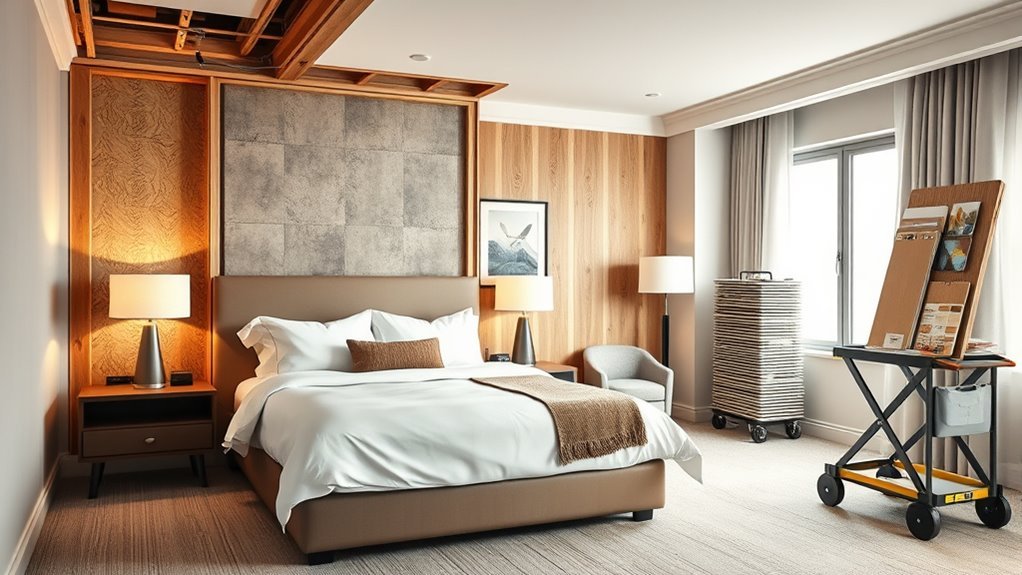
Cost control should begin before products are ordered or demolition starts. Cutting the wrong item late in the project can create delays, rework, and a weaker guest experience.
Effective cost control comes from defining the scope early, comparing equal bids, testing the design in one room, and limiting changes after procurement begins.
- Complete a condition assessment: Inspect rooms, bathrooms, plumbing, electrical systems, HVAC, waterproofing, doors, and life-safety equipment before finalizing the budget.
- Separate required and optional work: Create one list for brand, code, safety, and maintenance requirements and another for discretionary enhancements.
- Standardize repeatable items: Limit unnecessary variations in furniture, fixtures, tile, flooring, and lighting across similar room types.
- Keep sound systems in place: Refinish or reuse serviceable items when the lifecycle cost and appearance support that decision.
- Protect the schedule: Approve designs, samples, and shop drawings before demolition begins.
- Compare complete bids: Require every bidder to use the same drawings, specifications, quantities, alternates, and exclusion form.
- Control change orders: Require written pricing and approval before changed work proceeds, except for immediate safety needs.
- Use value engineering carefully: Reduce cost without weakening durability, accessibility, fire safety, waterproofing, or maintainability.
Pro Tip: Build and approve one model room before releasing the full furniture order or starting mass installation. It can reveal measurement errors, clearance problems, lighting issues, weak finishes, and housekeeping concerns while changes are still manageable.
Seasonal Trends for Planning Hotel Upgrades
Renovation timing should follow the property’s actual demand calendar, not a generic national season. A beach resort, ski hotel, convention property, and highway hotel can have completely different low-demand periods.
Peak Travel Seasons
Major work during a high-demand period can increase the cost of room downtime. Noise, dust, closed amenities, construction traffic, and limited room inventory may also affect guest satisfaction.
If work must occur during a busy period:
- Isolate construction floors or wings.
- Set strict noisy-work hours.
- Separate workers and deliveries from guest routes.
- Protect elevators, corridors, and occupied rooms.
- Keep front-desk and sales teams informed about room availability.
- Communicate any material amenity closures before arrival.
Off-Peak Maintenance Opportunities
Lower-demand periods may allow a hotel to remove more rooms from service with less lost revenue. They can also make deliveries, contractor access, inspections, and utility shutdowns easier to manage.
Off-peak work does not automatically make labor or materials cheaper, and a renovation does not guarantee higher occupancy. The financial benefit must be tested against the property’s expected room revenue, contractor schedule, product lead times, and reopening date.
Accessibility, Code, and Safety Requirements
Hotel renovations must be reviewed under the building, fire, electrical, plumbing, mechanical, energy, and accessibility rules adopted by the local jurisdiction.
The ADA Standards for Accessible Design apply to alterations that affect usability. Depending on the project, the review may include accessible guestrooms, bathroom clearances, doors, hardware, controls, communication features, routes, counters, and common areas.
Older commercial buildings should also be evaluated for hazardous materials before demolition. The U.S. Environmental Protection Agency explains that asbestos requirements can apply to commercial renovation work. Construction work involving lead-containing materials is covered by the applicable OSHA lead standard.
Warning: Do not begin destructive work based only on a visual estimate. Use qualified designers, engineers, environmental professionals, and licensed contractors to determine the rules and testing required for the specific property.
Why Sustainable Upgrades Matter in Hospitality
Sustainable upgrades can reduce utility use, maintenance, waste, and replacement frequency when they are selected for the building and verified after installation.
Energy savings should be measured against the property’s actual baseline, not promised as a fixed percentage of total operating cost.
According to ENERGY STAR guidance for lodging properties, lighting represents almost one-quarter of the electricity consumed by a typical hotel, excluding its effect on cooling. Depending on the starting system, a lighting retrofit may reduce lighting electricity use by 50% or more and may also lower cooling demand.
Potential renovation measures include:
- LED lighting and properly designed controls
- Efficient HVAC equipment and guestroom controls
- Low-flow plumbing fixtures that maintain acceptable performance
- Improved insulation and air sealing where practical
- Durable, repairable, and replaceable finishes
- Products with lower maintenance requirements
- Construction-waste sorting and material reuse
Before approving an efficiency measure, compare its installed cost, expected life, maintenance needs, utility savings, available rebates, and effect on guest comfort. Use qualified energy and tax professionals before relying on any incentive or deduction.
How to Calculate Renovation Return on Investment
A renovation may create value through higher room rates, stronger occupancy, lower utilities, fewer repairs, improved brand compliance, or reduced room outages. None of these outcomes is automatic.
A simple annual benefit estimate can include:
- Incremental room revenue from an achievable ADR increase
- Incremental room revenue from an achievable occupancy increase
- Documented utility savings
- Reduced repair and replacement expenses
- Revenue preserved by reducing out-of-order rooms
Subtract additional operating expenses, financing costs, and replacement reserves from those benefits. Then compare the net annual benefit with the total project cost.
Note: Use conservative assumptions. Compare the renovated property with its realistic unrenovated performance, not with an ideal best-case forecast.
Crafting Your Renovation Budget: A Step-by-Step Guide
- Define the project objective: State whether the project addresses condition, brand compliance, repositioning, accessibility, operating efficiency, or several goals.
- Document every room type: Measure standard rooms, suites, connecting rooms, and accessible rooms separately.
- Inspect concealed-risk areas: Review plumbing, electrical systems, HVAC, waterproofing, subfloors, walls, ceilings, and signs of moisture.
- Reconcile all requirements: Combine the owner’s scope, brand PIP, code requirements, accessibility work, deferred maintenance, and desired upgrades.
- Prepare drawings and specifications: Give every bidder the same information so prices can be compared fairly.
- Create a quantity schedule: Count furniture, fixtures, finishes, hardware, equipment, and spare stock by room type.
- Price the complete project: Include construction, FF&E, professional fees, permits, testing, freight, warehousing, installation, tax, and operational disruption.
- Add a controlled contingency: Renovations commonly carry more uncertainty than new work because concealed conditions are harder to predict. Set the reserve according to the building’s age, investigation quality, and project complexity.
- Build and approve a model room: Confirm appearance, clearances, durability, housekeeping needs, installation sequence, and brand approval.
- Track commitments and forecasts: Update the budget for contracts, purchase orders, approved changes, pending risks, invoices, and expected final cost.
A practical budget formula is:
Total project budget = construction + FF&E + professional and compliance costs + procurement and logistics + operational impact + contingency.
How to Compare Hotel Renovation Bids
Do not choose a contractor based only on the lowest total. Create a bid-leveling sheet that compares the same categories across every proposal.
- Scope included and excluded
- Allowances and unit prices
- Demolition and disposal
- Permits and inspections
- Night or weekend work
- Site supervision and project management
- Protection, dust control, and cleaning
- Freight, storage, delivery, and installation
- Schedule and rooms renovated per phase
- Warranty and closeout requirements
- Insurance, licensing, and relevant hotel experience
Clarify every exclusion before award. An omitted bathroom, corridor, tax, freight, or protection allowance can be much larger than the apparent difference between two bids.
Sources
- Nehmer and HVS Design 2026 Hotel Cost Estimating Guide — hotel renovation cost categories by property tier and area.
- U.S. Department of Justice ADA Standards for Accessible Design — accessibility requirements that may apply to hotel alterations.
- U.S. Environmental Protection Agency asbestos guidance — commercial renovation and demolition responsibilities.
- Occupational Safety and Health Administration lead standard — construction work involving lead-containing materials.
- ENERGY STAR lodging energy guidance — hotel lighting and energy-efficiency opportunities.
Frequently Asked Questions
What is the 30% rule for hotel renovations?
There is no universal rule requiring a hotel renovation budget to equal 30% of projected revenue. Owners should evaluate the complete project cost against available cash, financing terms, required brand work, property value, expected operating benefits, and downside risk.
How much does it cost to furnish a hotel room?
Furniture and decorative fixtures can cost from several thousand dollars to tens of thousands of dollars per room. The amount depends on the hotel tier, room size, quantities, custom fabrication, material quality, freight, storage, installation, tax, and whether beds, lighting, window treatments, artwork, and technology are included.
Do hotel upgrades cost money?
Yes. Property renovations require design, materials, labor, logistics, and room downtime. This is different from a guest receiving a complimentary room-category upgrade at check-in, which is an operating decision rather than a construction project.
What is the difference between a soft-goods refresh and a full renovation?
A soft-goods refresh mainly replaces visible finishes and movable items such as paint, flooring, bedding, drapery, upholstery, and artwork. A full renovation can also replace furniture, bathrooms, lighting, wiring, plumbing, HVAC components, doors, technology, and built-in elements.
How often should hotel rooms be renovated?
There is no single schedule for every property. Timing depends on wear, guest expectations, brand standards, market position, product durability, maintenance history, and available capital. Inspect rooms regularly and plan smaller refreshes before visible wear becomes widespread.
How much contingency should a hotel renovation budget include?
The right amount depends on project risk. A newer property with detailed surveys and a simple scope may need less contingency than an older building with concealed plumbing, structural, moisture, or hazardous-material risks. Keep the contingency controlled and use it only for genuine unknowns or approved changes.
Conclusion
Hotel room renovation costs can range from a limited four-figure refresh to a six-figure luxury rebuild, but the most useful number is not a broad national average. It is a complete, project-specific cost based on the property’s condition, room types, brand requirements, design, local regulations, logistics, schedule, and operating plan.
Define the scope, inspect the building, reconcile code and brand requirements, obtain comparable bids, approve a model room, and include every soft and hidden cost before committing funds. That process produces a budget that is far more reliable than choosing a single per-room figure from an online estimate.
