
For the 2026 Illinois license year, a standard annual fishing license costs $15 for an Illinois resident and $31.50 for a nonresident. Most anglers age 16 or older need a license, although exemptions apply to youth, qualifying residents with disabilities, certain military members and disabled veterans, eligible landowners or tenants, and people fishing at licensed fee-fishing areas.
Quick Answer
A 2026 Illinois annual fishing license costs $15 for residents and $31.50 for nonresidents. Anglers generally need a license beginning at age 16. Short-term licenses, senior rates, veteran products, lifetime licenses, and limited exemptions are also available. The 2026 annual license is valid through March 31, 2027.
Key Takeaways
- The standard 2026 annual fee is $15 for residents and $31.50 for nonresidents.
- The lower first-time or lapsed-angler rate is not a general fee reduction; eligibility is limited to qualifying anglers age 26 or older.
- Residents age 65–74 pay $7.75, while residents age 75 or older can buy a $1.50 Super Senior license.
- An Inland Trout Stamp or Lake Michigan Salmon Stamp costs an additional $6.50 when required.
- Electronic license copies are accepted, but saving an offline copy helps when cellular service is unavailable.
Note: Fees, free-fishing dates, site rules, and available license products can change. Verify the current information on the Illinois Department of Natural Resources fishing-license page before purchasing.
Who Needs a Full-Year Fishing License in Illinois?
Under the Illinois Fish and Aquatic Life Code, residents and nonresidents generally need a sport fishing license when they are 16 or older and take or attempt to take fish in waters under Illinois jurisdiction. The rule includes the Illinois portion of Lake Michigan.
You do not have to keep a fish for the license requirement to apply. Casting, attempting to catch fish, and catch-and-release fishing are still fishing activities.
Main License Exemptions
An Illinois sport fishing license is generally not required for:
- Residents and nonresidents who are under age 16.
- Illinois residents who are blind or have a qualifying Class 2 disability and carry the required Illinois disability identification.
- Disabled veterans, including qualifying resident and nonresident veterans, who have proof of an eligible service-connected disability.
- Eligible Illinois residents on ordinary or emergency leave from active military duty.
- People fishing at a fee-fishing area licensed by IDNR.
- Qualifying owners or bona fide tenants fishing waters lying upon or flowing over the land where they actually reside, along with specified close family members who permanently reside with them.
- Anyone fishing during officially designated Illinois Free Fishing Days. The 2026 dates were June 19–22.
Warning: A license exemption does not cancel seasons, daily harvest limits, minimum-length rules, gear restrictions, protected-species rules, property-access requirements, or site-specific regulations.
Private Pond and Landowner Exemption
The landowner and tenant exemption is narrower than many anglers assume. It applies to qualifying owners or bona fide tenants who actually reside on the land and fish waters lying upon or flowing over that land. Certain close relatives who permanently live with them may also qualify.
The exemption does not automatically cover guests. It also does not apply to club lakes, organizational lakes, or subdivision-style lake developments. A guest age 16 or older normally needs a license unless another exemption applies.
Resident Annual License: Eligibility and Proof of Residency
The standard resident annual fishing license costs $15. To qualify as an Illinois resident, you must have maintained your permanent abode in Illinois for at least 30 consecutive days immediately before applying and must not claim residency in another state to obtain a similar license.
Illinois law describes a permanent abode as a fixed and permanent home rather than a temporary place to stay. Evidence of residency can include where you vote, pay state income tax, obtain a driver’s license, and otherwise demonstrate an intent to make Illinois your permanent home.
IDNR requires definite proof of identity and legal residence when issuing a resident license. The IDNR license-sales page also states that a valid Social Security number is required for a license purchase. The online system may use an IDNR customer number, identification number, or Social Security number together with the buyer’s date of birth.
Do not buy a resident license solely because you own property, attend school, work, or temporarily stay in Illinois. Those facts alone may not establish the required permanent residency.
Nonresident Annual License: Rules and Restrictions
A nonresident age 16 or older generally needs an Illinois fishing license before fishing in waters under Illinois jurisdiction. The standard annual nonresident license costs $31.50.
Eligibility and Residency Rules
Choose a nonresident product when you do not meet Illinois’ 30-day permanent-abode definition. Nonresidents must follow the same Illinois seasons, size limits, daily harvest limits, gear rules, protected-species rules, and site-specific regulations as residents.
An Illinois license covers fishing within Illinois jurisdiction. This includes the Illinois portion of Lake Michigan. It does not authorize fishing after crossing into another state’s jurisdiction. For example, you need the license required by Michigan when fishing within Michigan waters.
Fees and Payment Options
Nonresidents can choose among these commonly available products:
- Annual nonresident fishing license: $31.50
- Three-day nonresident fishing license: $15.50
- 24-hour nonresident sport fishing license: $10.50
Licenses are sold through the ExploreMoreIL online portal and authorized license vendors. Online purchases are normally paid electronically. Payment methods at physical vendors vary by business.
License Limitations and Exemptions
Nonresidents cannot buy Illinois resident senior, resident veteran, three-year resident, or resident lifetime products. However, a nonresident may still qualify for an exemption that applies regardless of residency, such as being under age 16 or being a disabled veteran with qualifying documentation.
Nonresident guests fishing a private pond are not covered by the owner’s landowner exemption. They need their own Illinois licenses unless they independently qualify for another exemption.
2026 Annual Fee Schedule and First-Time License Law
The following table summarizes the principal 2026 recreational fishing products shown by IDNR. Posted prices may include the amount charged through the licensing system.
| License or Stamp | 2026 Posted Fee | Who It Is For |
|---|---|---|
| Resident annual fishing license | $15 | Eligible Illinois residents |
| Resident 24-hour license | $5.50 | Residents fishing for one 24-hour period |
| Resident first-time or lapsed-angler annual license | $5.50 | Qualifying residents age 26+ without a resident license during the previous 10 years |
| Resident three-year license | $44 | Eligible Illinois residents |
| Resident senior annual license | $7.75 | Illinois residents age 65–74 |
| Resident Super Senior annual license | $1.50 | Illinois residents age 75+ |
| Resident veteran annual license | $7.75 | Eligible resident veterans after prior certification |
| Nonresident annual license | $31.50 | Nonresidents age 16+ |
| Nonresident three-day license | $15.50 | Short nonresident trips |
| Nonresident 24-hour license | $10.50 | One 24-hour fishing period |
| Resident lifetime fishing license | $435.50 | Eligible Illinois residents only |
| Electronic Inland Trout Stamp | $6.50 | Required when fishing for trout in applicable inland waters, unless exempt |
| Electronic Lake Michigan Salmon Stamp | $6.50 | Required when fishing for salmon in Illinois waters of Lake Michigan, unless exempt |
Products Worth Considering

Decorative Item Only: This product is a vintage-style decorative license plate, crafted as a replica/artifact. It is NOT a real license plate and cannot be used as such. Please comply with all applicable laws—it must NOT be mounted on any vehicle to replace, cover, or imitate an official license plate. Use only for indoor or outdoor decoration where legally permitted.

Team colored license plate measures 6-inches by 11.5-inches

Team colored license plate measures a standard 6-inches by 11.5-inches
How the First-Time or Lapsed-Angler License Works
The discounted program did not replace Illinois’ standard annual fees. The law, effective January 1, 2024, created a one-time annual license for qualifying residents and nonresidents who:
- Are age 26 or older; and
- Have not purchased the corresponding Illinois resident or nonresident fishing license during the previous 10 years.
The statute sets a $5 resident fee and $10 nonresident fee. IDNR’s 2026 public fee table lists the resident product at $5.50. Eligible products are normally displayed according to the customer’s profile in the licensing portal.
The discounted first-time license is a one-time reentry offer for qualifying lapsed anglers, not a reduction of Illinois’ ordinary $15 and $31.50 annual fees.
Special Rates: Seniors, Veterans, and Lifetime Options

Products Worth Considering

Made of chrome metal with a durable finish that resists the elements

Premium Quality – Our high-quality license plate frames are crafted from durable zinc alloy metal, featuring a vibrant design on both the top and bottom. Each design is coated with a protective epoxy layer to shield it from weather, UV rays, and outdoor elements, ensuring long-lasting beauty and resilience for your vehicle’s license plate frame.

Durable and long-lasting license frame measures a standard 6 x 12.25-inches
Senior Discount Details
Illinois resident seniors receive reduced prices:
- Age 65–74: $7.75 for an annual fishing license or $22.25 for a three-year fishing license.
- Age 75 or older: $1.50 for an annual Super Senior fishing license or $3.50 for a three-year Super Senior fishing license.
These are resident-only products. A nonresident age 65 or older does not qualify for an Illinois resident senior license.
Veteran Exemptions Explained
Illinois has separate benefits for different military and veteran categories:
- Qualifying resident veterans: Resident veterans who meet IDNR’s service requirements and complete prior certification can buy a resident veteran fishing license for $7.75. Initial certification generally requires a DD-214 and photo identification.
- Disabled veterans: Qualifying resident or nonresident disabled veterans with at least a 10% service-connected disability may fish without purchasing a fishing license when they carry the required disability proof.
- Illinois residents on military leave: A person who was an Illinois resident when entering the Armed Forces and is on ordinary or emergency leave may qualify to fish without a license.
- Recently returned or mobilized Illinois service members: Eligible members may qualify for time-limited fee-waived licenses through the Armed Forces Special Pass program.
Nonresident veterans do not qualify for the ordinary half-price resident veteran license merely because of veteran status. A qualifying disabled-veteran exemption is a separate benefit.
Lifetime License Options
Illinois currently offers resident lifetime licenses. The Resident Lifetime Fishing License costs $435.50, while the Resident Lifetime Sportsman’s Combination Hunting/Fishing License costs $765.75.
A lifetime fishing license removes the need to buy another ordinary annual fishing license. It does not automatically remove requirements for additional stamps, permits, or site-specific permissions. For example, the holder may still need an Inland Trout Stamp or Lake Michigan Salmon Stamp when applicable.
At the current $15 annual price, the lifetime fishing license represents roughly 30 annual-license purchases. Future fee changes, how many years you expect to fish, and additional stamp costs affect the real break-even point.
How and Where to Purchase Your Annual License
You can purchase an Illinois fishing license through the ExploreMoreIL online licensing system or from an authorized license vendor. Vendors include many bait shops, sporting-goods retailers, convenience stores, and other approved businesses.
Products Worth Considering

Enough to Use: you will receive 6 pieces of fishing license holders, and 6 pieces of safety pins, abundant in quantity, enough for you to choose and replace, can meet your different needs; You can also share them with your friends

Enough to Use: you will receive 6 pieces of fishing license holders, and 6 pieces of safety pins, abundant in quantity, enough for you to choose and replace, can meet your different needs; You can also share them with your friends

REPRESENT YOUR STATE – Show off your state pride with custom license plate hats that are as unique as you are. Our men’s snapback hats are available in designs from all 50 states (including Puerto Rico) and will have everyone you meet asking where you got your hat from!
Online Purchase Steps
- Open the ExploreMoreIL licensing portal.
- Choose the license or permit purchase and reprint option.
- Select resident or nonresident status accurately.
- Enter the requested identification information and date of birth.
- Review the fishing products for which your customer profile is eligible.
- Select the license and any required trout or salmon stamp.
- Complete payment and save the electronic license to your phone or computer.
Pro Tip: Save a PDF or screenshot that is readable without cellular service. An electronic copy is accepted, but a dead battery or weak signal can prevent immediate presentation during an inspection.
When buying from a vendor, bring the identification and customer information needed to establish identity, age, and residency. Vendor payment methods vary, so contact the business before traveling if you need to pay with cash.
License Validity, Renewal Dates, and Expiration Rules
The 2026 Illinois license year began March 1, 2026. A 2026 annual fishing license remains valid through March 31, 2027.
This creates a one-month overlap between license years. For example:
- A 2025 annual license remained valid through March 31, 2026.
- A 2026 annual license became available on March 1, 2026.
- An angler buying a new license during March needed to select the correct license year.
An ordinary annual license bought late in its license year still expires on the fixed March 31 expiration date. It does not remain valid for 12 months from the individual purchase date.
Three-year resident licenses expire on the applicable March 31 date shown for the multi-year product. A lifetime license does not require annual repurchase, although additional stamps and permits may still be required.
Pro Tip: When purchasing near the end of February or during March, check the license year before paying. IDNR warns that a license bought before the new license year begins may belong to the expiring year and may not be refundable.
Identification and On-Water Compliance Requirements
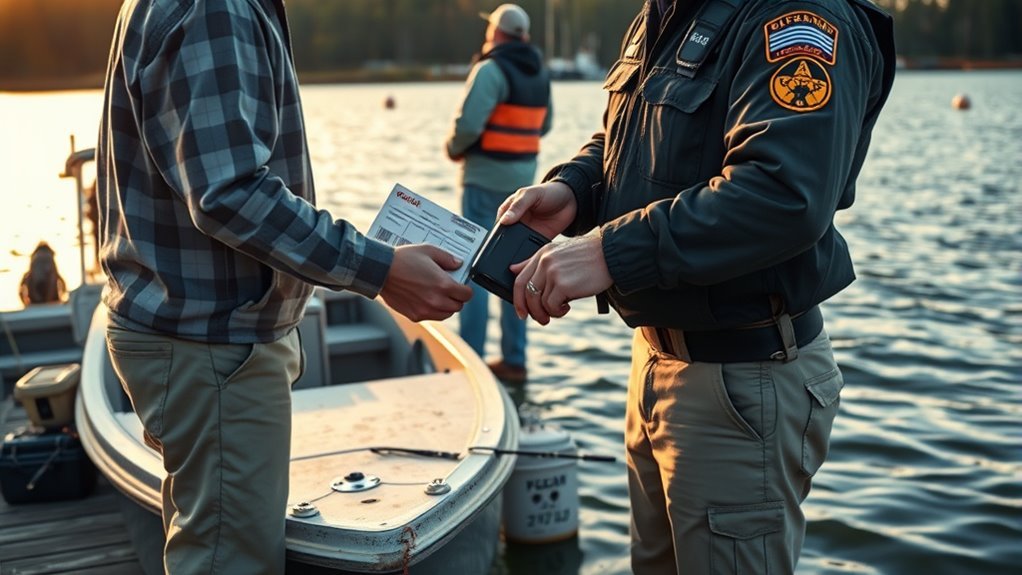
Illinois law requires a person holding a fishing license, stamp, or permit to have it available for immediate presentation when an authorized officer requests it. The official I Fish Illinois FAQ confirms that an electronic copy of a fishing license is allowed.
A practical pre-trip checklist includes:
- A readable paper or electronic copy of the correct fishing license.
- Any required Inland Trout Stamp or Lake Michigan Salmon Stamp.
- Documentation supporting a disability, disabled-veteran, military, age, or other exemption when applicable.
- Photo identification, especially when needed to verify the identity attached to a license or exemption.
- The current statewide and site-specific fishing regulations.
- Any separate parking, launch, access, reservation, or event permit required by the fishing location.
When Trout and Salmon Stamps Are Required
An Electronic Inland Trout Stamp is generally required in addition to the fishing license when taking or attempting to take trout from applicable inland waters. The 2026 posted price is $6.50.
An Electronic Lake Michigan Salmon Stamp is generally required when taking or attempting to take salmon in the Illinois portion of Lake Michigan. The 2026 posted price is also $6.50.
People who are legally exempt from the fishing-license requirement are generally also exempt from these stamps. Always check the current season announcement and site regulations before fishing for stocked trout or Lake Michigan salmon.
What the License Does Not Cover
A fishing license gives you the legal privilege to fish, but it does not replace other rules. You must still follow:
- Open and closed seasons.
- Daily harvest and possession limits.
- Minimum and maximum length limits.
- Protected-species regulations.
- Legal bait and tackle rules.
- Number-of-poles and number-of-hooks restrictions.
- Boat registration, launch, parking, and access requirements.
- Special rules for an individual lake, river, park, refuge, or tournament.
Penalties, Lost Licenses, and How to Replace Them
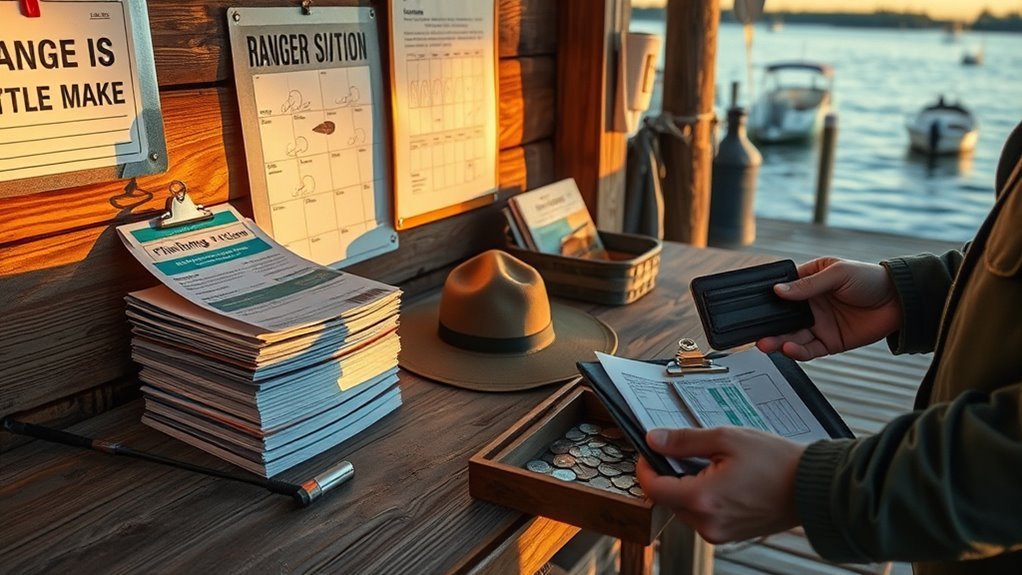
Fishing without a required license is an offense under the Illinois Fish and Aquatic Life Code and may result in a citation, court-imposed penalties, and possible effects on future fishing privileges. Buying a license after an inspection does not erase a violation that has already occurred.
Reprinting an Online-Purchased License
IDNR states that fishing licenses purchased online can be reprinted free of charge. Use the purchase or reprint option in the ExploreMoreIL system, enter the requested customer identification and date-of-birth information, and open the previous transaction to display the license.
Replacing a Vendor-Purchased License
If the original license was purchased over the counter from a vendor, return to an authorized vendor for a reprint. IDNR currently lists a $5 vendor reprint fee.
Saving the original electronic file after purchase can prevent a replacement problem. Keep a backup on your phone, computer, or secure cloud-storage account until the license expires.
Frequently Asked Questions
Can I fish on federally managed land with an Illinois license?
An Illinois license is normally still required when fishing waters under Illinois jurisdiction, even when the surrounding land or recreation area is federally managed. The federal site may impose additional access, boating, species, or area rules. Check both Illinois regulations and the rules of the federal property before fishing.
Are fishing tournaments covered by an annual license?
An annual license covers the participant’s ordinary fishing-license requirement, but it does not replace tournament approval. Organizers may need an IDNR fishing-tournament permit, site approval, a local permit, or additional permission. IDNR states that tournaments with fewer than 20 participants may not need the state tournament permit, although organizers must still contact the applicable IDNR site when using an IDNR location.
Do youth under 16 ever need an Illinois fishing license?
No. Residents and nonresidents under age 16 are exempt from the Illinois sport fishing license. A location, camp, tournament, or access program may still require registration, permission, or another type of permit, but that is separate from the state fishing license.
Is catch-and-release fishing subject to different license rules?
No. Catch-and-release fishing still involves taking or attempting to take fish, so a license is required when the angler is age 16 or older and no exemption applies. Special catch-and-release seasons may also restrict harvest, hooks, bait, locations, or fishing hours.
Are bait and tackle regulations included with the license?
The license authorizes fishing but does not remove bait, hook, pole, net, or gear restrictions. Statewide and site-specific rules determine which baits and devices are legal, how baitfish may be collected or transported, and how many poles or hooks may be used.
Can I show my Illinois fishing license on my phone?
Yes. I Fish Illinois states that an electronic copy is allowed. Save a readable offline copy so that you can present it immediately even when your fishing location has weak cellular service.
Does a private-pond owner’s exemption cover guests?
Usually not. Qualifying owners, bona fide tenants, and specified family members who permanently reside with them may use the private-land exemption. Other guests age 16 or older normally need their own licenses unless another exemption applies.
How long is a 2026 annual Illinois fishing license valid?
The 2026 license year began March 1, 2026, and the annual license remains valid through March 31, 2027. An annual license uses the fixed license-year expiration date rather than expiring 12 months after the individual purchase date.
Conclusion
The standard 2026 Illinois annual fishing license costs $15 for residents and $31.50 for nonresidents. Most anglers need a license beginning at age 16, but carefully defined exemptions apply to youth, qualifying people with disabilities, certain veterans and military members, licensed fee-fishing areas, and eligible residents fishing on their own land.
Choose the product that matches your residency, age, trip length, and eligibility. Add the required trout or salmon stamp when applicable, save an accessible copy of the license, and review the rules for the exact water you plan to fish. A valid license does not replace seasons, harvest limits, gear restrictions, site permits, or property-access requirements.
Sources
- Illinois Department of Natural Resources — Fishing Licenses — current resident, nonresident, short-term, stamp, senior, veteran, three-year, and lifetime fees.
- I Fish Illinois — Fishing FAQ — age requirements, electronic license copies, private-pond rules, and common licensing questions.
- 515 ILCS 5/20-5 — general fishing-license requirement and exemptions for youth and qualifying residents with disabilities.
- 515 ILCS 5/20-15 — landowner, tenant, resident-family, and military-leave exemptions.
- 515 ILCS 5/20-56 — eligibility rules for the one-time first-time or lapsed-angler license.
- IDNR Military Members and Veterans — military fee waivers, resident veteran reductions, certification, and documentation.
