
In New York, children age 15 and younger can fish in freshwater without buying a fishing license. There is no separate state “Young Angler Permit” that a child must apply for or carry. A freshwater fishing license becomes necessary at age 16, while different registration rules apply to saltwater and migratory fish.
Quick Answer
In New York, anglers age 15 and younger do not need a freshwater fishing license, so there is no separate youth permit to buy or renew. At age 16, a license is required for most freshwater fishing. Annual fees are $25 for residents ages 16–69 and $50 for nonresidents.
Key Takeaways
- Children age 15 and younger may fish New York freshwaters without a fishing license.
- The required youth license cost is $0 because New York uses an age exemption rather than a separate junior fishing permit.
- A license is required beginning on an angler’s 16th birthday unless a specific exemption applies.
- Youth anglers must still follow seasons, size limits, daily limits, bait restrictions, access rules, and special waterbody regulations.
- Saltwater anglers and people targeting migratory fish of the sea need the no-fee Marine Fishing Registry beginning at age 16.
At a Glance
| Time Required | No application for anglers 15 and younger; an online age-16+ purchase can be completed in one session. Mailed copies may take up to 14 business days. |
| Difficulty | Easy |
| Tools Needed | For age 16+: personal details, residency information, email access, and a payment method |
| Cost | $0 for ages 15 and younger; annual license from age 16 is $25 for residents ages 16–69 or $50 for nonresidents |
Do Kids Need a New York Fishing License?
No freshwater fishing license is required for a child who is 15 or younger. The rule applies to both New York residents and visitors.
The phrase Young Angler Permit is sometimes used informally, but it is not the name of a standard New York license that parents must obtain. The child’s ability to fish without a license comes directly from the age exemption in New York’s fishing-license rules.
The license threshold is simple: New York freshwater anglers need a fishing license beginning at age 16.
Not needing a license does not remove the other rules. A young angler must follow the same open seasons, minimum sizes, daily catch limits, fishing methods, bait restrictions, and special waterbody regulations that apply to other anglers. Review the current New York freshwater seasons and catch limits before each trip.
Products Worth Considering

Specialty taper designed specifically for delivering heavier permit flies

This cute fishing art is perfect for ladies, females, women and moms who are fishing enthusiasts. Get ready with the bait, hook and rod; cast a line and show up in fishing competitions. Males, men and dads can also have this on Father's Day celebration.

Eligibility and Age Requirements
Age—not residency—determines whether a child needs a standard New York freshwater fishing license. The main requirements are summarized below.
| Age or situation | Freshwater requirement |
|---|---|
| Age 15 or younger | No freshwater fishing license required |
| Age 16–69, New York resident | License required unless an exemption applies; annual fee is $25 |
| Age 70 or older, New York resident | License required unless exempt; reduced annual fee is $5 |
| Age 16 or older, nonresident | License required unless exempt; annual fee is $50 |
| Any age on a 2026 Free Fishing Day | Freshwater license requirement is waived, but all other rules apply |
DEC does not publish a blanket rule requiring every unlicensed child to carry proof of age while fishing. However, a parent may choose to carry a copy or photo of age identification if the child is close to 16 and an officer could reasonably have a question.
Note: Proof of age and residency may be required when applying for an actual license, including an optional lifetime license purchased for a child. That application requirement is different from saying every child must carry a youth permit.
Fishing License Costs and Payment Options
The required freshwater fishing-license cost for an angler age 15 or younger is $0. Beginning at age 16, the following general fees apply.
| License type | Resident fee | Nonresident fee |
|---|---|---|
| Annual | $25 for ages 16–69; $5 for ages 70+ | $50 |
| 7-day | $12 | $28 |
| 1-day | $5 | $10 |
These are the general fees listed by the New York State Department of Environmental Conservation. Reduced or free licenses may be available to qualifying seniors, military members, veterans with qualifying disabilities, legally blind residents, and certain full-time college students.
New York residents may also purchase an optional lifetime freshwater fishing license for a child. The current fishing-only lifetime fee is $460 for resident applicants ages 0–69. This purchase is optional; it is not needed for a child to fish before age 16.
Pro Tip: Choose email delivery or print the license from the online account to avoid mailing charges. A printed-and-mailed online or phone transaction costs $2, while a license issuing agent may charge an optional $1 print fee.
Products Worth Considering

Package length: 0.508 cm

Enough to Use: you will receive 6 pieces of fishing license holders, and 6 pieces of safety pins, abundant in quantity, enough for you to choose and replace, can meet your different needs; You can also share them with your friends

Enough to Use: you will receive 6 pieces of fishing license holders, and 6 pieces of safety pins, abundant in quantity, enough for you to choose and replace, can meet your different needs; You can also share them with your friends
How to Apply Online, by Phone, or In Person
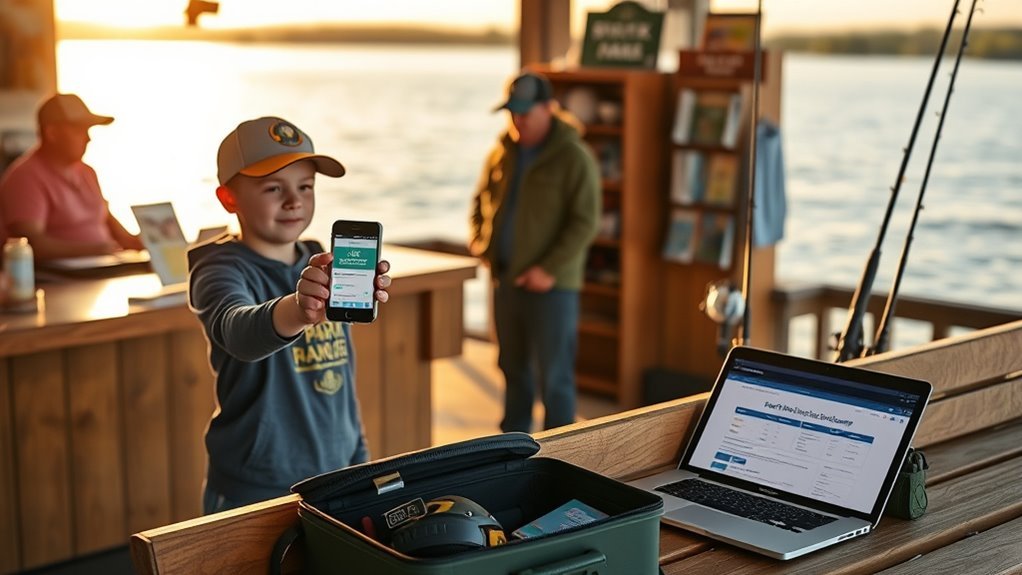
A child age 15 or younger does not need to complete a standard freshwater fishing-license application. Use the following steps when the angler turns 16 or when purchasing an optional lifetime license.
- Choose the correct product. Select an annual, 7-day, or 1-day freshwater license. For saltwater or covered migratory fishing, use the separate Recreational Marine Fishing Registry.
- Prepare the applicant’s information. Have the angler’s legal name, date of birth, address, and residency information available. Documentation may be needed to claim resident or reduced-fee status.
- Choose a purchase channel. Buy through the official DEC Automated Licensing System, call 1-866-933-2257, or visit an authorized License Issuing Agent.
- Select delivery. Online purchases are emailed and can be printed at home. Phone customers receive a 12-digit DEC ID that can serve as proof and can also receive the license by email.
- Check every detail. Confirm that the name, date of birth, address, license type, and validity dates are correct.
- Keep proof available while fishing. Use a printed copy, the official HuntFishNY app, or another proof method accepted by DEC.
| Channel | Delivery and possible charge | Best for |
|---|---|---|
| Online | Email and home printing available; $2 only if printed and mailed | Fast access and account management |
| Phone | DEC ID and email delivery; $2 if printed and mailed | Assisted transactions |
| License Issuing Agent | Immediate in-person transaction; agent may charge $1 to print | Applicants who need in-person help |
If a transaction involves a child age 15 or younger, such as the purchase of a lifetime license, a parent or legal guardian must assist in validating the information.
License Validity, Renewal, and Expiration Dates
There is no youth permit that expires on a child’s birthday. Instead, the under-16 exemption stops applying when the angler turns 16. The angler must then have the correct license before fishing unless another exemption applies.
- Annual freshwater license: Valid for 365 days from the date of purchase or renewal.
- 7-day license: Valid for the selected seven-day period.
- 1-day license: Valid for the selected day.
- Recreational Marine Fishing Registry: Valid for 365 days from registration.
- Under-16 exemption: Ends when the angler reaches age 16.
Check the dates shown on the actual license or registration. Do not assume that an annual fishing license ends on December 31 or at the end of a hunting-license year.
Warning: A child who turns 16 during fishing season must obtain the required license before continuing to fish. The previous age exemption does not remain valid through the end of the trip, month, or calendar year.
Where the Rules Apply: Freshwater vs. Marine Fishing
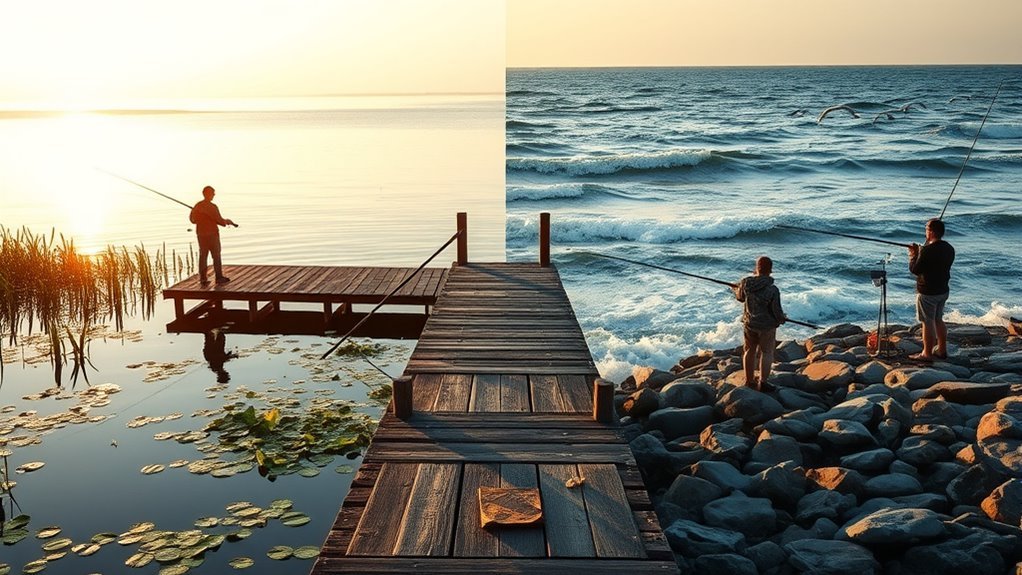
A freshwater fishing license and the Recreational Marine Fishing Registry serve different purposes.
| Fishing activity | Age 15 or younger | Age 16 or older |
|---|---|---|
| Freshwater fish, frogs, or freshwater baitfish covered by license rules | No license required | Freshwater license generally required |
| Saltwater species in New York’s Marine and Coastal District | No Marine Registry enrollment required | No-fee Marine Fishing Registry generally required |
| Covered migratory fish of the sea in specified tidal waters | No Marine Registry enrollment required | No-fee Marine Fishing Registry generally required |
The Recreational Marine Fishing Registry is free, although optional printing or mailing charges may apply. It covers saltwater species in the Marine and Coastal District and certain migratory fish in specified tidal portions of the Hudson, Delaware, and Mohawk systems.
Special access requirements may still apply. For example, some New York City watershed lands and certain Long Island state lands require a separate access permit. A New York license also does not automatically authorize fishing in every part of a border water shared with another state, province, or country.
Note: Confirm the exact waterbody before leaving home. The license, registry, access permit, season, and catch rules can change when you move between freshwater, tidal water, marine water, reservation land, or a neighboring jurisdiction.
Products Worth Considering
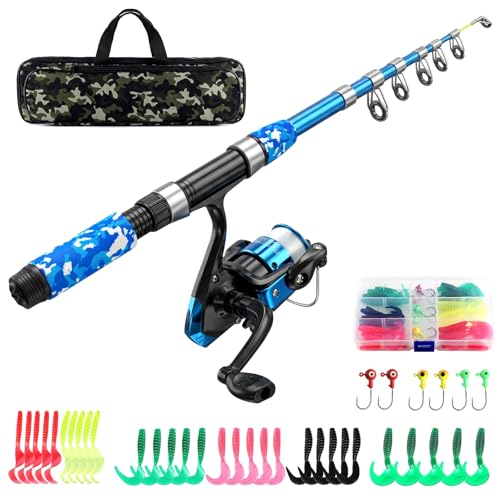
KIDS FISHING FULL KIT : This kids fishing combo includes light-weight camouflage telescopic fishing rod + spinning reel + fishing line(bundled on the reel) + 36 pcs fishing lures hooks (with plastic case) + fishing carry bag. One stop shopping for all your fishing needs

Size Tips: Loose Fit Style, Please Select One Size Smaller for Better Fit.
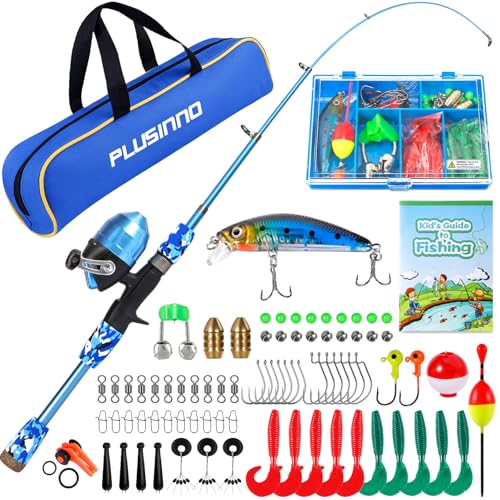
Kids will enjoy hours of angling fun with this PLUSINNO Kids Fishing Kit. It comes complete with a telescopic fishing rod,spincast reel,fishing line,fishing tackle and travel Bag.necessary fishing gear provided by plusinno.
Exemptions, Free Fishing Days, and Special Cases
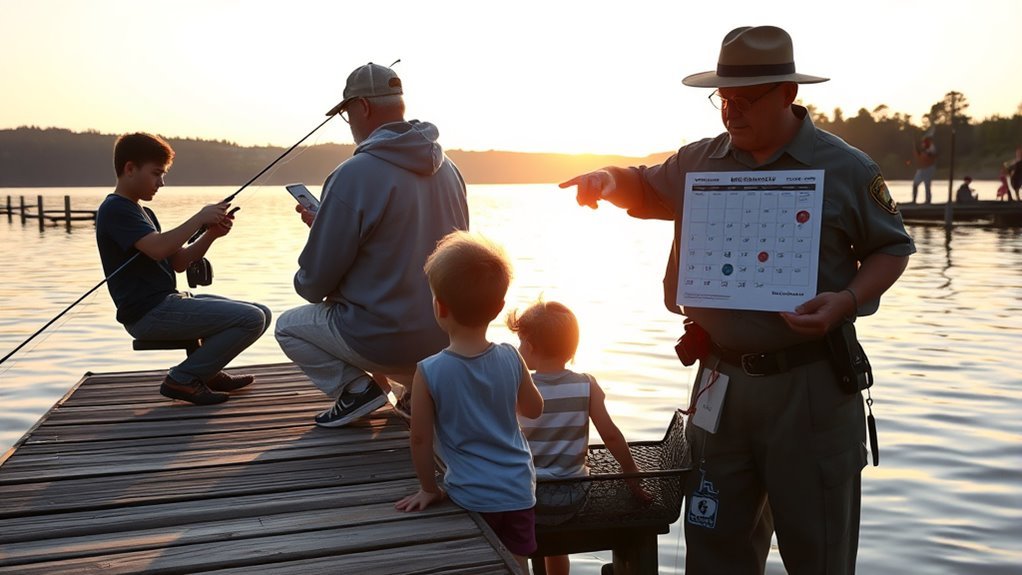
Children under 16 already fish without a freshwater license, but New York also provides exemptions for certain older anglers and activities.
2026 Free Fishing Days
The freshwater license requirement is waived for residents and nonresidents of all ages on these six days in 2026:
- February 14–15, 2026
- June 27–28, 2026
- September 26, 2026
- November 11, 2026
All other fishing regulations remain in force on Free Fishing Days. Anglers must still obey seasons, methods, minimum lengths, daily limits, bait rules, and special waterbody restrictions.
Other License Exemptions
A freshwater fishing license may also be unnecessary when a person is:
- Fishing on a licensed fishing preserve
- Participating in an approved free learn-to-fish clinic
- A qualifying resident farmer or lessee fishing on farmland occupied and cultivated by that person
- An immediate family member covered by the qualifying farm exemption
- A farm-fish-pond-license holder or covered immediate family member fishing on the licensed water
- A Native American living and fishing on reservation land
- A resident patient at a qualifying U.S. Veterans Administration hospital or facility in New York
Private ownership by itself does not exempt every angler. Friends and guests age 16 or older may still need a license when fishing a privately owned pond.
Carrying and Presenting a License
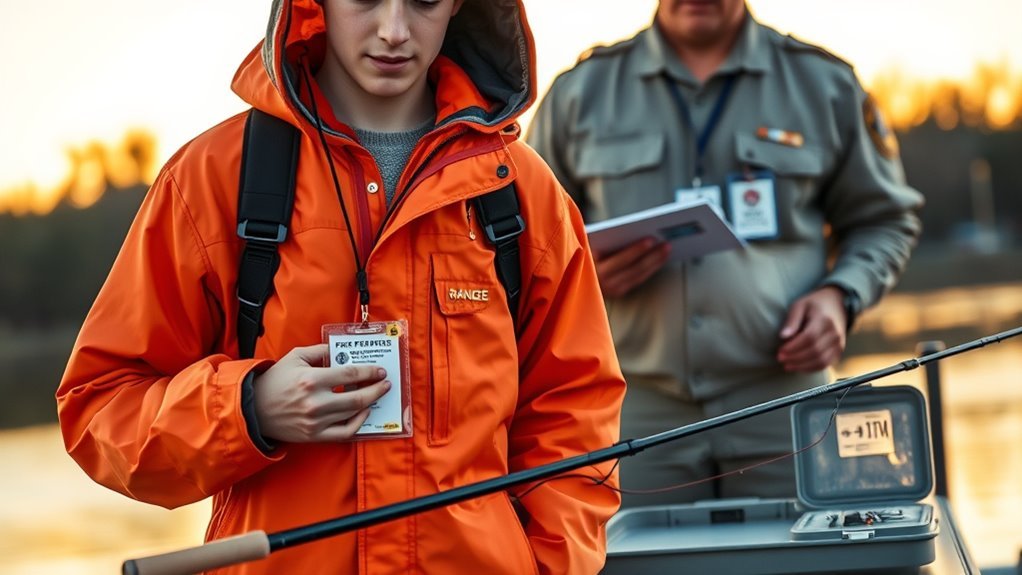
An angler age 15 or younger has no standard freshwater license to carry. Beginning at age 16, a license holder must keep valid proof available while fishing and display it when properly requested.
Accepted proof may include a plain-paper license, an electronic license in the official HuntFishNY app, or a DEC ID when accepted under DEC’s licensing procedures.
A police officer, peace officer, or the owner or person controlling the land or water may request to see the license. The license must belong to the person fishing and must contain accurate information.
A fishing license does not grant permission to enter private property. Obtain the landowner’s permission and follow posted access hours, parking rules, municipal permits, and site-specific restrictions.
Pro Tip: Save an electronic copy before traveling to a location with poor cellular service. A screenshot should not replace any official proof requirement, so also keep the license available in the HuntFishNY app or carry a printed copy.
Youth Fishing Safety and Responsible Angling
A license exemption does not determine whether a child is ready to fish alone. Consider the child’s swimming ability, judgment, casting control, familiarity with the location, and ability to respond to weather or an emergency.
Supervision and Hook Safety
- Supervise beginners closely, especially near deep water, strong current, slippery banks, docks, or ice.
- Create a clear casting area and make sure nobody is standing behind the angler.
- Use barbless hooks or pinch down the barb while a child is learning.
- Carry pliers, line cutters, a basic first-aid kit, drinking water, sun protection, and weather-appropriate clothing.
- Check the rules of clinics, camps, parks, charters, and fishing events because they may impose their own adult-supervision requirements.
Warning: New York requires children under 12 to wear a properly sized, U.S. Coast Guard-approved life jacket on most recreational boats while underway, unless the child is inside a fully enclosed cabin. A wearable life jacket must also be available for each person aboard.
Bait and Catch Rules
Youth anglers follow the same applicable bait and tackle rules as adults. Rules may differ by species, season, county, and waterbody. Review the official New York baitfish regulations before collecting, transporting, or using baitfish.
Never release unused live bait into the water, move fish from one waterbody to another, or use a prohibited bait species. Dispose of bait-bucket water on land.
Catch and Release
Catch and release is useful when required by regulation or when the angler does not intend to keep a legal fish. It is not automatically permitted for every species during every closed season.
- Wet your hands before touching the fish.
- Keep the fish in the water as much as possible.
- Support the body instead of holding a large fish only by the jaw.
- Remove the hook quickly with pliers.
- Cut the line when removing a deeply swallowed hook would cause more injury.
- Release the fish promptly and gently.
Fish caught during a closed season must be handled according to the applicable DEC rule. Threatened or endangered fish that are caught unintentionally must be released immediately.
Fish Consumption Advice
Before keeping fish for a meal, check the New York State Department of Health fish advisories. Advice varies by waterbody, fish species, and the person eating the fish. Children and people who may become pregnant can have more restrictive recommendations.
Resources, Contact Information, and Helpful Links
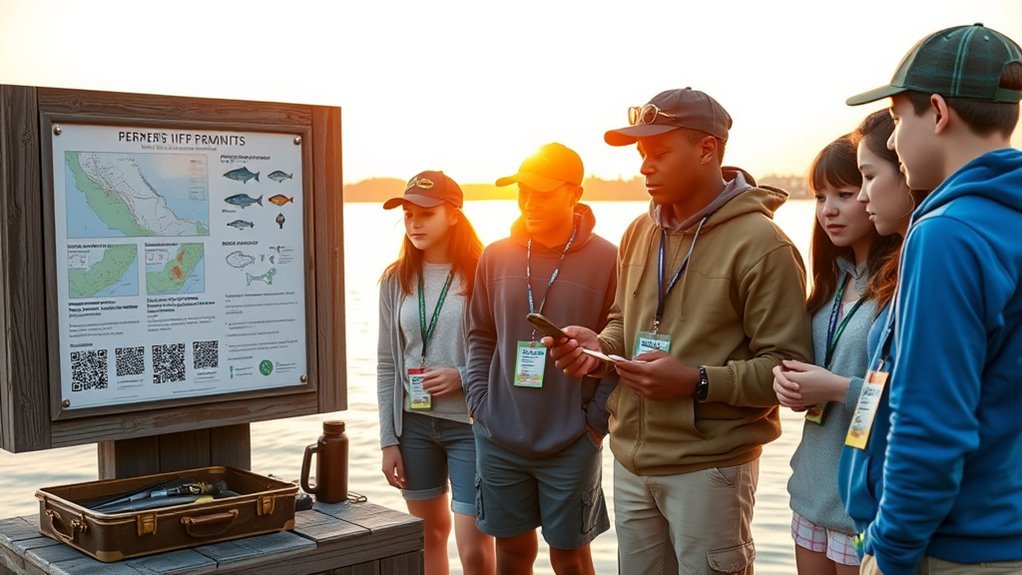
Use official state sources to confirm the current age rule, license fee, fishing season, and waterbody restrictions before a trip.
Where to Buy
- Online: Use the official DECALS licensing system.
- By phone: Call 1-866-933-2257.
- In person: Visit an authorized New York License Issuing Agent.
No standard license purchase is needed for a child age 15 or younger. These purchase channels apply when an angler turns 16, registers for covered marine fishing, or buys an optional lifetime license.
Contact and Links
For fishing-license questions, contact the DEC License Sales Unit at 518-402-8843. The DECALS call center at 1-866-933-2257 can help with online and phone transactions.
- New York fishing-license requirements and fees
- DECALS purchase and delivery information
- Freshwater fishing regulations
- Free Fishing Days and learn-to-fish resources
- HuntFishNY app and Tackle Box
Frequently Asked Questions
Does a 15-year-old need a fishing license in New York?
No. A child who is 15 or younger does not need a New York freshwater fishing license. The child must obtain a license beginning at age 16 unless a specific exemption applies.
Is there a $5 junior fishing license in New York?
No required $5 junior freshwater fishing license applies to children 15 and younger. New York lists $5 junior products for certain hunting and trapping privileges, which can be confused with fishing-license rules.
Must a child carry proof of age while fishing?
DEC does not publish a blanket requirement that every unlicensed child carry age documentation while fishing. Carrying a copy or photo of identification may still be practical when a teenager is close to age 16.
Can a young angler fish without adult supervision?
New York’s general freshwater license rule does not create one statewide supervision requirement for every child. However, a park, event, camp, charter, or local authority may require an adult. Beginners should be supervised near water, boats, hooks, current, ice, or other hazards.
Are bait and tackle rules different for children?
No. Youth anglers follow the same applicable gear, bait, season, size, and daily-limit rules as adults. The exact restrictions depend on the species, fishing method, waterbody, and time of year.
Do nonresident children fish free in New York?
Yes. The freshwater license exemption applies to resident and nonresident anglers age 15 and younger. At age 16, a nonresident generally pays $50 for an annual freshwater fishing license unless an exemption or special qualification applies.
Does a child need New York’s Marine Fishing Registry?
No Marine Registry enrollment is required before age 16. Beginning at 16, an angler generally must join the no-fee registry when fishing for saltwater species in the Marine and Coastal District or for covered migratory fish in specified tidal waters.
Is catch and release always allowed?
No. Catch-and-release fishing may be limited by species, season, or waterbody. Fishing for some species during a closed season is prohibited even when the angler plans to release the fish. Check the current regulation for the location and species.
Conclusion
New York makes freshwater fishing simple for young anglers: children age 15 and younger do not need a fishing license, and there is no required youth permit or junior fishing fee. A license becomes necessary at 16, with annual fees starting at $25 for residents ages 16–69 and $50 for nonresidents.
The license exemption does not waive fishing or safety rules. Check the exact waterbody, season, catch limit, bait restriction, access requirement, and fish-consumption advice before leaving home. With the right supervision and equipment, a child can learn to fish legally, safely, and responsibly.
Sources
- New York State DEC — Fishing Licenses — age threshold, license types, fees, exemptions, border waters, and access permits
- New York State DEC — DEC Automated Licensing System — online and phone purchases, electronic delivery, DEC ID proof, printing, and mailing
- New York State DEC — Recreational Marine Fishing Registry — age, cost, covered waters, and 365-day validity
- New York State DEC — Learn to Fish — 2026 Free Fishing Days and approved clinics
- New York State DEC — General Freshwater Fishing Regulations — catch-and-release, closed seasons, protected species, and general angling rules
- New York State Parks — Boating Safety and Equipment — youth life-jacket and vessel-safety requirements
