

Florida makes fishing inexpensive for children, but the age rules are easy to misread. Children under 16—whether residents or visitors—do not need a recreational fishing license. Florida residents ages 8–15 may optionally buy a $17 youth freshwater or saltwater license that remains valid until their 17th birthday.
Quick Answer
In Florida, anglers under 16 do not need a fishing license. Residents ages 8–15 may optionally buy a $17 youth freshwater or $17 youth saltwater license, each valid until the 17th birthday. A 16-year-old without an existing youth license must buy the appropriate standard license or qualify for another exemption.
Key Takeaways
- Florida residents and nonresidents under 16 are exempt from the recreational fishing-license requirement.
- The optional $17 resident youth license is sold only to ages 8–15 and covers either freshwater or saltwater—not both.
- A youth license bought before age 16 stays valid until the holder’s 17th birthday.
- At age 16, species permits and designations may be required even when an earlier youth license still covers the base fishing privilege.
- Bag limits, seasons, size limits, gear rules, and closed areas apply even when a child is license-exempt.
At a Glance
| Time Required | A few minutes online once the youth’s account details are ready |
| Difficulty | Easy, but you must choose the correct water type and check exemptions |
| Tools Needed | Date of birth, account information, residency proof when needed, and payment method |
| Cost | $0 under the age exemption; optional resident youth license $17 per water type, plus possible transaction fees |
What Is a Florida Youth Fishing License and Who Qualifies?
A Florida youth fishing license is an optional resident license for ages 8–15. The Florida Fish and Wildlife Conservation Commission (FWC) offers separate freshwater and saltwater youth licenses for $17 each. Each remains valid until the holder’s 17th birthday.
The word optional matters. Under Florida’s exemption rules, a child younger than 16 may fish without buying a recreational license. The child must still follow all seasons, bag limits, size limits, gear restrictions, and area closures.
Families may still choose the youth license because it gives the young angler a license record that continues through age 16. License purchases also support fish and wildlife management and help the state qualify for federal Sport Fish Restoration funding.
Florida’s youth license is a voluntary bridge into the first year when the under-16 exemption no longer applies.
Note: The $17 freshwater license does not authorize saltwater fishing, and the $17 saltwater license does not authorize freshwater fishing. A youth who fishes both types of water needs both privileges or another license package that covers both.
Age Ranges and Validity Periods for Junior Permits
Florida’s rules create four practical age groups. The key turning point is the 16th birthday, because that is when the general youth exemption ends.
Age Brackets Explained
| Age | Florida License Rule | Best Next Step |
|---|---|---|
| 0–7 | No recreational fishing license is required. The $17 youth license is not offered yet. | Carry reasonable proof of age and follow all fishing rules. |
| 8–15 | No license is required, but a Florida resident may buy a $17 youth freshwater or saltwater license. | Buy only if the long validity or conservation benefit is useful to your family. |
| 16 | The general under-16 exemption has ended. A youth license purchased earlier remains valid until the 17th birthday. | Use the existing youth license or buy the appropriate standard license. Add any required species permits. |
| 17 and older | The youth license has expired. | Buy the appropriate resident or nonresident adult license unless another exemption applies. |
Permit Validity Spans
A Florida resident must buy the optional youth license while the child is 8 through 15. Once issued, it remains valid until the 17th birthday. It is not an annual license and does not need renewal at age 16.
Validity is tied to both the holder and the water type. A freshwater youth license remains a freshwater privilege for the entire period; it does not become a freshwater-and-saltwater combination license when the holder turns 16.
Pro Tip: A Florida resident who is still 15 can buy the appropriate $17 youth license before turning 16. That license can then cover the base freshwater or saltwater privilege until the 17th birthday, although age-16 permit requirements may still apply.
Typical Youth Fishing License Costs by State
There is no reliable national youth-license price. States use different age cutoffs and may offer an exemption, an optional youth license, a mentored permit, or a full-price license once a child reaches the state’s minimum licensing age.
| State | Youth Rule | 2026 Cost Example |
|---|---|---|
| Florida | Under 16 exempt; optional resident youth license for ages 8–15 | $17 freshwater or $17 saltwater, valid until age 17 |
| Texas | Resident and nonresident anglers under 17 are exempt | $0 for the basic fishing privilege |
| California | A sport fishing license is required at age 16; some species report cards apply even to exempt youth | $0 for the basic license under 16 |
| Pennsylvania | A general license is required at 16; younger anglers may obtain an optional youth credential | $2.97 voluntary youth license or free mentored youth permit |
These examples show why a broad claim such as “youth licenses usually cost $10–$20” is not dependable. Always check the current fish-and-wildlife agency page for the state where the child will fish.
Products Worth Considering

Package length: 0.508 cm

Enough to Use: you will receive 6 pieces of fishing license holders, and 6 pieces of safety pins, abundant in quantity, enough for you to choose and replace, can meet your different needs; You can also share them with your friends

Enough to Use: you will receive 6 pieces of fishing license holders, and 6 pieces of safety pins, abundant in quantity, enough for you to choose and replace, can meet your different needs; You can also share them with your friends
Resident vs. Nonresident Youth License Fees in Florida
Residency affects which optional license a young angler can buy, but it does not change Florida’s under-16 exemption. Both resident and nonresident children younger than 16 may fish without a recreational license.
Products Worth Considering

DIMENSIONS: 6" X 12"

FISHING LICENSE HOLDER W/ZIP CLOSURE

Resident Youth Rates
Florida residents ages 8–15 may buy either of these optional licenses:
- Resident Youth Freshwater Fishing License: $17, valid until the 17th birthday.
- Resident Youth Saltwater Fishing License: $17, valid until the 17th birthday.
- Resident Youth Gold Sportsman’s License: $100 after completing hunter education requirements, valid until the 17th birthday.
At the time of purchase, a youth under 18 may use a Florida school identification card or a parent’s proof of Florida residency. When using the parent’s proof, the parent must accompany the youth during the purchase, according to the FWC residency guidance.
Nonresident Youth Fees
Florida does not list a special nonresident youth fishing license. A nonresident child under 16 is exempt. Once the visitor turns 16, the standard nonresident rates apply unless another exemption covers the trip.
| Nonresident Option | Freshwater Fee | Saltwater Fee |
|---|---|---|
| 3-day | $17 | $17 |
| 7-day | $30 | $30 |
| Annual | $47 | $47 |
Validity, Fees, and Exemptions
Listed license prices may not be the final checkout total. FWC states that online and phone orders can include handling and percentage-based surcharges, and some vendors may charge an additional issuance fee. All license and permit sales are final and nonrefundable.
A 16-year-old Florida resident who did not buy a youth license before turning 16 may choose a $17 annual freshwater license, a $17 annual saltwater license, or a $32.50 annual freshwater-and-saltwater combination license.
Warning: Do not assume a child remains exempt for the entire calendar year in which they turn 16. The exemption ends at age 16. Check the birthday and the exact expiration of any youth license before the trip.
Combination Licenses and Bundled Youth Options
Florida’s $32.50 freshwater-and-saltwater combination license is an annual resident license, not a special multi-year youth license. It may make sense for a 16-year-old who has no existing youth license and plans to fish both freshwater and saltwater.
For residents ages 8–15, buying both separate youth licenses costs $34 before transaction fees, but both remain valid until the 17th birthday. The better value depends on the child’s age and how long the privileges will be used.
The $100 Resident Youth Gold Sportsman’s License is the broad bundled option for a resident age 8–15 who has completed hunter education and will both hunt and fish. It includes freshwater, saltwater, hunting, and listed sportsman’s permits until the 17th birthday.
Florida also offers a no-cost resident saltwater shoreline license. It is not a youth endorsement and is unnecessary for children under 16 because they are already exempt. For older residents, it is valid only from shore or a fixed structure—not from a vessel, a shoreline reached by vessel, or while swimming or diving.
Products Worth Considering

Enough to Use: you will receive 6 pieces of fishing license holders, and 6 pieces of safety pins, abundant in quantity, enough for you to choose and replace, can meet your different needs; You can also share them with your friends

Enough to Use: you will receive 6 pieces of fishing license holders, and 6 pieces of safety pins, abundant in quantity, enough for you to choose and replace, can meet your different needs; You can also share them with your friends

STARTER FISHING GEAR KIT includes: 65 inch camo green telescopic fishing rod, spinning reel, minnow net, beginner’s guide, fishing lures, carry case and tackle box stocked with gear.
Where and How to Purchase a Youth Fishing License
Before buying, confirm that the child is a Florida resident age 8–15 and decide whether the fishing will be freshwater, saltwater, or both.
- Check the exemption first. A child under 16 can fish without buying a license. Purchase the optional youth license only when its longer validity or other benefits are useful.
- Choose the correct privilege. Freshwater and saltwater youth licenses are separate.
- Gather the child’s details. Have the date of birth and acceptable residency proof available. A parent’s residency proof may be used when the parent accompanies the youth at purchase.
- Buy through an approved channel. Use Go Outdoors Florida, the Fish|Hunt FL app, a license agent, a county tax collector’s office, or call 888-FISH-FLORIDA (888-347-4356).
- Save proof of the license. Print a copy or store it in the Fish|Hunt FL app. The app counts as personal possession of the license.
Pro Tip: Online reprints are free. A lost paper license can also be stored in the Fish|Hunt FL app, while an agent or tax collector may charge a reprint fee.
Exemptions, Special Rules, and Local Variations
The under-16 exemption is the main rule for young anglers, but several other Florida exemptions can affect family trips. Review the full FWC exemption list before relying on one.
- License-free fishing days: The license requirement is waived for residents and nonresidents on designated freshwater and saltwater days. Seasons, bag limits, and size limits still apply.
- Home-county pole-and-line exemption: A Florida resident may fish with live or natural bait using a pole or line without a line-retrieval mechanism for noncommercial purposes in the resident’s home county. The exemption does not include fish management areas.
- Qualifying private fish ponds: Freshwater fishing may be exempt in certain man-made ponds located entirely on private property, subject to FWC’s size and licensing conditions.
- Licensed charters, vessels, and piers: Some saltwater anglers are covered by the operator’s valid license.
- Military leave: A Florida resident serving in the U.S. Armed Forces, stationed outside Florida, and home on leave for 30 days or less may qualify with orders.
- Resident seniors: Florida residents age 65 or older are exempt with proof of age and residency, which may matter for accompanying grandparents.
Warning: Fishing on “private property” does not automatically create an exemption. The pond, property, water connection, and owner-license conditions must match FWC’s rule.
License status is only one part of compliance. Waterbody-specific FWC rules, federal rules, wildlife management area requirements, park access rules, and temporary closures may still apply.
Required Permits Beyond the Youth Fishing License
Florida’s general under-16 exemption also covers the snook and spiny lobster permit requirements. That changes at age 16, even if a youth freshwater or saltwater license purchased earlier remains valid.
| Activity | Under 16 | Age 16 With a Valid Youth Saltwater License |
|---|---|---|
| Taking or attempting to take snook | Snook permit exempt | Annual snook permit required; $10 |
| Taking or attempting to take spiny lobster | Spiny lobster permit exempt | Annual spiny lobster permit required; $5 |
| Certain reef fish from a private vessel | State Reef Fish Angler designation begins at 16 | Free annual designation required |
| Shore-based shark fishing | Permit begins at 16 | Free annual permit required after completing the educational course |
| Recreational blue-crab or stone-crab traps | Trap registration begins at 16 | Free registration required for the applicable trap type |
A tarpon tag is a separate, no-exemption requirement when an angler intends to land a tarpon in pursuit of a Florida state or world record. Normal recreational tarpon fishing is catch-and-release, so most young anglers will not need the tag.
Note: A permit exemption never cancels seasons, harvest closures, bag limits, minimum or maximum sizes, or legal-gear rules.
Tips for Parents: Saving Money and Preparing Young Anglers
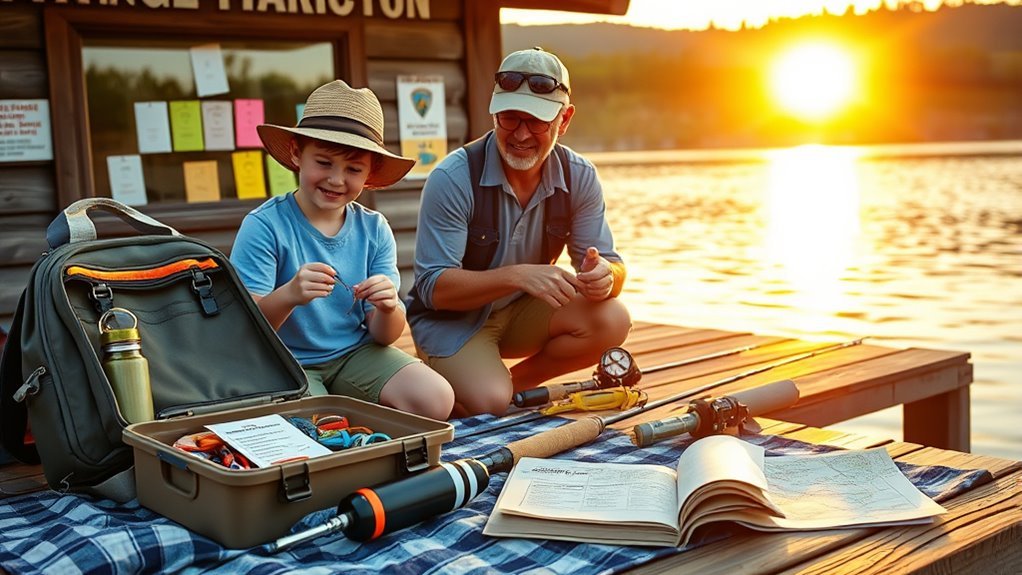
- Start with the exemption. Do not buy a license for a child under 16 unless the optional youth license offers a real benefit.
- Match the license to the water. Buy freshwater, saltwater, or both based on actual plans—not a guess.
- Compare timing. For a 15-year-old resident, a youth license can last until age 17. For a 16-year-old without one, compare the $17 single-water annual license with the $32.50 resident combination.
- Use license-free days for adults. Children under 16 are already exempt, but designated days can save money for accompanying adults who want to fish.
- Keep digital proof available. Store purchased licenses and permits in the Fish|Hunt FL app and carry age or residency proof when appropriate.
- Check rules the day before fishing. Seasons and emergency closures can change faster than license prices.
- Prepare safe gear. Use an age-appropriate rod, eye protection when casting, sun protection, drinking water, and a properly fitted life jacket whenever boating or when conditions call for one.
Sources
- Florida FWC: What Exemptions May Apply? — youth, military, pole-and-line, pond, charter, vessel, and pier exemptions.
- Florida FWC: Freshwater Recreational Licenses and Permits — resident, nonresident, combination, and youth freshwater fees.
- Florida FWC: Saltwater Recreational Licenses and Permits — youth licenses, saltwater fees, shoreline license, and species permits.
- Florida FWC: How to Order — approved purchase channels and transaction-fee information.
- Florida FWC: Residency Requirements — acceptable youth and parent residency documents.
- Florida FWC: Replace a Lost or Stolen License — free online reprints and digital possession through the app.
Frequently Asked Questions
Do youth licenses cover ice fishing and saltwater species at the same fee?
Florida does not have an ice-fishing license category. Its $17 resident youth freshwater and $17 resident youth saltwater licenses are separate. For ice fishing in another state, use that state’s official licensing and ice-fishing rules.
Can a lost or stolen Florida youth license be replaced online for free?
Yes. FWC allows a license or permit to be reprinted online at no cost. The Fish|Hunt FL app can also store the license and counts as personal possession. Agents and tax collectors may charge for a paper reprint, and replacement hard cards cost extra.
Are there age-based equipment restrictions tied to the Florida youth license?
FWC does not list a broad youth-only tackle restriction tied to this license. However, species, waterbody, and method-specific gear rules apply to young anglers just as they apply to adults. Parents should also choose equipment that the child can handle safely.
Does a youth license automatically allow entry into youth fishing tournaments?
No. A license or exemption covers the legal fishing privilege; tournament eligibility is controlled by the organizer’s age, registration, waiver, supervision, and equipment rules. The organizer may also need an event or tournament permit.
Is a parent or guardian signature required for a Florida youth fishing license?
FWC does not publish a blanket parent-signature rule for the optional youth fishing license. For residency, a youth under 18 may use a Florida school ID or a parent’s proof of residency; the parent must accompany the youth when the parent’s proof is used.
Does a 16-year-old need a Florida fishing license?
Usually, yes. The under-16 exemption has ended. A youth license bought at age 8–15 remains valid until the 17th birthday; otherwise, the 16-year-old needs the appropriate standard freshwater, saltwater, or combination license unless another exemption applies.
Can a nonresident child buy Florida’s $17 youth fishing license?
FWC lists the $17 youth freshwater and saltwater licenses as resident licenses. Nonresident children under 16 are exempt. At age 16, visitors generally use the standard 3-day, 7-day, or annual nonresident license unless another exemption applies.
Conclusion
Florida youth fishing costs are simpler once the age rule is clear: children under 16 fish without a recreational license, while residents ages 8–15 may buy an optional $17 freshwater or saltwater license that lasts until age 17. Check the child’s birthday, residency, water type, and target species before paying. Then keep proof handy and follow every season, size, bag, gear, and area rule.
