

You’ll pay about $94 per night on average for an Airbnb in Delaware in 2026, with coastal towns like Rehoboth and Lewes running $200–$350 (peaking near $500 in summer) while Wilmington averages $80–$120 nightly. Expect 20–40% seasonal spikes at the shore, higher rates for beachfront, pools, and pet-friendly spots, and extra cleaning/service/taxes on top. Use off-peak dates, weekly discounts, and filters to cut costs — keep going to get specific tips and examples.
Average Airbnb Cost Per Night in Delaware (2026): Statewide Snapshot

While rates have edged up, you can expect the average Airbnb in Delaware to run about $94 per night in 2026, reflecting a modest year-over-year increase.
You’ll find that statewide averages mask clear Airbnb trends: coastal pockets and specialty listings lift the mean, while urban Wilmington options pull it down. For budgeting, use $94 as your baseline, then layer in seasonality — expect peak summer surges — and property type adjustments like tiny homes or historic suites, which average near $100.
You’ll apply pricing strategies by comparing weekday versus weekend rates, booking early to dodge peak-season premiums, and targeting Wilmington for lower nightly costs often between $80 and $120.
If you want financial freedom in travel, lean into data: monitor nightly volatility, prioritize off-peak stays, and choose properties that maximize value per dollar. This disciplined, cost-focused approach frees you to travel more without breaking your budget.
Coastal vs Inland Airbnb Rates: Rehoboth, Lewes, Bethany, Wilmington
You’ll notice coastal towns like Rehoboth and Lewes carry a clear premium—top-rated listings often run $200–$350 per night, with Bethany averaging $150–$250.
Inland Wilmington is typically 30–50% cheaper, averaging $100–$200, and off-peak booking can compress that gap considerably.
Expect amenities and exact beachfront proximity to drive the biggest price swings during peak season.
Coastal Premiums vs Inland
Because location drives price in Delaware, expect coastal towns like Rehoboth and Bethany to run about $200–$300 per night in peak season while inland spots such as Wilmington and Milton average $100–$150, reflecting a clear coastal premium tied to beach proximity and tourist demand.
You’ll pay for coastal allure: ocean views, pools, and higher demand push averages up despite strong listing ratings (Rehoboth 4.81/5).
Inland charm delivers value—Wilmington averages near 4.92/5 with steadier, lower nightly costs.
If you want freedom to travel more often, favor inland stays to stretch budget without sacrificing quality.
Watch amenity differentials and rating-driven pricing when comparing listings; targeting off-peak dates and longer stays still reveals the greatest cost efficiencies.
Peak Season Price Swings
When demand spikes in summer, expect coastal nightly rates in Rehoboth and Bethany to climb sharply—from roughly $150 up to $500 depending on property type and amenities—often pushing prices 20–40% above off-peak levels. You’ll see clear price elasticity as seasonal demand concentrates on beachfront inventory; unique features push some listings past $400. Inland options—Lewes, Wilmington, Newark—hold steadier, $100–$250 peak averages, freeing you to choose value over prestige. Use data to time bookings: earlier reservations and flexible dates lower cost exposure. The trend favors coastal spikes and inland stability; if liberation means spending less for similar satisfaction, pivot inland or target high-rated Lewes listings around $150.
| Location | Peak Range | Typical Change |
|---|---|---|
| Rehoboth/Bethany | $150–$500 | +20–40% |
| Lewes | ~$150 | Modest |
| Wilmington/Newark | $100–$250 | Stable |
Amenities And Location Impact
After looking at how seasonality widens the gap between beachside and inland rates, let’s examine how specific amenities and location drive those differences:
Coastal Rehoboth and Lewes routinely command higher nightly prices—Rehoboth averaging over $200 and Lewes often near $150—because listings offer ocean views, pools, and larger family-friendly layouts, while Bethany’s median sits around $180 thanks to roomy units and similar features.
You’ll see amenity trends push prices up: private outdoor space, pet-friendly policies, and pools add premiums in coastal markets.
Conversely, Wilmington and other urban-adjacent spots average $90–$120, appealing to budget-minded travelers who value location preferences like dining and culture over beach access.
Use these cost signals to choose value and freedom in your stay.
Price Differences by Property Type: Condos, Beach Houses, Cottages, Tiny Homes
Compare costs by property type to see where your budget stretches furthest: condos typically run $150–$300/night while beach houses hit $200–$500/night.
Cottages and tiny homes sit lower at $120–$250 and $100–$200 respectively, but beachfront location and amenities can push any category higher.
Expect clear seasonal spikes—summer and holiday weeks raise nightly rates sharply, especially for beach houses and premium condos.
Products Worth Considering

Rental Property Signs, Vacation Rentals: Cute but subtle sign with a message for rental properties to encourage guests to respect the house. A handcrafted welcome sign perfect for your foyer or entryway.

HOME DECOR: Brand new 4"x18" aluminum sign with rounded corners. Easy to read text with a vibrant graphic design.
Condos vs Beach Houses
Although location and size drive most of the price gaps, you’ll typically pay about $150–$250 per night for condos in Delaware versus $200–$500+ for beach houses.
Cottages average $175–$350 and tiny homes $100–$200. When you compare condos and beach houses, focus on condo location and beach house amenities: condos nearer boardwalks or with pools and parking skew higher, while beach houses command premiums for direct beachfront, multiple bedrooms, and private outdoor space.
Expect seasonal surges — summer bumps of 20–50% — and factor pet policies or proximity to attractions into your budget.
If you’re aiming to maximize freedom, choose the property type that matches your group size and priorities, then optimize dates to cut nightly costs.
Cottages And Tiny Homes
When you’re budgeting for a Delaware stay, cottages and tiny homes usually offer the best value—cottages average $150–$300 per night while tiny homes run about $100–$200—so they’re typically cheaper than condos ($200–$400) and beach houses ($250–$500). You’ll find cottage features like historic charm and beach proximity driving demand without the top-tier price, while tiny home amenities—kitchens, outdoor showers—deliver freedom and lower nightly costs. Data shows strong ratings (Cottage in Frankford 5/5, Tiny Home in Selbyville 4.97/5) that reinforce value-seeking travel. Use the table to compare quickly and pick the option that frees your budget for experiences.
| Type | Avg Nightly | Typical Perks |
|---|---|---|
| Cottage | $150–$300 | cottage features |
| Tiny Home | $100–$200 | tiny home amenities |
Seasonal Price Fluctuations
Cottages and tiny homes give you clear year-round savings, but seasonal demand reshapes prices across all property types in Delaware.
You’ll see condos span $150–$350 per night, with beachfront units pushing the top end during late spring to early fall; expect the biggest spikes in Rehoboth and Bethany.
Beach houses average $250–$500 and show the widest volatility—proximity to shore, pools, and pet policies lift peak rates.
Cottages sit at $100–$300, where historic or unique stays hit higher seasonal premiums.
Tiny homes remain the budget option at $80–$200, retaining relative stability but still climbing in summer.
Travel off season and you’ll find off season bargains across property types, freeing your budget while keeping quality and choice.
Which Amenities Raise Nightly Rates on Delaware Airbnbs
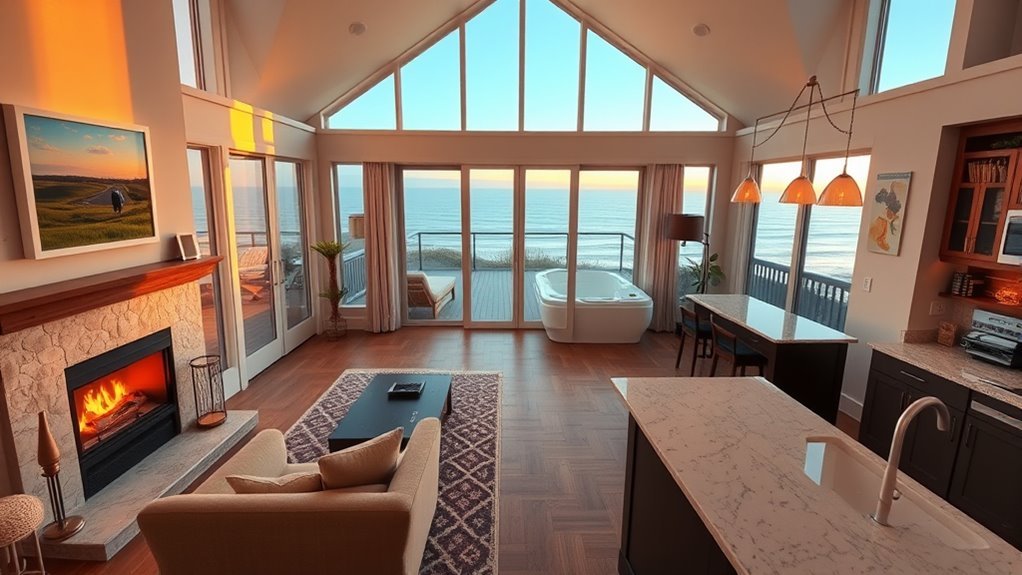
Because guests are willing to pay for convenience and exclusivity, certain amenities raise nightly rates across Delaware. Private pools often push prices above $200, pet-friendly policies add roughly 15–20%, high-speed WiFi (especially in 4.9+ rated listings) boosts rates by about 10–15%, beachfront proximity increases averages by ~30%, and fully equipped kitchens command premiums by appealing to families and longer stays.
Amenities drive rates: private pools, pet-friendly options, fast WiFi, beachfront access, and full kitchens boost nightly prices.
You’ll see clear pricing trends: listings with luxury amenities or targeted conveniences consistently outperform basics. Focus on what elevates perceived value and freedom — guests want choice and comfort.
- Private pool: notable premium for exclusivity and privacy.
- Pet-friendly: +15–20% to capture traveling pet owners.
- High-speed WiFi (4.9+): +10–15% for remote work viability.
- Beach proximity: ~30% uplift for shore access.
Use this data-driven approach to set rates that reflect market demand and positioning. You’ll liberate revenue potential by matching amenities to target segments and monitoring competitive pricing trends.
Products Worth Considering

Size: Approx 30 * 40cm/ 12 * 16 inch(L * W). Hole Diameter: About 0.3cm/ 0.12 inch.

Durable and Long-Lasting Quality - Crafted from premium rust-free aluminum, our signs are built to last for years in both indoor and outdoor environments, maintaining their new look. Proudly made in the USA!

Durable and Long-Lasting Quality - Crafted from premium rust-free aluminum, our signs are built to last for years in both indoor and outdoor environments, maintaining their new look. Proudly made in the USA!
How Seasonality and Events Change Delaware Nightly Prices
As summer demand surges, expect Delaware nightly rates to peak in July and August—coastal listings typically lead the rise—while major events like the Rehoboth Beach Independent Film Festival and the Delaware State Fair can spike prices 20–30% on event weekends. You’ll see clear seasonal demand cycles: peak summer, reduced late fall/winter with averages down 15–25%, and sharp event-driven pricing around festivals and fairs. Properties by beaches or venues can jump as much as 50% during marquee events. Book early and target weekdays to break free from premium weekend rates; prices climb as event dates approach. Below is a concise snapshot to guide tactical choices.
| Period | Typical Price Change |
|---|---|
| Summer (Jul–Aug) | + peak; coastal leads |
| Event weekends | +20–50% (event driven pricing) |
Use this trend-oriented, cost-focused view to reclaim control of your travel budget and exploit off-peak windows for savings.
How Airbnb Fees Affect Your Total Cost: Base, Cleaning, Service, Taxes
When you pull up a Delaware listing, the nightly rate is just the starting point — hosts set a base price, but cleaning fees (commonly $30–$150+), Airbnb service fees (typically 14–16% of the booking subtotal), and local taxes can push the final bill substantially higher.
Always review the fee breakdown so you know the true per-night cost before you book. You want clear, actionable numbers to feel free to choose where you stay, so focus on fee comparison and Airbnb transparency when evaluating options.
- Base price: host-set nightly rate; this anchors your cost and varies by size, location, and season.
- Cleaning fee: often $30–$150+; single-charge that skews short stays into higher per-night costs.
- Service fee: roughly 14–16% of subtotal; platform cost that scales with booking value.
- Local taxes: variable by municipality; can add several percentage points to the total.
Track these line items to reveal true trends in per-night pricing and reclaim control of your travel budget.
How to Find the Best Value on Delaware Airbnbs: Filters, Discounts, Timing
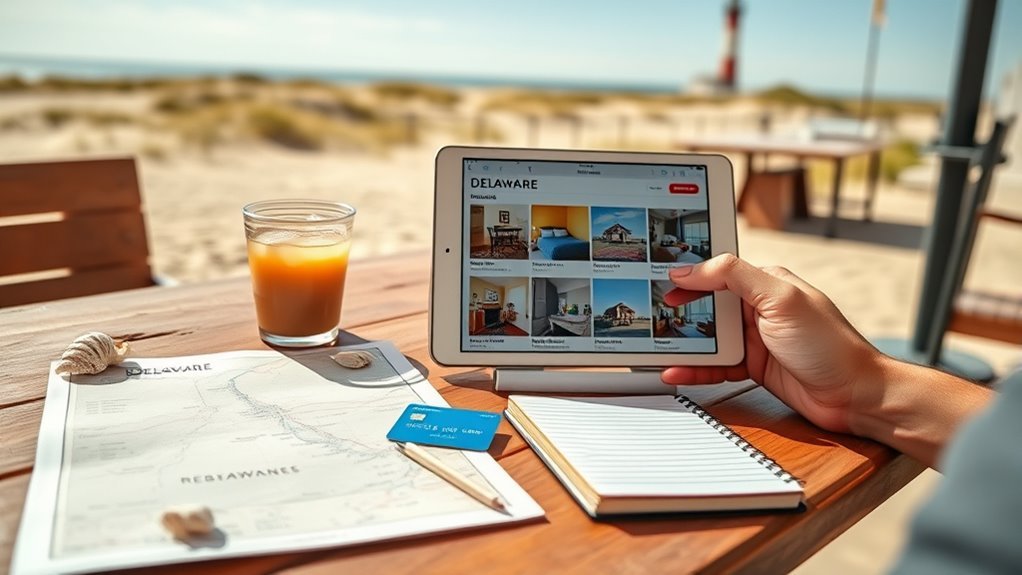
If you want the best value on Delaware Airbnbs, use Airbnb’s filters to target price ranges, must-have amenities (kitchen, parking, AC), and property types, then prioritize listings that show weekly or monthly discounts—these longer-stay reductions often cut the effective nightly rate by 10–30%. Use price sliders, filter for value amenities, and sort by “lowest price” or “best value.” Book off-peak (late fall–early spring) to capture seasonal drops. Monitor last-minute listings for hosts applying discount strategies to fill gaps. Always check ratings to avoid costly trade-offs.
| Action | Expected Savings | When to Use |
|---|---|---|
| Weekly/Monthly discounts | 10–30% | Longer stays |
| Off-peak booking | 15–40% | Nov–Mar |
| Last-minute deals | 5–25% | <2 weeks out |
Adopt data-driven tactics, combine filters with timing, and prioritize high-rated listings so you’re free to travel affordably and confidently.
Budget Strategies for Families and Groups: Affordable Beachfront and Inland Picks
Because stretching your travel budget matters, prioritize high-rated, lower-cost listings that match your group’s size and needs—examples include a 4.89-rated Cottage in Milford for beachfront access, Dewey Beach’s pet-friendly Bright & Breezy Bayside Home that sleeps 10, and inland options like a 4.96-rated Guest Suite in Newark with a full kitchen; target nightly rates under market median by booking tiny homes (e.g., 4.97-rated Selbyville) or highly rated economical stays (Milton’s Home at 4.99) and combine weekly discounts, off‑peak timing, and pet-friendly filters to cut total lodging costs by 10–30%.
Prioritize high-rated, budget-friendly stays—beach cottages, pet-friendly bayside homes, or inland guest suites—to cut lodging costs 10–30%.
Use a data-driven approach: compare per-night means, cleaning fees, and occupancy taxes. Prioritize listings with strong ratings to reduce risk. Seek beachfront options for shared experiences and inland retreats for lower baseline rates.
Tactics that free your budget:
- Book weekly discounts and weekday check-ins to lower nightly averages
- Filter for pet-friendly stays to avoid unexpected surcharges
- Favor tiny homes or guest suites with full kitchens to cut dining costs
- Compare recent reviews and fee breakdowns to predict real total price
When to Splurge on a Delaware Airbnb: Top Reasons It’s Worth Paying More
Although sticking to a strict budget usually saves you the most, paying up for a top-rated Delaware Airbnb often delivers measurable benefits: higher-rated condos and cottages (4.99–5.0) routinely include amenities—pools, ocean views, larger floor plans—that drive up guest satisfaction and can reduce incidental costs like dining out or rideshares.
When you choose a premium rental, you’re buying time and convenience: proximity to Lewes and Milton beaches cuts commute costs and maximizes beach hours, turning higher nightly rates into greater value per day. Data shows 5/5 properties in Frankford correlate with fewer complaints and higher repeat bookings, a proxy for reliable guest satisfaction.
If you want liberation from logistics, splurging for a Greenwood hobby farm or a waterfront condo gives curated, luxury experiences that justify the price spike. Added perks—free parking, high-speed internet, full kitchens—translate into saved fees and flexible planning.
Pick splurges strategically when location, unique experience, or bundled amenities materially lower your trip’s overall expense or friction.
Frequently Asked Questions
What Is the Average Cost of an Airbnb in Delaware?
About $94 per night on average; you’ll spot ranges by Delaware attractions, with urban and beach spots varying based on Airbnb amenities. Expect peaks in December, family options $80–$150, unique stays $120–$200.
What Is a Good Price per Night for Airbnb?
Aim for $80–150 per night as a good price; you’ll balance budget travel and comfort while following rental trends. Book off-peak, compare urban versus coastal options, and leverage flexible dates to maximize freedom and savings.
Is Delaware Good for Airbnb?
Like a sunrise over the shore, yes — you’ll find Delaware lucrative if you track Airbnb regulations, leverage local attractions, optimize pricing trends, and cut costs strategically; data shows demand, seasonality, and high review scores boost revenue potential.
What Is the 75-55 Rule for Airbnb?
The 75-55 rule for Airbnb means you’ll target 75% occupancy and at least 55 booked nights yearly; you’ll optimize Airbnb pricing and rental strategies, track revenue trends, cut turnover costs, and free yourself with steady, data-driven income.
Conclusion
You’ll save money by booking off-peak, using filters for must-have amenities, and comparing total nightly costs (base + cleaning + fees + taxes) across coastal and inland listings — data shows Rehoboth and Lewes command 20–40% premiums over inland Wilmington. Think like a traveler and a spreadsheet: weigh per-night rates against occupancy and group size, and you’ll spot value where others pay more. Treat seasonality as opportunity, not obstacle.
