
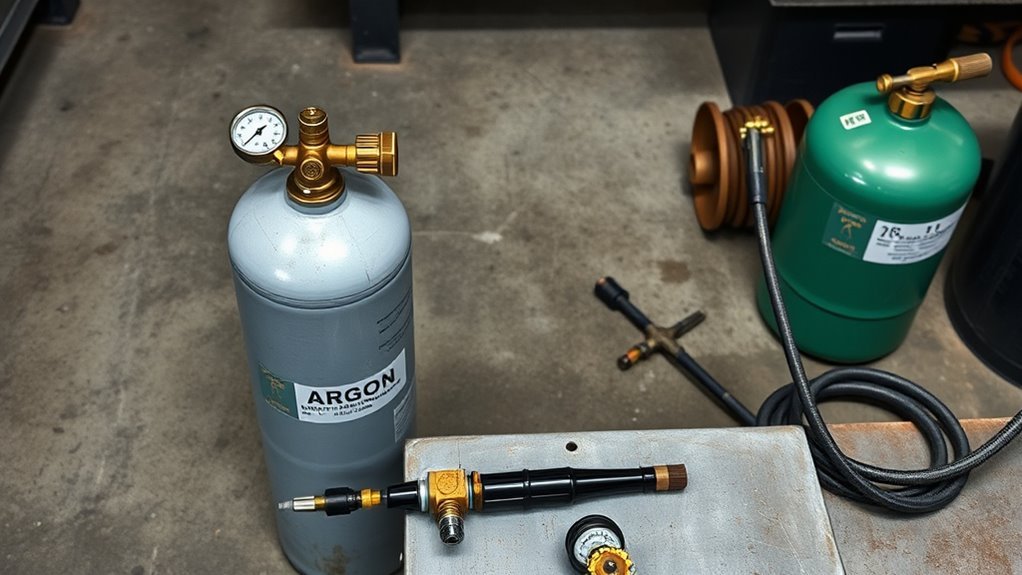
For MIG welding mild steel, you’ll usually spend less with a 75/25 argon-CO₂ mix than with 100% argon. Argon costs more per cylinder, while 75/25 gives you better arc stability, deeper penetration, and less cleanup than pure CO₂. You also avoid extra spatter, tip wear, and rework that raise total operating cost. If you want the best value, 75/25 is the practical choice, and there’s more to compare below.
Which Is Cheaper: Argon or 75/25?
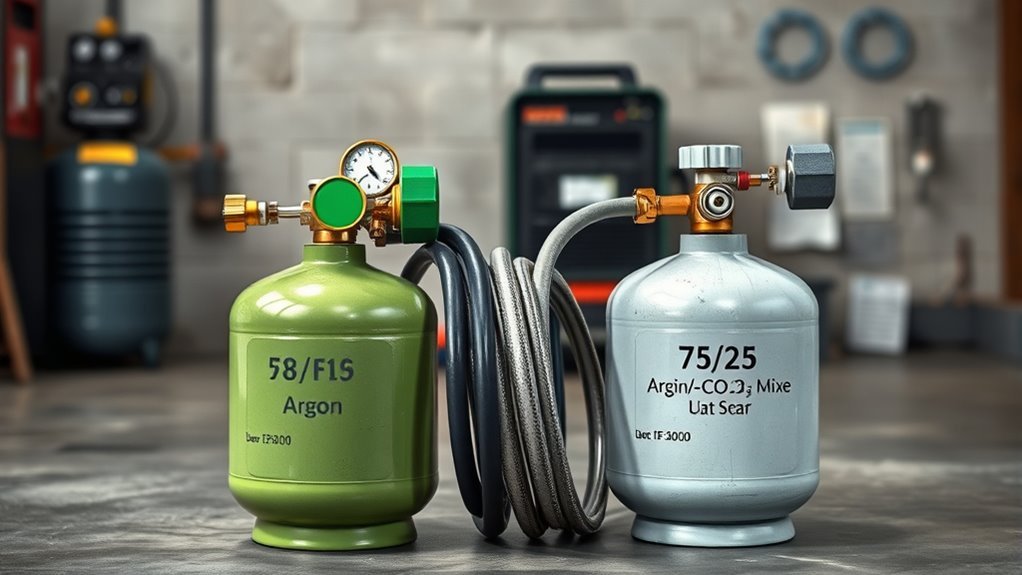
100% argon is typically more expensive than a 75/25 argon-CO₂ mix, so if price is your main concern, 75/25 usually wins.
You’ll see that in direct cost comparisons: a 300CF argon tank can run about $125, while a 125CF 75/25 tank may cost around $90.
That gap matters when you’re buying, swapping, or refilling gas. The 75/25 mix also tends to have better gas availability, and many suppliers price it competitively, which lowers your operating cost over time.
That gap matters when buying or refilling gas, and 75/25 often keeps costs lower over time.
If you’re welding mild steel and want to keep your setup lean, 75/25 gives you a practical balance of affordability and flexibility.
Argon can still make sense for non-ferrous work, but its higher price makes it harder to justify when you’re protecting your budget and your freedom to work without waste.
Products Worth Considering
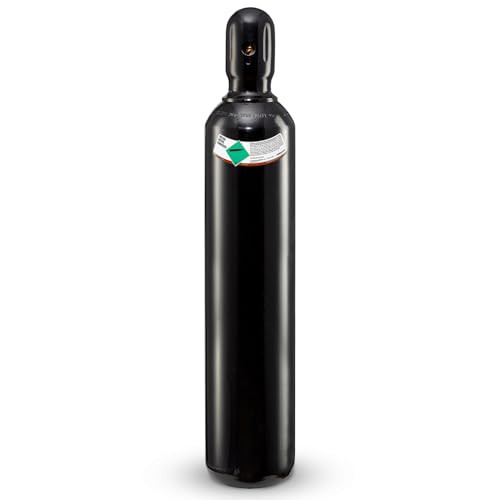
Welding Gas to Your Door - Get PrimeWeld's industrial grade Argon welding gas delivered right to your door. We offer different mixtures for any application, and you can purchase a tank without worrying about costly rental fees or wasted trips out to your local welding supply shop.

75 cu. ft. Steel Acetylene Cylinder
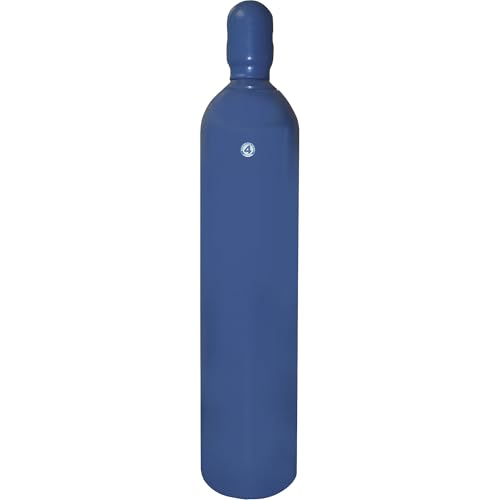
Argon Vs 75/25 MIG Weld Quality
In MIG welding, argon and 75/25 deliver different results, and the better choice depends on the metal and the finish you need.
Pure argon gives you a smooth, stable arc with very low spatter, so you get cleaner control on non-ferrous work. Those argon benefits shine when you weld aluminum or other precision jobs, but on mild steel the arc can feel soft and penetration can come up short.
The 75/25 mix changes that. Its CO₂ content drives deeper penetration and steadier bead formation, giving you tighter control on carbon steel.
You’ll usually see better weld appearance, less wandering, and the 75/25 advantages become clear on thicker mild steel. It can create more spatter than argon, but for MIG on steel, you often get stronger, cleaner results overall.
When 75/25 Saves More Money
When you’re welding mild steel, 75/25 often saves more money than pure argon or straight CO₂ because it balances performance with lower total cost. A 300CF refill around $125 lands in the middle, but your real cost analysis should include cleanup, defects, and downtime.
CO₂ is cheaper upfront, yet its extra spatter can force more grinding and rework, which eats labor fast. 75/25 produces cleaner beads, so you spend less time finishing joints and more time moving product. That improves production efficiency on small jobs and shop runs alike.
Pure argon typically costs more and doesn’t justify itself when you need practical welds, not luxury shielding. If you want reliable results without paying for wasted motion, 75/25 gives you the strongest economic edge. It’s the mix that lets you work freer, cut waste, and keep your budget under control.
Products Worth Considering

POWERFUL HOLDING FORCE: Featuring robust magnets embedded in the welding holder, these durable magnets boasts a strong magnetic holding force of up to 75 lbs, ensuring...
How Mild Steel Changes the Gas Choice
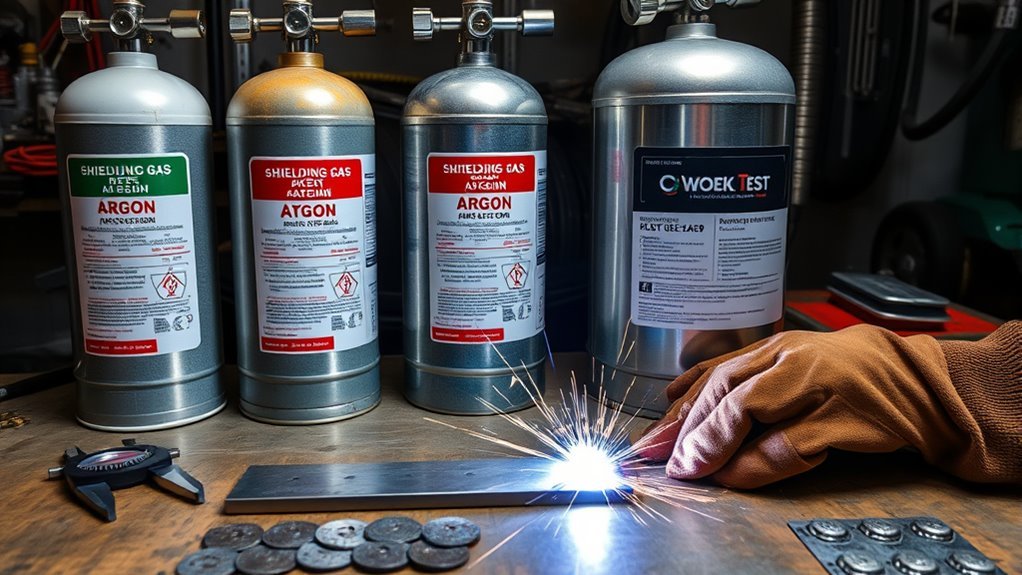
Mild steel usually points you toward a 75/25 argon-CO₂ mix because it gives you a cleaner, more stable arc than 100% argon and far less spatter than straight CO₂. When you judge mild steel properties, the gas selection criteria shift toward arc control, bead shape, and cost balance.
- 75/25 mix: You get strong arc stability, good wetting, and a bead that looks right on mild steel.
- 100% argon: It’s a poor fit here; you’ll fight an unstable arc and weaker fusion behavior.
- 100% CO₂: It’s the cheapest gas, but it drives up spatter and makes the weld less refined.
If you want freedom from overpaying, don’t chase the lowest cylinder price alone. The 75/25 blend often wins on total value because it matches mild steel better and cuts the drag of inefficiency.
Products Worth Considering

All HP cylinders come with a 10 year hydrotest date stamped.

Wide Application: Effortlessly connect to Argon, Helium, and Argon/CO2 mixed gas tanks with the CGA-580 inlet nut. No adapters are necessary, ensuring a secure and leak-free setup right out of the box. Ideal choice for MIG TIG welding, chemical, industrial applications and electronics industry
Hidden Costs of Spatter and Cleanup
Spatter changes the cost picture fast: 100% CO₂ usually throws more metal around the weld, so you spend extra time on cleanup, inspection, and rework. That extra labor hits your budget hard, especially when you run high volume.
CO₂ also increases wear on tips and nozzles, so you replace consumables sooner and keep more spares on hand. More frequent maintenance follows, and that adds hidden downtime you can’t ignore.
CO₂ drives faster tip and nozzle wear, boosting consumable costs and hidden downtime.
A 75/25 mix cuts spatter, improves bead quality, and supports cleaner starts and stops. Better spatter management means less grinding, less brushing, and fewer rejects, so your cleanup efficiency climbs.
You don’t just save minutes; you free up labor, reduce maintenance cycles, and stretch consumable life. In a production setting, that translates into lower total cost and more throughput.
If you want tighter control over expenses, the mixed gas usually wins by shrinking the work you do after the arc stops.
Which Gas Works Best for DIY MIG Welding
For DIY MIG welding on mild steel, the 75% argon/25% CO₂ mix, often called C-25, is usually the best choice because it gives you a more stable arc, less spatter, and better bead control.
You’ll get cleaner welds, less warpage, and less time grinding away waste. That makes it the practical winner when you want freedom from tedious cleanup and better results on thin or medium-gauge steel.
- C-25: Best balance of arc stability, bead shape, and cleanup.
- 100% CO₂: Cheaper per cylinder, but it throws more spatter and costs you time.
- 100% Argon: Fine for aluminum, not for mild steel MIG work.
Use smart MIG welding techniques and gas selection tips to match the gas to the job.
If you’re building, repairing, or learning at home, C-25 usually gives you the strongest long-term value, even if CO₂ looks cheaper upfront.
Products Worth Considering

All HP cylinders come with a 10 year hydrotest date stamped.

Welding Gas to Your Door - Get PrimeWeld's industrial grade 75 %Argon 25% CO2 gas cylinder delivered right to your door. We offer different mixtures for any application, and you can purchase a tank without worrying about costly rental fees or wasted trips out to your local welding supply shop.
All HP cylinders come with a 10 year hydrotest date stamped.
Frequently Asked Questions
What Is 75/25 Argon Used For?
You use 75/25 argon for MIG welding mild steel in welding applications where stable arc and low spatter matter. Its gas properties improve bead quality, penetration, and cleanup, especially on medium to thick carbon steel.
Which Shielding Gas Is the Cheapest?
CO₂ is cheapest: in one shop, a 125 CF refill ran about $90, like a lean engine humming on fumes. Your cost comparison favors gas efficiency, though spatter can raise cleanup and consumable costs.
Why Is Argon the Cheapest?
You’ll find argon cheapest because Argon properties simplify production, storage, and supply. In a Cost comparison, you pay less for handling and often less for cleanup, so your overall welding expense drops.
Which Gas Is Known as Lazy Gas?
Lazy gas is CO₂, not argon—think of it as a blunt hammer beside a fine chisel. You’ll see different argon properties and welding techniques, but CO₂ stays the cheaper, deeper-penetrating, spatter-prone choice.
Conclusion
You’re choosing between two shop travelers: pure argon and 75/25. For most DIY MIG work on mild steel, 75/25 usually carries the lighter wallet because it runs cheaper, welds smoother, and cuts spatter cleanup. Argon can seem less costly at first, but it often asks for more correction and less stable arc control on steel. If you want dependable results and lower total cost, 75/25 is usually the smarter gas to buy.
