
Welding certification cost depends on the code, welding process, material, test position, testing facility, and type of credential you need. That is why one advertised price rarely tells the whole story. Before paying, identify the exact qualification required for the job, request an itemized quote, and budget for preparation, travel, maintenance, and a possible retest.
Quick Answer
Welding certification does not have one national price. For a common AWS plate test, a practical 2026 planning budget is about $400–$700 before travel, practice, or retests. The testing facility sets its fee; AWS separately lists a $70 Certified Welder application and a $105 annual maintenance subscription. Pipe and specialty qualifications can cost more.
Key Takeaways
- An Accredited Test Facility sets its own testing, material, inspection, and retest prices; AWS does not publish one national exam price.
- AWS lists a $70 Certified Welder application fee and a $105 yearly maintenance subscription as of January 1, 2026.
- AWS does not require welding school, prior certification, or a minimum amount of work experience before its performance test.
- Confirm the exact code, process, position, material, thickness, and Welding Procedure Specification before booking.
- A credential can help satisfy hiring requirements, but an employer or project may still require a separate qualification test.
At a Glance
| Time Required | Usually one testing appointment; some facilities allow about three hours for a common plate test. Training and credential processing take additional time. |
| Difficulty | Intermediate to advanced hands-on skill, depending on the process, material, position, and acceptance criteria. |
| Tools Needed | Photo ID, required PPE, and any hand tools or WPS documents specified by the testing facility. |
| Cost | Plan roughly $400–$700 for many common plate-testing paths, then add any preparation, travel, AWS application, annual maintenance, or retest expenses. |
Types of Welding Certifications and What They Cover

The first step is understanding what the word certification means in your situation. A personal AWS Certified Welder credential is different from an employer qualification record created under a construction code or project specification.
The AWS Certified Welder program is performance-based. AWS states that it has no prerequisite education, prior certification, or minimum work-experience requirement. You take a hands-on test at an AWS Accredited Test Facility using an approved Welding Procedure Specification, commonly called a WPS.
ASME BPVC Section IX, by contrast, contains rules for qualifying welding procedures and welding personnel used in pressure-equipment work. A manufacturer, contractor, employer, or testing organization normally documents that qualification. ASME does not automatically issue every tested welder a universal personal card.
Common standards and applications include:
- AWS D1.1: Structural steel fabrication and erection.
- AWS D1.5: Bridge welding.
- AWS D17.1: Aerospace fusion welding.
- API 1104: Pipeline and related facility welding.
- ASME Section IX: Procedure and personnel qualification for boilers, pressure vessels, and pressure piping.
- Employer or project tests: Qualifications written for a particular job, contract, material, or production procedure.
Warning: Do not book a test based only on a phrase such as “AWS certified” or “pipe certified.” Ask the employer, union, contractor, or customer for the exact code edition, process, position, base metal, thickness, diameter, backing condition, and WPS. Passing the wrong test may not qualify you for the job.
Certification Versus Qualification
A certification is a credential issued or maintained through a certification program. A qualification is evidence that you produced an acceptable weld under a defined set of variables. Those variables can limit what the test covers.
For example, a test performed with one process, position, electrode group, backing condition, or material does not automatically qualify every other combination. The applicable code and WPS determine the permitted range. That is why the cheapest available test is not always the most useful one.
How to Choose the Right Welding Test
- Start with the job requirement. Obtain the code, specification, or employer instructions in writing.
- Confirm the welding process. Examples include SMAW, GMAW, FCAW, GTAW, or a combination process.
- Confirm the test position. Plate tests may use positions such as 1G, 2G, 3G, or 4G. Pipe testing may include 2G, 5G, or 6G.
- Confirm the test material and dimensions. Thickness, pipe diameter, base-metal group, filler metal, and backing can affect the qualification range.
- Ask who must issue or accept the record. The answer may be AWS, an employer, a contractor, a union, an inspector, or an authority having jurisdiction.
Standard Pricing for Common Certification Tests

There is no single national welding certification test price. AWS allows each Accredited Test Facility to set its own testing and retest charges. The facility’s price may depend on the process, position, test coupon, inspection method, number of positions, and paperwork requested.
The table below provides current, publicly listed examples to help with planning. These are not mandatory nationwide rates.
| Cost Item | Current Published Amount | What It Means |
|---|---|---|
| AWS Certified Welder application | $70 | AWS administrative fee listed in its price schedule effective January 1, 2026; the facility test fee is separate unless bundled. |
| AWS yearly maintenance subscription | $105 per year | Current AWS WeldCert Pro maintenance charge for Certified Welder records. |
| EVIT individual-position test | $350 | A current public example from one AWS Accredited Test Facility; materials are included there. |
| EVIT 3G and 4G combination | $450 | A current example of a two-position structural plate-testing package. |
| Earlbeck D1.1 send-in test kits | $330–$585 | Current public kit examples; price varies by limited or unlimited thickness and by one or two positions. |
| Pipe, specialty, or project-specific tests | Quote required | Cost varies with materials, diameter, process, inspection method, code documentation, and facility policy. |
For that reason, a reasonable planning budget for many common structural plate paths is roughly $400–$700 when the facility charge and applicable AWS paperwork are considered together. Your actual total may be lower or higher.
Note: Published prices can change, and facilities package services differently. The examples above were verified on July 28, 2026. Obtain a written quote before making travel or training arrangements.
What’s Included in Test Fees and Optional Add-Ons

Some facilities include test coupons, consumables, machine use, inspection, and basic paperwork in one price. Others charge separately for materials, destructive testing, radiography, AWS processing, shipping, or additional copies of the qualification record.
Ask whether the written quote includes each of the following:
- The correct test coupon, pipe, plate, backing strip, or insert
- Filler metal, wire, rods, electrodes, shielding gas, and machine use
- Coupon preparation, cutting, grinding, and cleaning
- CWI or examiner supervision
- Visual inspection
- Bend testing, macroetching, fracture testing, or radiography
- WPS access or review
- Facility qualification paperwork
- AWS Certified Welder application processing, when requested
- Digital credential, card, or additional record copies
- PPE, hand tools, grinder, wire brush, or chipping hammer
- Shipping for remote or send-in kits
- Cancellation, rescheduling, and retest charges
A send-in kit can reduce travel, but it is not simply a mail-order certification. You must follow the provider’s identity-verification, witnessing, WPS, coupon-preparation, and return-shipping rules. Confirm that the resulting record will be accepted by the employer or project before choosing this route.
Products Worth Considering

MG-11 GAUGE SET: Metal Weld Fillet Gages Set (7PCS), It has wide measurement range, meets various kinds of needs. Checking fillet leg size and fillet throat size. Increments standard and metric equivalents etched into the surface for clarity and easier reading.
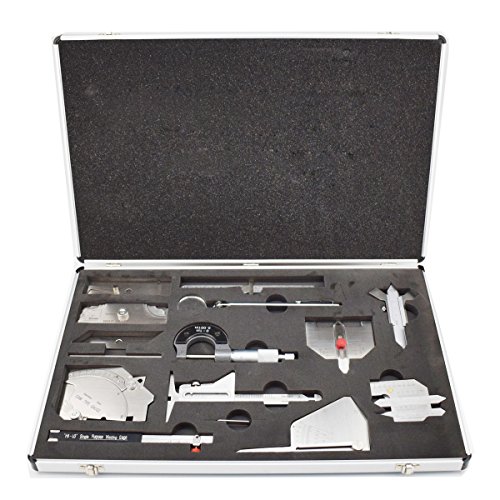
Most ruler are INCH size, some angle measurement are Metric size.
How to Estimate Your Total Certification Cost
Use this formula before comparing providers:
Total cost = preparation + facility test + inspection + credential processing + equipment + travel + lost work time + maintenance + retest contingency.
- Identify the exact test. Write down the code, process, position, material, thickness, diameter, and backing condition.
- Ask for an itemized facility quote. Confirm materials, machine use, inspection, records, and taxes or administrative charges.
- Add credential fees. Include the AWS application and annual maintenance only when you are pursuing the AWS Certified Welder credential.
- Add preparation costs. Count practice booths, instructor time, coupons, consumables, and any refresher course.
- Add logistics. Include fuel, airfare, lodging, meals, shipping, parking, and unpaid time away from work.
- Plan for continuity. Budget for current AWS maintenance charges and the administrative effort needed to document welding activity every six months.
- Keep a retest reserve. A failed test can require another facility fee, more practice, new materials, and another trip.
Pro Tip: Ask a prospective employer whether it will pay for the required test after a conditional job offer. Many employers prefer to qualify welders on their own WPS rather than rely only on an outside credential.
Products Worth Considering

FR Materials: 5.5OZ Cotton Twill, FR treated, with FR buttons & threads. Clear FR tag on arms & bottom front. Neck tag with UL Certification details. Small FR sample included for customers to have a simple FR try


FR MATRIALS:7.5OZ Cotton Twill FR Treated,FR Buttons,FR Sewing Threads!Clear FR Tag on Phone Pocket front.More FR info On Neck Tag About UL Certification.We Attached A Small Sample Inside Package For Cunstomers Simple FR Try
Scheduling, Locations, and What to Bring on Test Day

Testing schedules are not standardized. One facility may offer weekly appointments, while another may schedule tests only on certain days or after enough candidates register. Use the AWS directory to locate an Accredited Test Facility, then confirm its current address, appointment time, process availability, and cancellation policy.
Before the appointment, request written answers to these questions:
- Which code edition and WPS will be used?
- How much time is allowed?
- Can you practice at the facility before the test?
- Which machines, electrodes, gases, and test materials are supplied?
- Which PPE and hand tools must you bring?
- How will the coupon be inspected or tested?
- When will results and records be available?
- Does the price include AWS application processing?
Unless the facility gives different instructions, plan to bring:
- A valid government-issued photo ID
- Your appointment and payment confirmation
- The employer or project WPS when the facility requires it
- An approved welding helmet and safety glasses
- Welding gloves and flame-resistant clothing
- Protective footwear and any required hearing protection
- Hand tools specified by the facility
Warning: Welding can expose you to fumes, ultraviolet radiation, hot metal, electrical hazards, fire, and compressed gases. Follow the facility’s ventilation, PPE, fire-prevention, and equipment rules. Review the OSHA welding, cutting, and brazing guidance before testing or practicing.
Products Worth Considering

201 STAINLESS STEEL - Made of Premium Type 201 stainless steel with excellent corrosion and heat resistance. Ideal for consistent practice across MIG, TIG, Stick, and wire-feed welding applications.

🎲Superior Processing: Our steel plates are all laser-cut, providing edge and overall flatness that is unmatched by other stamped and sheared components.

Quantity and size:Welding Practice Kit, With 8 Of 3x5”, 8 Of 2x4”, 4 Of 3x3” And 4 Of 2x2” 24 pieces in total.
Retest Policies and Additional Costs

AWS does not publish one national retest fee. The testing facility decides what a new attempt costs, when it can be scheduled, and whether any part of the original fee can be reused.
Policies vary considerably. One facility may charge only for a replacement coupon and inspection, while another may require the full test price again. EVIT, for example, currently states that a retest costs the same as the original test and can be scheduled no earlier than the next day.
AWS does not set a general limit on the number of Certified Welder retest attempts, but a facility, employer, union, training program, or project may impose its own waiting period or eligibility rule.
The least expensive retest is the one you avoid by practicing the exact process, position, joint, and WPS used during the examination.
Before trying again:
- Ask which visual or mechanical acceptance criterion the coupon failed.
- Review the discontinuity, such as incomplete fusion, slag inclusion, porosity, undercut, overlap, or a dimensional problem.
- Practice with the same process, electrode classification, joint design, position, and permitted parameters.
- Confirm whether the original qualification can be repaired or whether a complete new test is required.
- Request the new total in writing, including materials and inspection.
- Keep copies of the test report and any inspector comments.
Certification Portability and AWS Registry Benefits

An AWS Certified Welder credential can be useful because AWS maintains a record of the accepted qualification. This can make it easier to show what process, specification, and test variables you successfully completed.
Portability does not mean universal acceptance. An employer, customer, code official, union, or project specification may require:
- A test witnessed by its own inspector
- Qualification to the company’s production WPS
- A different code or code edition
- A different process, material, position, thickness, or diameter
- Additional safety, site-access, or quality-control requirements
AWS Registry Entry
After an accepted test at an AWS Accredited Test Facility, the facility can submit the qualification through the Certified Welder program. AWS’s current price list shows a $70 application fee. A testing facility may collect that amount separately or include it in a larger package, so check the quote.
The record identifies the scope of the qualification rather than declaring that the welder can perform every welding process or application. Employers should still compare the record with the work they need performed.
Portable Certification Record and Maintenance
AWS says a Certified Welder credential can remain valid indefinitely when continuity is maintained. The welder must document use of the applicable welding process at least once every six months and submit the required maintenance information.
AWS also lists a $105 annual WeldCert Pro maintenance subscription as of January 1, 2026. Missing continuity or maintenance requirements can make the record inactive, even if the original test was passed.
Note: Keep copies of your qualification record, WPS, test date, continuity submissions, employer verification, and payment receipts. Do not rely only on a wallet card or verbal statement of certification.
Training and School Costs Versus Certification Fees

Welding school and welding certification are separate expenses. AWS does not require you to complete a school program before taking its Certified Welder performance test. However, attempting an advanced position without enough practice can lead to repeated test fees.
Your most economical preparation route depends on your current ability:
- Experienced welder: A short practice session using the exact WPS may be enough.
- Welder changing processes or positions: Targeted booth rental or a focused course may offer better value than a full program.
- Beginner: A structured certificate, diploma, community-college program, or registered apprenticeship may provide the foundation needed for safe, consistent work.
- Current employee: Employer-funded practice and testing may reduce or eliminate out-of-pocket costs.
Program Tuition Versus Exams
There is no dependable national tuition range that fits every welding program. Costs differ by course length, public or private status, residency, equipment, supplies, and eligibility for aid.
As one current private-provider example, Earlbeck lists individual 2026 courses from approximately $295 for Welding Basics to several thousand dollars for longer fundamentals or intermediate courses. Its larger training packages are listed at roughly $5,080–$5,460. These figures show why readers should compare the exact hours, processes, booth time, consumables, and testing included rather than judging a program by tuition alone.
Community colleges and technical schools may use per-credit tuition. Registered apprenticeships combine paid work with related instruction, which can reduce the need to finance a full-time private program.
Equipment and Materials
Ask the school or testing facility which items are included before buying equipment. Possible out-of-pocket expenses include:
- Welding helmet and replacement lenses
- Safety glasses, gloves, jacket, sleeves, and boots
- Respiratory protection when required and properly selected
- Chipping hammer, wire brush, pliers, files, and grinders
- Practice coupons, pipe, plate, electrodes, wire, rods, and gas
- Books, code excerpts, calculators, notebooks, and measuring tools
- Machine rental or supervised booth time
Avoid buying a welding machine solely for certification practice until you know the exact process, amperage range, polarity, and controls used for the planned test. Training on equipment unlike the test machine may provide limited value.
Financial Aid Options
Federal student aid may help with an eligible welding program at a participating school, but it does not automatically pay for every independent certification exam, short course, or testing-facility charge.
Submit the Free Application for Federal Student Aid and ask the school’s financial-aid office which tuition, books, supplies, and equipment are eligible. Pell Grant and loan eligibility depends on the student, school, program, enrollment status, and current federal rules.
Financial Aid, Scholarships, and Cost-Saving Strategies

Start with funding that does not need to be repaid, then compare employer support and low-cost training routes before taking on debt.
- FAFSA and federal aid: Eligible students at participating career schools or colleges may qualify for grants, work-study, or federal loans.
- AWS Foundation scholarships: Review current AWS scholarship opportunities and each award’s permitted uses.
- GI Bill® benefits: Eligible veterans and dependents may be able to use benefits for approved trade training or receive reimbursement for certain licensing and certification tests. Verify the program through the U.S. Department of Veterans Affairs.
- Registered apprenticeships: Programs listed through Apprenticeship.gov combine paid work, progressive wages, instruction, and a recognized credential.
- Employer reimbursement: Ask about pre-employment testing, tuition assistance, tool allowances, union training funds, or reimbursement after passing.
- Workforce programs: State and local workforce agencies may fund approved training for eligible job seekers.
- Payment plans: Some schools or facilities divide tuition or testing expenses into installments, although terms and fees vary.
Pro Tip: Apply for grants and scholarships before borrowing. Compare the net amount you must pay—not just the advertised tuition—and confirm whether certification testing, PPE, books, supplies, and tools are included.
Career Value: Salary, Job Prospects, and Return on Investment

Certification can help demonstrate that you produced an acceptable weld under controlled test conditions. It may satisfy a hiring requirement or give an employer clearer evidence of your tested process and position. It does not guarantee a job, a promotion, or a specific wage.
The U.S. Bureau of Labor Statistics reports a median annual wage of $51,000 for welders, cutters, solderers, and brazers in May 2024. It projects employment growth of 2% from 2024 to 2034 and about 45,600 openings per year, on average, during that period.
BLS reports a $51,000 median annual wage in May 2024 and projects about 45,600 openings per year through 2034.
Actual earnings vary by region, industry, experience, shift, overtime, union agreement, travel, security clearance, code knowledge, and the difficulty of the work. Specialized industries may pay more, but they may also require additional qualifications, medical clearance, travel, confined-space work, or challenging conditions.
To estimate return on investment, compare:
- The total cost of training and testing
- The number of local job postings that request the qualification
- Whether employers provide their own test after hiring
- The likely starting wage and available hours
- Travel, tools, dues, PPE, and credential-maintenance expenses
- The probability that your chosen test will be accepted
A modest testing expense may have a strong return when it unlocks a specific job you are prepared to perform. A costly credential has poor value when local employers require a different process or plan to retest every applicant.
Sources
- American Welding Society — Certified Welder Program — prerequisites, testing process, facility-set pricing, retests, continuity, and credential validity.
- American Welding Society — Program Price List — current application and annual maintenance charges effective January 1, 2026.
- ASME — BPVC Section IX — scope of welding procedure and personnel qualification rules.
- American Welding Society Directory — locating Accredited Test Facilities.
- Occupational Safety and Health Administration — Welding, Cutting, and Brazing — welding hazards, standards, and protective measures.
- U.S. Bureau of Labor Statistics — Welders, Cutters, Solderers, and Brazers — wage, outlook, work environment, and training data.
Frequently Asked Questions
How long does an AWS welding certification remain valid?
An AWS Certified Welder credential can remain valid indefinitely when you maintain continuity in the applicable welding process and submit the required documentation every six months. Current AWS maintenance also uses a yearly WeldCert Pro subscription. Employer, union, project, and other code qualifications may follow different rules.
Are welding certifications recognized internationally?
AWS and other major standards are used internationally, but recognition is not automatic. The employer, customer, country, contract, or authority having jurisdiction decides whether it accepts the credential. You may need an additional test under a local code or project WPS.
Can an employer require a company-specific welding test?
Yes. An employer can require qualification on its own equipment, procedure, material, position, or production joint. An existing AWS credential may document your skill, but it does not prevent the employer from requiring another test.
Do welding testing facilities offer payment plans?
Some schools and testing facilities offer installment plans, employer billing, or financing, but AWS does not require them to do so. Ask about deposits, finance charges, refund rules, missed-payment terms, and whether the credential is withheld until the balance is paid.
Is a medical or vision exam required for AWS Certified Welder testing?
AWS does not list a medical exam, vision test, formal education, or minimum experience as a prerequisite for its Certified Welder performance test. An employer or worksite may separately require a physical, respirator evaluation, drug screening, hearing test, vision standard, or fitness-for-duty assessment.
Do I need to attend welding school before taking the test?
No school is required by the AWS Certified Welder program. You still need enough practical skill to follow the WPS and produce a weld that passes visual and mechanical or radiographic acceptance criteria. Beginners usually benefit from structured training before paying for an advanced test.
What happens if I fail a welding certification test?
You can normally arrange another attempt, but the facility controls the schedule and fee. Ask for the failed acceptance criterion, practice the same process and position, and request a complete retest quote. AWS does not publish one national retest price or a general maximum number of attempts.
Are materials and inspection included in the test price?
Sometimes. Some facilities include coupons, consumables, machine use, visual inspection, bend tests, and paperwork. Others itemize one or more of those services. Request a written list of inclusions before comparing prices.
Which welding certification test should I take?
Take the test required by the employer, customer, union, contract, or project specification. Obtain the exact code, process, position, material, thickness, diameter, backing condition, and WPS before booking. A broad-sounding credential may still fail to cover the work you want.
Conclusion
A common welding certification path may require a planning budget of roughly $400–$700, but the final amount depends on the facility, code, process, position, materials, inspection, paperwork, and preparation required. AWS separately lists a $70 Certified Welder application and a $105 annual maintenance subscription for 2026.
The most important cost-saving step is choosing the correct test before paying. Get the job requirement in writing, compare itemized facility quotes, confirm what the fee includes, and ask whether the employer will fund or repeat the qualification. A well-matched credential can support a job application; the wrong test can leave you paying twice.
