
If you fish Arizona public freshwater and are age 10 or older, you’ll need a valid license: an annual general fishing license costs $37 for residents and $55 for non‑residents. Combination hunt‑and‑fish options run $57 for residents and $160 for non‑residents; short‑term combos are $15–$20 per day. Licenses fund stocking, habitat restoration, monitoring, and outreach. Keep your license on you—more details on exemptions, purchase methods, and program benefits follow.
Who Needs a Fishing License in Arizona
Although Arizona requires a valid fishing license for most anglers, you only need one if you’re age 10 or older fishing in public waters; youth under 10 and blind residents are exempt.
You should know the fishing age requirements precisely: anyone 10+ actively fishing public waters must carry a license, and armed forces members may qualify for resident licenses under defined conditions.
Licenses are non-transferable, non-refundable, and valid for 365 days from purchase, so you’ll plan renewals around that interval. Carrying the license while fishing is mandatory; failure to do so exposes you to license penalties including fines.
From a conservation standpoint, these rules create quantifiable compliance that funds habitat management, stocking, and scientific monitoring. You’ll reduce enforcement impact and support population sustainability by adhering to possession requirements and age-based exemptions.
Track your license dates and personal eligibility to guarantee legal, data-informed participation in Arizona’s freshwater fisheries.
Products Worth Considering

ARIZONA STATE FLAG DESIGN: Features the bold red, yellow, and blue of the Arizona state flag with full embossed detail.

FISHING LICENSE HOLDER W/ZIP CLOSURE

DECORATIVE LICENSE PLATE – Signs 4 Fun License Plates give personality to any vehicle. These license plates do not intend to cover or block any existing license plate on a vehicle. Our decorative license plates can be hung on walls as well as decoration in man caves, garages, or other displays.
Types of Fishing Licenses and Prices

When planning your time on Arizona’s public waters, choose from several license types that balance access, residency status, and conservation funding:
You’ll typically buy a general fishing license ($37 resident, $55 non-resident) for standard angling in public waters. If you’ll also hunt, a combination hunt-and-fish license costs $57 for residents and $160 for non-residents, consolidating permits while directing revenue to habitat and population management.
Short-term combination options allow temporal flexibility at $15 per day for residents and $20 per day for non-residents, useful for targeted trips with minimal commitment. Youth licenses are highly subsidized: ages 10–17 obtain a youth combination hunt-and-fish license for just $5 regardless of residency, supporting early engagement in fisheries stewardship.
For long-term investment, lifetime licenses are available only to Arizona residents, with prices scaled by age from $296 up to $1,500, providing perpetual access while contributing substantial one-time conservation funding.
Choose the option that aligns with your usage pattern and supports management objectives.
Products Worth Considering

Mirrored Acrylic

Material:License Plate made of Stainless steel. Non-blocking and street legal, that won't block the upper and lower status and year labels, never having to worry about getting a ticket and wasting time

Enough to Use: you will receive 6 pieces of fishing license holders, and 6 pieces of safety pins, abundant in quantity, enough for you to choose and replace, can meet your different needs; You can also share them with your friends
Where and How to Buy Your License
After selecting the license type that fits your trip and conservation goals, you can obtain your permit through several established channels.
For rapid issuance and record accuracy, use the Arizona Game and Fish Department website for online purchases; the system generates an immediate printable license and timestamps the purchase, establishing a one-year validity from that date.
If you prefer in-person service, visit one of over 150 licensed dealers statewide—sporting goods retailers and convenience stores—that process sales and report transactions to the department. Department offices also sell licenses and offer expert assistance for complex questions.
Note that all purchased licenses are nonrefundable and nontransferable, a policy that supports program integrity and revenue forecasting for conservation projects.
While complimentary licenses exist for qualifying groups, purchasing pathways remain consistent: online purchases for speed, licensed dealers for convenience, and department offices for guidance.
Record and retain your license during fieldwork to comply with enforcement and data-collection protocols.
Products Worth Considering

All Team Golf product is officially licensed by the NFL, NCAA, MLB, NHL, or Military

Comes with pre-drilled holes for easy installation
Exemptions, Free Fishing Days, and Special Licenses
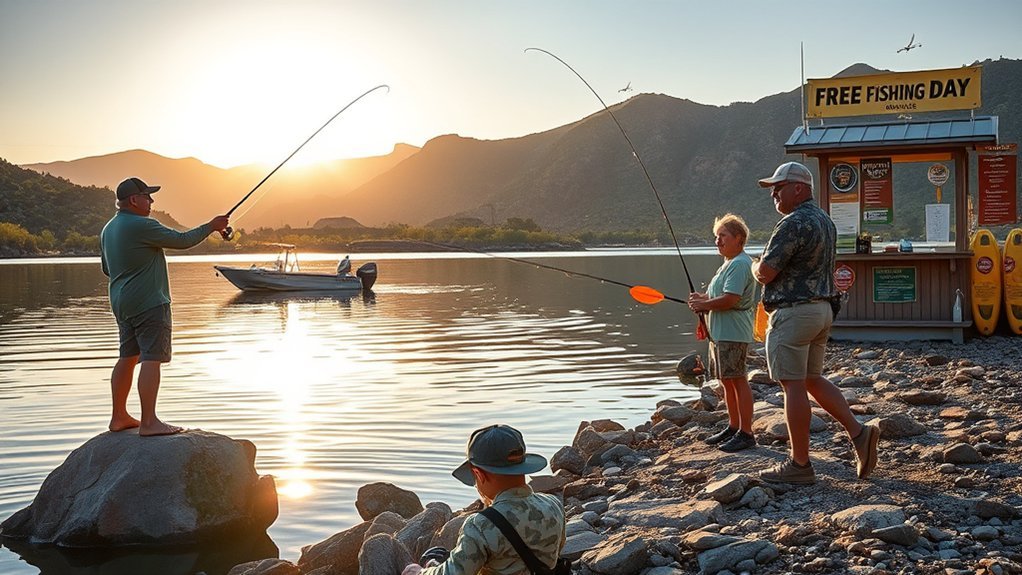
If you’re planning a trip, note that Arizona law carves out clear exemptions and targeted programs to support access while conserving fisheries: children under 10 and blind residents don’t need licenses, anglers fishing on private waters with the owner’s permission are exempt, and the state designates free fishing days (next on June 7, 2025 and June 6, 2026) when anyone may fish without a license. You should track youth exemptions and special licenses to comply with fishing regulations and minimize enforcement risk. The Youth Combination Hunt and Fish license (ages 10–17) costs $5 for residents and non-residents, offering a low-cost pathway for data collection and participation. Use exemptions responsibly; private-water permission must be documented when practical.
| Category | Key detail |
|---|---|
| Youth exemptions | Under-10 exempt; 10–17 eligible for $5 combo |
| Free days | June 7, 2025; June 6, 2026 |
Follow rules and record effort to support adaptive, conservation-minded management.
How License Fees Support Conservation
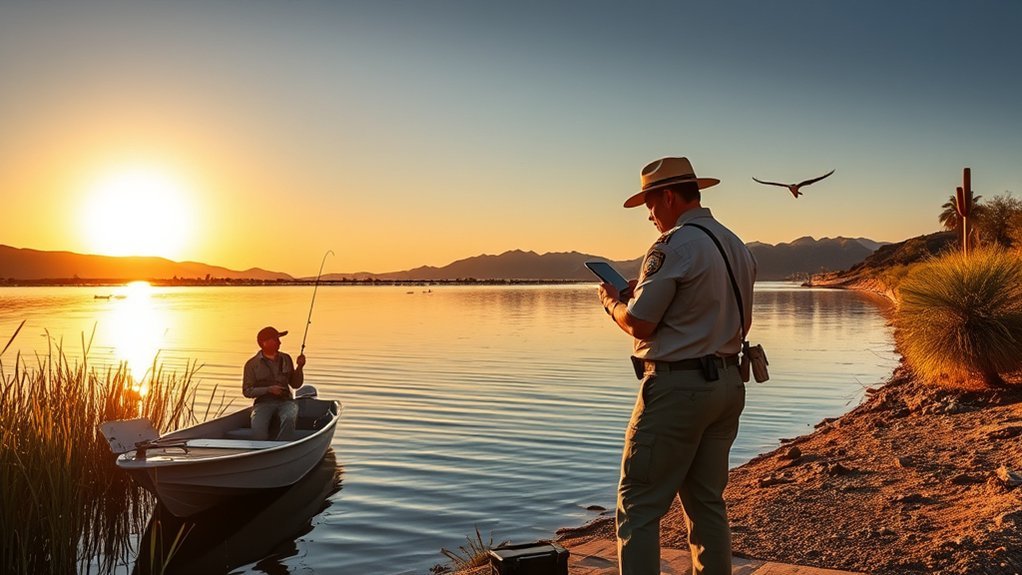
Exemptions and targeted programs make fishing accessible, but the fees most anglers pay are the engine that funds measurable conservation outcomes.
When you buy a license, you provide conservation funding that underwrites habitat restoration projects proven to improve water quality and aquatic vegetation metrics. Those projects increase carrying capacity and resilience of native fish populations against temperature and pollution stressors.
Buying a license funds habitat restoration that improves water quality, aquatic vegetation, and native fish resilience.
License revenue also supports fish stocking programs that expand recreational opportunities without compromising native-species management objectives. Monitoring and adaptive-management efforts financed by fees let managers quantify population responses and refine techniques.
Educational initiatives funded through this revenue promote sustainable practices by delivering best-practice retention, size-limit compliance, and gear-use guidance, reducing unintended mortality.
In short, your purchase is a targeted investment: it sustains restoration, stocking, species protection, monitoring, and outreach programs that together maintain and enhance Arizona’s freshwater ecosystems for future anglers and ecological integrity.
Frequently Asked Questions
Can I Fish From a Private Dock Without a License?
Generally, no — you’ll still need a license unless state statute exempts you; follow private property regulations and fishing dock guidelines, document species and effort, report catches, and prioritize conservation-minded practices supported by regional data and agency rules.
Are License Fees Refundable if I Cancel a Trip?
Like a sudden rain, no — you won’t typically get refunds; you’ll follow the license cancellation policy and trip refund process, which statistically offer limited exceptions, documented steps, and conservation-focused justifications to protect resource management funding.
Do Youth Licenses Require Parental Consent or Presence?
Yes — for youth fishing, you’ll need parental guidance: parents or guardians usually must consent for license issuance and may need to accompany minors depending on state rules. Data show supervision increases safety and compliance with conservation regulations.
Can I Transfer My License to Another Person or Year?
No, you generally can’t transfer your license to another person or carry it over to a different year. Follow the license transfer process and check eligibility criteria for exceptions, using official data to support conservation and compliance.
Are There Discounts for Military or Veterans?
Yes — you’ll often get reduced fees; agencies publish military discounts and veterans benefits with eligibility criteria, documentation requirements, and data showing increased recreation access while supporting conservation funding and resource management.
Conclusion
You rely on accurate licensing to support Arizona’s fisheries: over 85% of state fish and wildlife funding comes from license sales and user fees, meaning your purchase directly funds habitat restoration, stocking, and research. By securing the appropriate freshwater fishing license, you legally enjoy resources while contributing to measurable conservation outcomes. Keep records, choose the correct permit for your situation, and consider multi-year or youth options to maximize long-term ecological benefits from your participation.
