
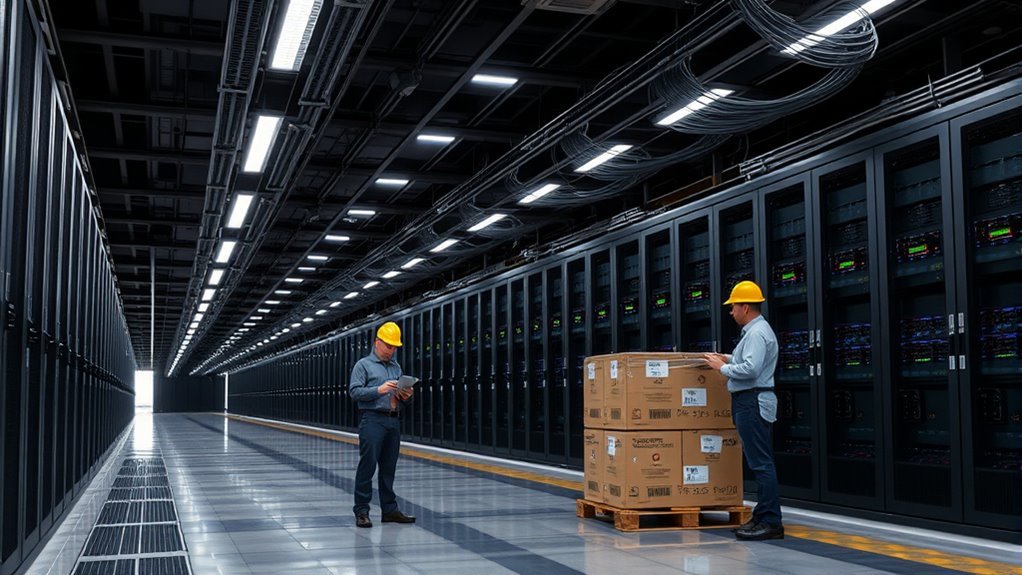
You should budget about $7 million to $12 million per MW to build a modern data center, or roughly $600 to $1,100 per square foot overall. Your actual cost depends mostly on power availability, land, redundancy level, and MEP scope, with electrical systems taking 40% to 45% of spend and cooling adding 15% to 20%. Brownfield projects can trim costs by 10% to 15%, while Tier IV and AI-heavy builds can push budgets far higher as complexity increases.
Quick Answer
- Modern data centers typically cost $7M–$12M per MW or $600–$1,100 per square foot to build.
- Electrical systems are the single biggest cost driver, consuming 40%–45% of total project spend.
- Tier IV facilities cost 25%–40% more than Tier III because of deeper redundancy requirements.
- AI-optimized builds can exceed $20M per MW due to advanced cooling and higher electrical loads.
- Brownfield redevelopment usually runs $7M–$8M per MW, saving 10%–15% versus greenfield.
What Is Data Center Cost Overall?
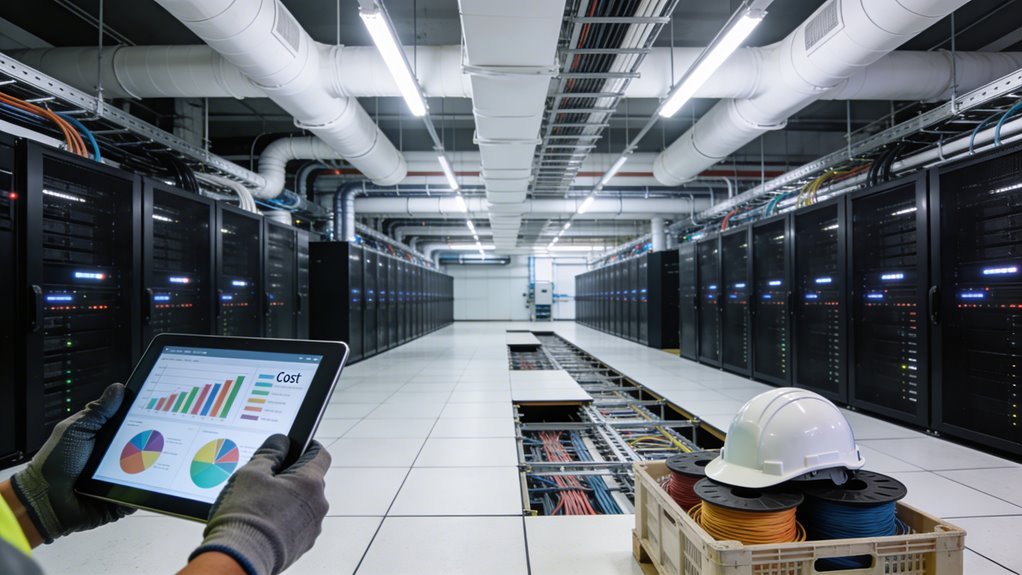
Data center cost is driven by power density, redundancy, and scale. Those three variables can swing your total budget sharply depending on your design target. Most projects land in the range of $600 to $1,000 per square foot for initial build costs, with total development typically running $625 to $1,135 per gross square foot.
Electrical systems consume 40% to 45% of total spend, making power architecture your biggest budget lever. Cooling adds another 15% to 20%, so thermal design affects both your upfront costs and long-term operating expenses.
Higher resilience means higher cost. Tier IV facilities generally run 25% to 40% more than Tier III because of the redundancy required at every layer. At the extreme end, large campuses can surpass $2 billion, and flagship builds have reached $5 billion.
What Is Data Center Cost per MW?
When you benchmark by IT load, data center construction costs typically land at $7 million to $12 million per MW. That’s a more useful planning metric than square footage alone.
The range shifts with location, power density, and cooling technology. Greenfield sites usually stay within that same $7M–$12M band. Brownfield redevelopment compresses to roughly $7M–$8M per MW.
High-density deployments cost more. AI infrastructure can push beyond $20M per MW because advanced cooling, deeper redundancy, and higher electrical throughput all raise capital requirements at the same time.
Evaluating energy efficiency and modular design early won’t eliminate cost pressure, but it can improve budget predictability, shorten delivery schedules, and tighten your control over per-MW economics.
Products Worth Considering

[Cable Management] 1U Brush panel will complement your rackmount gear and make cable management look organized and professional.

UNIVERSAL DESIGN: The cable management brush strip panel mounts to a standard 19" 2 or 4-post rack to organize cables while keeping dust and dirt out of the rack.

Pro-Level Cable Management Solution – Engineered for IT professionals, data center technicians, and AV installers, this 1U rack mount brush panel keeps cable pathways organized, protected, and easy to access without clutter or obstruction.
What Is Data Center Cost per Square Foot?
Per-megawatt pricing gives you the best read on infrastructure intensity. Cost per square foot still matters, though, for early budgeting, site comparison, and shell-versus-fit-out analysis.
Data center construction costs typically run $600 to $1,100 per gross square foot, with total development landing around $625 to $1,135 per gross square foot.
If you’re isolating the shell, powered shell costs fall in the $105 to $235 per gross square foot range. For full improvements, plan on $520 to $900 per gross square foot for the specialized build-out.
Land averages about $5.59 per square foot, though parcels above 50 acres have risen 23% year over year.
These benchmarks let you pressure-test financing assumptions, compare sites faster, and maintain capital control before committing to a final program.
Which Factors Drive Data Center Costs?
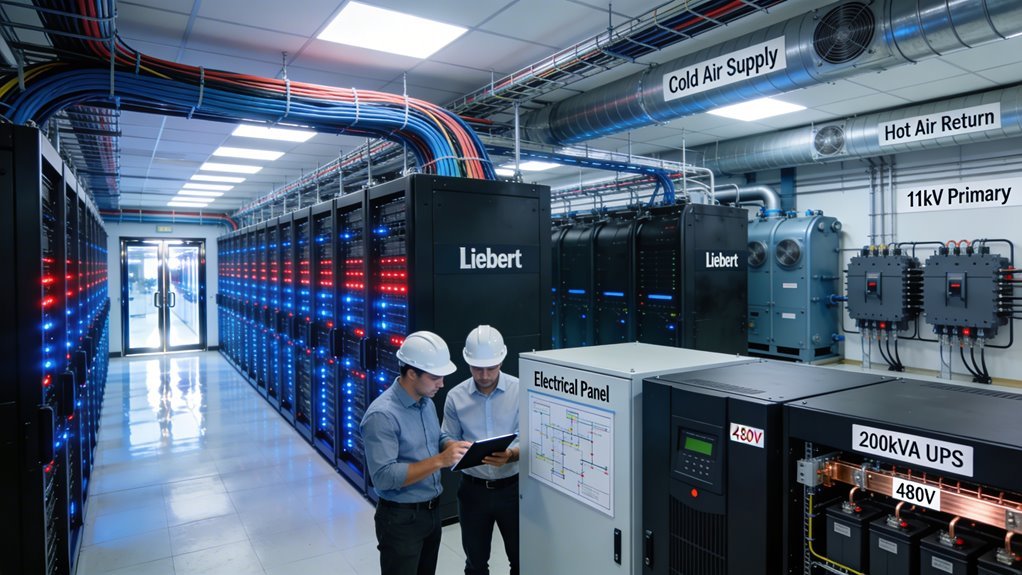
Data center costs move first with land and power. Site prices, utility access, and electrical systems consume a large share of the budget before a single server rack goes in.
MEP and cooling systems compound that spend quickly. Generators, PDUs, HVAC, and liquid cooling can all push cost per square foot and cost per megawatt materially higher.
As you scale capacity, redundancy targets and power density drive costs even further, making scale and resiliency two of the most important variables in any budget model.
Products Worth Considering
1500VA/1000W PFC Sine Wave Battery Backup Uninterruptible Power Supply (UPS) System designed to support active PFC and conventional power supplies; Safeguards computers, workstations, network devices, and telecom equipment

1500VA/900W Intelligent LCD Battery Backup Uninterruptible Power Supply (UPS) System uses simulated sine wave output to safeguard workstations, networking devices, and home entertainment equipment

Land And Power
| Cost Driver | 2024 Signal |
|---|---|
| Land | $5.59/sf average |
| Large parcels | +23% YoY |
On greenfield developments, expect $7M to $12M per megawatt. Local land conditions and grid access drive most of the spread. Electrical systems alone absorb 40% to 45% of total project cost, so power access is one of the strongest determinants of whether your capital works efficiently. Buying land without secured utility commitments often forces added spending before operations can begin.
MEP And Cooling
Two systems dominate this layer of spend: MEP and cooling.
MEP systems typically absorb 30%–50% of total project cost, with electrical infrastructure driving the largest share. UPS systems, switchgear, and backup generators consume 40%–45% of the full budget on their own, so MEP optimization directly affects both upfront capex and long-term operating costs.
Cooling infrastructure adds another 15%–20%, covering chillers, CRAC units, controls, and distribution. As rack power density rises, hitting your cooling efficiency target gets harder and more expensive.
AI deployments intensify that pressure because liquid cooling often becomes necessary, increasing design complexity, installation effort, and commissioning cost. Engineering thermal performance and electrical resilience from day one is the most reliable way to control costs in this area.
Scale And Redundancy
Scale determines how efficiently you deploy capital. Redundancy determines how much infrastructure you must duplicate. Together, they set the cost curve for nearly every data center build.
Construction costs typically run $600 to $1,100 per gross square foot. Greenfield development lands at $7M to $12M per megawatt depending on your redundancy tier. Choosing N+1 or pursuing Tier IV resilience raises your budget fast; Tier IV can cost 25% to 40% more than Tier III.
Stranded capacity is a real risk at scale. Electrical systems consume 40% to 45% of total cost and HVAC adds 15% to 20%, so every duplicated path compounds capital requirements. Right-sizing scale and redundancy protects uptime without locking up excess capital.
Is Greenfield or Brownfield Cheaper?
Which option costs less depends on how much existing infrastructure you can reuse. Brownfield sites usually have the cost edge.
Brownfield redevelopment can cut total costs by 10% to 15%, with average build costs around $7M to $8M per megawatt. Greenfield projects typically land between $8M and $12M per megawatt because you must buy land and build utilities, access, and site systems from scratch.
- You save upfront by reusing power, water, roads, and sometimes existing buildings.
- You compress timelines because utilities and some permits may already be in place.
- You must still price environmental testing and any remediation into your model.
Brownfield often wins on pure economics, but poor due diligence can erase those savings fast. Disciplined site assessments and contingency budgeting are essential before you commit.
Retail vs. Wholesale: Which Costs More?
Retail colocation builds cost more than wholesale. Retail typically lands around $16.3 million per megawatt and $2,200 per square foot, compared to roughly $12 million per megawatt and $1,050 per square foot for wholesale.
That gap reflects infrastructure complexity, not inefficiency. Retail builds fund multi-tenant power distribution, segmented cooling, security layers, meet-me rooms, and tenant-ready fit-outs. You’re paying for tenant flexibility and immediate usability.
Wholesale uses standardized design, serves a single large tenant, and delivers cleaner operational efficiency. Less customization compresses construction scope and lowers unit costs.
Wholesale wins on raw construction economics. If you need turnkey delivery and the ability to serve multiple customers, retail costs more because you’re paying for that optionality upfront.
Products Worth Considering

100% Brand new and high quality.Perfect for Railway & Building Layout!This distribution is the ideal solution for the model train to supply all lighting.

HCDC HD062 8 output ports DC power distribution block module for 15/30/45A power pole connectors.
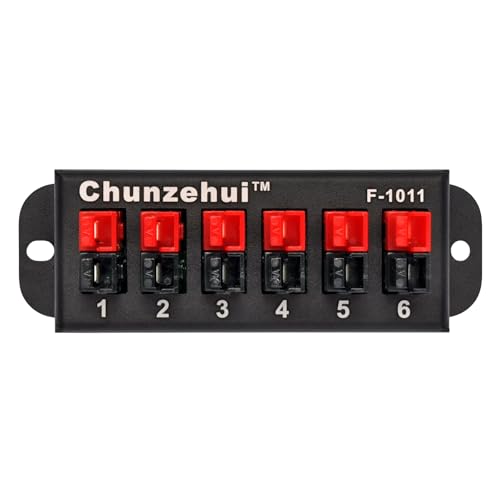
Connections: 6 Standard 45A power pole connectors. Can compatible 15A, 30A or 45A power pole connectors.
Frequently Asked Questions
How Much Did Elon Musk’s Data Center Cost?
Elon Musk’s data center reportedly cost about $1 billion. That figure reflects dense power infrastructure, renewable integration, premium site connectivity, and advanced cooling, all of which push technical build costs well above a standard facility.
Can You Make Money Owning a Data Center?
Yes. Profitability depends on balancing operational costs, maintenance, market demand, location, scalability, and competitive positioning. Strong demand for cloud and AI infrastructure has kept occupancy high in well-located facilities.
What Is the Most Expensive Part of Building a Data Center?
Electrical systems are the most expensive part, typically consuming 40%–45% of total build cost. Switchgear, UPS systems, and backup generators make up the bulk of that spend. High-density AI workloads push those requirements even higher.
How Much Does a Tier 4 Data Center Cost?
Tier 4 data centers typically cost $10 million to $20 million per megawatt, or $1,250 to $2,200 per square foot. Costs rise with energy efficiency requirements, security measures, scalability needs, and the maintenance demands of fully fault-tolerant infrastructure.
Conclusion
Building a data center means making a series of high-stakes engineering and financial decisions where every design choice shifts your capital and operating costs. You’ll need to weigh total project spend, per-MW and per-square-foot benchmarks, site conditions, and delivery model before you commit. Greenfield may offer cleaner optimization, while brownfield can cut timelines and costs. Retail and wholesale economics diverge significantly. Model these variables carefully and you’ll control risk, improve efficiency, and protect long-term ROI.
